 Garden

Affiliate Disclosure
Some links on this page are affiliate links. As an Amazon Associate, we earn from qualifying purchases — at no extra cost to you. We do not buy, test, or physically handle the products we cover; our rankings come from aggregated owner reviews, ratings and expert consensus. Commissions never change our verdicts. How we rank · full disclosure.
The short answer: low-voltage wins on brightness, reliability and lifespan; solar wins on install effort, running cost and flexibility. Buy low-voltage for steps, entries and any route people walk in the dark, and for feature uplighting you want working in January. Buy solar for bed edges, driveway markers, far corners with no power, and rentals. Expect a wired system to cost more up front and less over ten years.
The Comparison in One Table
| Solar | Low-voltage (12V) | |
|---|---|---|
| Typical path light output | 5–20 lumens (premium 20–50) | 60–120 lumens, specifiable higher |
| Uplighting capability | Limited; 50–200 lm for a few hours | 250–400 lm all night, every night |
| Summer runtime | 6–10 hours on a full charge | Unlimited |
| Winter runtime | 3–5 hours, less in the northern tier | Unlimited, identical to summer |
| Consistency | Varies with weather, shade, season | Completely predictable |
| Install | Push a stake in; 10 minutes | Transformer, cable, trenching; a weekend |
| Electrical work | None | Plugs into an existing GFCI outlet; no electrician in most cases |
| Running cost | Zero | Roughly $1 a month for a 12-fixture LED system |
| Consumables | NiMH or lithium cell every 2–3 years | None; LED lamps last a decade or more |
| Fixture lifespan | 2–5 years for most; longer for premium metal | 10–25 years for brass, copper and cast aluminum |
| Repositioning | Trivial — pull it up and move it | Requires digging up cable |
| Expandability | Buy another light | Only if the transformer has headroom |
| Control | Built-in dusk sensor; little else | Timers, zones, dimming, smart control |
| Best for | Bed edges, decoration, rentals, no-power corners | Steps, entries, walkways, feature lighting |

What Solar Genuinely Does Well
Solar landscape lighting has a reputation problem largely because people buy it for the wrong job and then judge it as a failed version of a wired system. Judged as what it is, it is very good at several things.
It goes anywhere. The far corner of the yard, the top of a slope, the far side of a driveway, an island bed in the middle of a lawn — all of these are trivial with solar and genuinely expensive with cable. If you have ever priced running 120 feet of buried cable to light one shrub, this is the whole argument.
It costs nothing to run and nothing to install. A set of eight solar path stakes is an evening and a modest outlay, with no transformer, no trenching and no permanent commitment.
It is reversible. Renters, people planning to move, and anybody still working out where the paths will eventually go should start here. Twenty minutes with a spade and the yard is back to how it was.
It is fine at what path lighting actually needs to do. A walkway is legible with small pools of light marking the route. Twenty lumens does that. The marker job and the illumination job are different, and solar does the first one honestly.
Where Solar Falls Down
Winter. This is the big one and it is structural rather than a quality problem. In December in the northern half of the US you get fewer daylight hours, a lower sun angle, more overcast days and often snow on the panel. Runtime that was eight hours in July becomes three or four in December, and the nights are longer. Bare deciduous branches help a little; short days hurt more.
Shade. A panel needs roughly six hours of direct sun. Under a canopy, on a north wall, or behind a fence, it will never reach full charge, and a chronically undercharged NiMH cell degrades faster than a well-cycled one — so a shaded fixture fails sooner as well as running shorter.
The cell is a consumable. Most solar path lights use a single AA-format NiMH cell in the 600 to 1000 mAh range, cycled every night. Two to three years is a realistic service life, after which runtime collapses. On serviceable fixtures a replacement cell is cheap and takes two minutes; on sealed fixtures the whole light is the consumable.
Cool white by default. Budget solar fixtures very often ship at 5000 to 6000K because those LEDs are cheaper, and many listings do not state a Kelvin figure at all. The result reads cold and institutional, which is covered in lumens and color temperature.
It is not a safety light. A solar fixture that has quietly stopped working is worse than no fixture, because people learn to rely on it. Anywhere a failure creates a hazard — steps, a threshold, a slope — should be wired.
What Low-Voltage Buys You
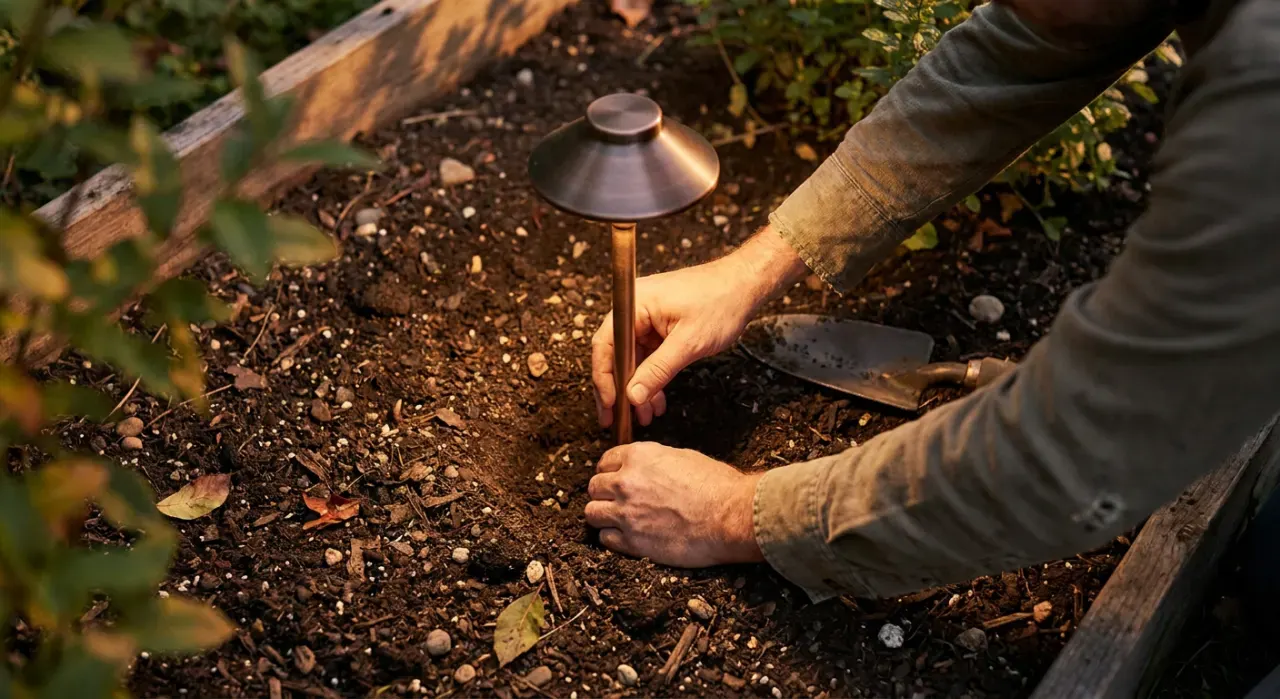
Twelve volts from a transformer is not a shock hazard, does not require an electrician in most residential situations, and delivers a completely different class of result. Brightness is specifiable rather than hoped for. January looks like July. Beam angles, dimming, zoning and timers all become available. And quality brass and copper fixtures genuinely last decades, developing a patina rather than degrading.
It also unlocks techniques solar cannot do. Downlighting from high in a tree — the moonlight effect, the most natural-looking move in landscape lighting — requires a fixture 20 feet up where there is no sun for a panel and no sensible way to change a battery. Grazing a stone wall requires sustained output at a controlled beam angle. Both are wired-only in practice.
The cost is the install: a transformer sized at about 1.5 times total fixture wattage, direct-burial cable of the right gauge, waterproof connectors, and a weekend of trenching along bed edges. It is genuinely DIY-able, and the full method including the voltage-drop math is in how to install path lighting.
Ten-Year Cost, Realistically
The sticker comparison flatters solar; the ten-year comparison usually does not. This is an illustrative sketch for a twelve-fixture path run, not a quote, and local prices vary widely.
| Cost element | Solar (12 stakes) | Low-voltage (12 fixtures) |
|---|---|---|
| Fixtures | Low up-front outlay | Substantially higher; brass costs multiples of plastic |
| Transformer | None | One 60–100W unit |
| Cable and connectors | None | 100–150 ft of 12 AWG plus sealed connectors |
| Install labor | An hour of your time | A weekend of your time, or a contractor |
| Electricity, 10 years | $0 | Roughly $100–130 at typical rates |
| Replacement cells | 3–4 rounds of 12 cells | None |
| Fixture replacement | 1–3 full replacements for budget plastic | Usually none for brass or cast aluminum |
| Ten-year picture | Cheap to start, repeated small costs | Expensive to start, then essentially static |
The crossover depends heavily on which solar fixtures you buy. Premium metal solar path lights with replaceable cells and glass lenses change the math considerably — those survive and only the battery recurs. The disposable plastic stake bought by the eight-pack is where the repeated replacement cost lives, and it is the pattern that recurs most consistently in long-term owner reviews across the category.
Choosing by Job, Not by Preference
| The job | Choose | Reason |
|---|---|---|
| Front steps, deck stairs, any level change | Low-voltage | A failed fixture here is a fall risk |
| Walk from driveway to front door | Low-voltage | Used every winter night; reliability matters |
| Entry door and house numbers | Low-voltage or line-voltage | Needs real output and consistency |
| Uplighting a specimen tree | Low-voltage | Sustained 250–400 lm is out of solar range |
| Downlighting from a tree | Low-voltage | No sun at the mounting point; no battery access |
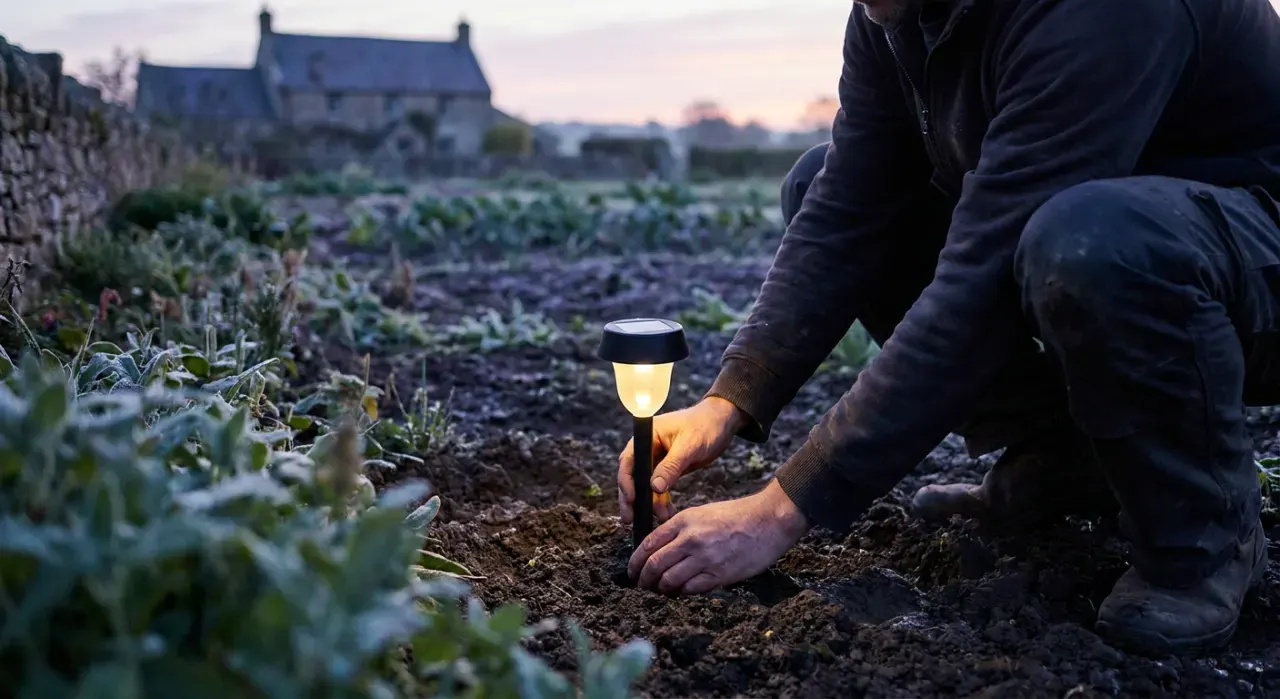
| Marking a curving garden path | Either | Marker job; solar is sufficient if the sun reaches |
| Driveway edge | Solar | Long run, low stakes, usually open sky |
| Far corner, island bed, no power nearby | Solar | Cable cost is disproportionate to the result |
| Rented property | Solar | Reversible, portable, no install |
| Under a dense tree canopy | Low-voltage | Solar will never charge properly there |
| Seasonal or trial lighting | Solar | Move it around until the layout is right |
| Pond, fountain, submerged | Low-voltage | Needs an IP68 fixture and consistent power |
The Approach That Usually Works Best
Start with solar, live with it, then wire the places that earned it. Put well-rated solar path lights along the main walkway and let the yard tell you where light is genuinely missing. Over a month you will notice the two or three spots where you reached for a phone flashlight — the corner of the steps, the gate latch, the point where the path turns. Those are the wired locations, and now you know them from experience rather than guesswork.
Two practical rules for a mixed yard. Match color temperature across both systems, because a 2700K wired run beside 6000K solar stakes looks wrong in a way that is more obvious than any brightness difference. And keep the two systems in the same visual language — if the wired fixtures are hooded and dark bronze, choose solar in a similar shape and finish rather than whatever eight-pack was convenient.
What to Look for When Buying Either
On solar, the traits that separate fixtures still working in year three from fixtures in a landfill are consistent across owner reports: a glass lens rather than clear plastic that clouds under UV, a metal or thick powder-coated body, a battery compartment you can actually open with a screwdriver, an IP65 or better seal, and a panel large enough for the LED it feeds. Stated color temperature at 3000K or below is the other thing worth insisting on. That is the filter applied in best solar landscape lights, and for uplighting specifically in best solar spotlights, where beam control and whether the aim holds over a season matter more than headline lumens.
On low-voltage, the long-term complaints cluster elsewhere: knuckle joints that loosen so a spotlight drifts off aim, thin stamped housings that corrode at the stake, and connectors that were never properly sealed. Solid brass, cast aluminum with a real powder coat, a toothed locking knuckle and a warranty measured in years rather than months are the markers, and they drive the ranking in best low-voltage landscape lights.
We never buy, test or physically handle the products we rank. Recommendations come from aggregated owner reviews, star ratings, review volume and expert consensus — see how we rank.
More from this hub: Garden Lighting · Why solar lights stop working · How to install path lighting · Outdoor lighting IP ratings · How we rank