 Garden
Affiliate Disclosure
Some links on this page are affiliate links. As an Amazon Associate, we earn from qualifying purchases — at no extra cost to you. We do not buy, test, or physically handle the products we cover; our rankings come from aggregated owner reviews, ratings and expert consensus. Commissions never change our verdicts. How we rank · full disclosure.
The short answer: for a typical one or two-car garage, buy the Mr. Heater MH18B Big Buddy — 18,000 BTU across three settings, an oxygen depletion sensor, a tip-over cutoff, and no electrical connection needed for the burner. It puts out more than three times what any plug-in electric heater can manage. If your space is large, drafty or you want it warm in twenty minutes, step up to a 60,000 BTU forced air torpedo: the Mr. Heater MH60QFAV is the quiet one, the Dyna-Glo RMC-FA60DGD is the cheap one.
Two rules before you shop, and both are safety rules rather than product advice. Ventilate, and fit a carbon monoxide alarm. Carbon monoxide is odorless and colorless and any fuel-burning appliance makes it, which is why the CDC treats fuel-burning heaters, generators and grills as the classic indoor sources. An unvented propane heater burns oxygen out of the room and puts combustion products into it — the oxygen depletion sensor on an indoor-rated unit is a backstop, not permission to seal the building. And never run one near gasoline, solvents or a running engine, which in a garage is a real constraint rather than a theoretical one. For the electric alternatives see best space heater for a garage, or the heating and cooling hub.
Top Picks at a Glance
Our #1 Pick: Mr. Heater MH18B Big Buddy
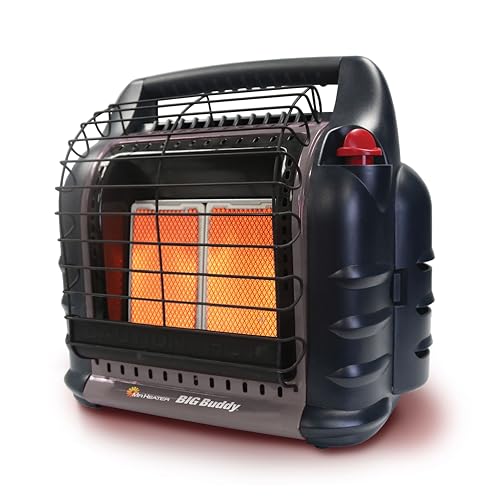
The Big Buddy has become the default answer for garage heat in unwired spaces for a simple reason: it produces meaningful warmth without requiring anything from your electrical panel. Eighteen thousand BTU at the top setting is roughly three and a half times what a 1,500-watt plug-in electric heater delivers, and it needs nothing but fuel to produce it.
Consensus Score ████████░░ 8.4 — owners consistently describe it turning an unusable winter garage into a workable one within fifteen minutes
Three settings — 4,000, 9,000 and 18,000 BTU — cover a useful range, and the low setting matters more than it sounds: an 18,000 BTU heater running flat out in a small garage becomes uncomfortable and eats fuel, so being able to throttle back and hold a temperature is what makes it livable. The radiant panels heat objects and people directly while the optional fan spreads warm air, which is a genuinely good combination in a space with a cold concrete floor.
The safety package is the reason it is indoor-rated. An oxygen depletion sensor monitors the air and shuts the burner down as oxygen falls below a threshold, and a tip-over switch kills it if the unit is knocked over. Neither replaces ventilation, and neither replaces a carbon monoxide alarm on the wall — but both are the difference between a heater designed for enclosed use and a patio heater that is not.
Fuel flexibility is the last piece. It will run from two 1 lb disposable bottles for portability, or from a 20 lb barbecue tank via a hose and filter for economy — and the economy is substantial, because 1 lb bottles cost several times as much per BTU. Buy the hose and filter at the same time as the heater; almost every owner ends up doing so.
Check price on Amazon → (paid link)
Best Propane Garage Heaters 2026: The Ranked Field

Best for a one or two-car garage with no dedicated wiring
- 4,000 / 9,000 / 18,000 BTU, rated for spaces up to about 450 sq ft
- Oxygen depletion sensor and accidental tip-over shutoff
- Runs on two 1 lb bottles or a 20 lb tank with a hose and filter
- Radiant and fan-assisted heat, no electrical connection needed for the burner
Why buy it: it is the safest indoor-rated propane heater in common use, and 18,000 BTU is more than three times what a plug-in electric heater can deliver.

Best for a large shop, a barn or a garage you need warm fast
- Variable 30,000 to 60,000 BTU, heats up to about 1,250 sq ft
- Up to 14 hours run time on a 20 lb tank
- QBT technology, around 50% quieter than a standard forced air heater
- Requires a 120 V outlet for the fan
Why buy it: nothing else here changes the temperature of a large uninsulated space in twenty minutes the way a 60,000 BTU torpedo heater does.

Best for jobsite-style heat at the lowest price
- Variable 30,000 to 60,000 BTU output
- Heats roughly 1,350 sq ft at full output
- Continuous electronic ignition, no pilot to light
- Runs from a standard 20 lb LP tank, needs a 120 V outlet
Why buy it: the same heating envelope as the Mr. Heater torpedo for meaningfully less money, at the cost of more noise.
Best for an enclosed garage, RV bay or workshop where fumes matter most
- 4,000 / 9,000 / 18,000 BTU with an indoor-safe rating
- Oxygen depletion sensor and tip-over cutoff
- Fold-down handle and swivel regulator
- Optional fan runs from four D cells or an AC adapter
Why buy it: the same output as the standard Big Buddy in the configuration specified for enclosed recreational spaces, where the safety margin is the point.

Best for a working shop that needs heat on demand
- Variable output to 60,000 BTU on liquid propane
- Heats roughly 1,500 sq ft of open workshop
- High-limit safety switch and a rugged steel body
- Needs a 20 lb tank, a hose and a 120 V outlet
Why buy it: the long-running workshop standard, and the model most likely to still be running in a decade of hard use.
Quick Comparison
| Product | Best for | Rating | Price | Buy |
|---|---|---|---|---|
| Mr. Heater MH18B Big Buddy Indoor and Outdoor Portable Propane Heater | Best Overall | — | Check (paid link) | |
| Mr. Heater MH60QFAV 60,000 BTU Portable Propane Forced Air Heater | Best for Big Cold Garages | — | Check (paid link) | |
| Dyna-Glo RMC-FA60DGD 30,000 to 60,000 BTU Liquid Propane Forced Air Heater | Best Value Forced Air | — | Check (paid link) | |
| Mr. Heater F274830 MH18BRV Big Buddy Indoor-Safe Portable RV Propane Heater | Best Indoor-Safe Compact | — | Check (paid link) | |
| Mr. Heater MH60FAV Workshop and Construction Forced Air LP Heater | Best Workshop Torpedo | — | Check (paid link) |
How We Rank
We do not buy, install or physically handle these heaters. Rankings come from aggregating star ratings and review volume across thousands of verified owner reviews, weighting recent reviews above launch-window ones, checking published BTU ranges, coverage claims, run times, safety certifications and fuel connections against manufacturer documentation, and reading negative reviews for the problems that appear after a full winter of use.
Four factors drive the order. Safety design first — oxygen depletion sensors, tip-over cutoffs, high-limit switches and indoor ratings are non-negotiable in an enclosed space. BTU delivered against space size, using real coverage figures rather than optimistic marketing. Fuel economy and run time on a standard 20 lb tank. And owner satisfaction weighted by review volume, with attention to regulator and ignition reliability, which is where these units usually fail. Prices were checked at time of writing. Full method: how we rank.
The Propane Heaters, Reviewed
1. Mr. Heater MH18B Big Buddy — Best Overall
Covered above. Consensus Score ████████░░ 8.4. Strengths: genuine 18,000 BTU with no wiring, three usable output levels, an oxygen depletion sensor and tip-over cutoff, quiet radiant operation, and the flexibility to run from bottles or a tank. Recurring complaints: the moisture is the biggest, and it is the one owners do not anticipate — condensation on tools, windows and cold cast iron is widely reported. The ODS shuts the heater down at elevation, which frustrates owners above roughly 7,000 feet. Regulator icing in very cold weather is reported when running from small bottles. And the fan runs on D cells, which owners find both fiddly and expensive unless they buy the AC adapter.
2. Mr. Heater MH60QFAV — Best for Big Cold Garages
A torpedo heater is a different animal: a fan blowing across an open propane flame, throwing a column of hot air down the length of the building. Thirty to sixty thousand BTU covers roughly 1,250 square feet, and a 20 lb tank gives up to about 14 hours at the low setting. Mr. Heater's QBT design cuts the noise roughly in half compared with a conventional torpedo, which is the whole reason to pay the premium over the Dyna-Glo.
Consensus Score ████████░░ 8.2 — strong ratings, with fuel consumption and noise the recurring themes
Recurring complaints: it still needs a 120-volt outlet for the fan, which surprises buyers who chose propane specifically to avoid electricity. Fuel consumption at full output is steep — a 20 lb tank is gone in about seven hours. Owners report regulator freeze-up in genuinely cold weather when the tank is small or nearly empty. And the exhaust smell in an enclosed space is significant enough that most owners run it to warm the garage, then shut it off before working.
3. Dyna-Glo RMC-FA60DGD — Best Value Forced Air
The same 30,000 to 60,000 BTU envelope for meaningfully less money, with continuous electronic ignition so there is no pilot to light and a coverage claim of around 1,350 square feet. Owners consistently report it bringing a cold jobsite or garage up to a comfortable temperature within half an hour.
Consensus Score ███████░░░ 7.8 — good ratings for the price, with build quality the persistent reservation
Recurring complaints: noise. Without the quiet-burner technology it is markedly louder than the Mr. Heater torpedo, and owners describe conversation being difficult with it running. Build quality attracts more criticism — thinner steel, and more reports of the igniter failing after a season or two. Several owners also report the thermostat dial being approximate to the point of being decorative.
4. Mr. Heater MH18BRV Big Buddy — Best Indoor-Safe Compact
The RV-specified version of the Big Buddy, which matters because recreational-vehicle certification implies a stricter view of enclosed-space operation. Same 4,000 / 9,000 / 18,000 BTU output and the same oxygen depletion sensor and tip-over cutoff, with a fold-down handle and a swivel regulator that makes tank connection easier in a tight bay.
Consensus Score ████████░░ 8.2 — well rated, essentially matching the standard Big Buddy
Recurring complaints: the price premium over the standard MH18B is real and several owners question whether the differences justify it for garage use. The same altitude, moisture and fan-battery complaints appear here. And a minority report the swivel regulator developing a slow leak, which is a reason to soap-test every connection each time you swap a tank.
5. Mr. Heater MH60FAV — Best Workshop Torpedo
The long-serving workshop model, and the one you see in trade vans. Variable output to 60,000 BTU covering roughly 1,500 square feet of open shop, a high-limit safety switch, and a steel body built to be thrown in a truck. It is the least refined heater here and probably the most durable.
Consensus Score ███████░░░ 7.9 — solid long-term ratings, with noise and smell the dominant complaints
Recurring complaints: loud, and owners say so consistently. The combustion smell in an enclosed garage is stronger than from the radiant Big Buddy units, which is inherent to an open-flame forced air design. It needs 120-volt power for the fan. And several owners report the thermostat being coarse enough that they run it manually and simply switch it off when the space is warm.

How to Choose a Propane Garage Heater
Match the BTU to the space and the climate. For a garage with some insulation and 8 to 9 foot ceilings, roughly 45 BTU per square foot is a working figure in a cold climate and about 25 in a mild one. A 400 square foot single-car garage therefore wants 10,000 to 18,000 BTU — squarely Big Buddy territory. A 700 square foot detached shop in a northern state wants 30,000 or more, which means a torpedo.
Decide between radiant and forced air, because they suit different habits. Radiant heats objects and people directly, works immediately, and is quiet enough to leave running while you work — which is what the Big Buddy does. Forced air heats a large volume of air fast but is loud, smells more, and is usually run to warm the space and then shut off before work starts.
Sort out ventilation before the heater arrives. Cracking a garage door two or three inches, or opening a window on the opposite side of the space, is the practical minimum. Mount a carbon monoxide alarm on the wall at breathing height — the CPSC warns every winter about CO poisoning from home heating equipment. And check clearances: three feet from anything combustible is the standard guidance, and in a garage that means moving the paint, the gas can and the drop cloths first.
Finally, buy the fuel setup at the same time. A hose and filter to run a 20 lb tank costs far less than the 1 lb bottles you would otherwise buy, and the filter matters — it catches the oils that come off some hose materials and that are the leading cause of regulator problems on these heaters. Store the tank outdoors, never inside the garage.
What Owners Actually Complain About
Four issues recur across every model here.
Moisture is the one nobody expects. Burning propane produces roughly a gallon of water vapor per gallon of fuel, and in an unvented heater all of it enters the room. Owners with table saws, hand planes and hand tools report surface rust after a season, which is a genuine cost. Ventilation reduces it; electric heat eliminates it.
Fuel logistics come second. One-pound bottles are convenient and expensive; 20 lb tanks are cheap and require a hose, a filter and a trip to a refill station. Owners consistently underestimate how quickly a torpedo empties a tank at full output.
Cold-weather regulator problems are third. Propane vapor pressure falls with temperature, and a small or nearly empty tank in single-digit weather can fail to feed the burner properly. Larger tanks, kept above freezing where practical, largely solve this.
And altitude shutdowns are the fourth, and they are specific to indoor-rated units. The oxygen depletion sensor is calibrated for near sea level, and above roughly 7,000 feet it can read normal air as oxygen-poor and shut the heater down. This is the sensor working as designed, not a defect, and there is no legitimate way to defeat it.
The Verdict
For most garages, buy the Mr. Heater MH18B Big Buddy — it is the right size, it needs no wiring, and its safety package is what makes propane defensible in an enclosed space at all. Add the hose and filter and run it from a 20 lb tank. For a big, cold or drafty shop, step up to a torpedo: the MH60QFAV if you want to be able to hear yourself think, the Dyna-Glo RMC-FA60DGD if the budget is tighter, and the MH60FAV if you want the model most likely to survive a decade of hard use. The MH18BRV is the choice where enclosed-space certification matters most.
Check price on Amazon → (paid link)
Next: weigh the alternative in best space heater for a garage, seal the space first with how to weatherstrip a door and how to insulate an attic, or read are space heaters safe to leave on overnight.