 Garden
Affiliate Disclosure
Some links on this page are affiliate links. As an Amazon Associate, we earn from qualifying purchases — at no extra cost to you. We do not buy, test, or physically handle the products we cover; our rankings come from aggregated owner reviews, ratings and expert consensus. Commissions never change our verdicts. How we rank · full disclosure.
The short answer: for a finished basement, buy an oil filled radiator — and on the owner-review record the De’Longhi Dragon Digital TRD40615E is the best of them. It is silent, it does not blow dust and allergens around a space that usually has plenty of both, and because the oil and steel hold heat it keeps radiating after the element cuts out. Cold, drafty or partly finished basement? Go infrared with the Dr Infrared DR-968. Large unfinished basement? Nothing on a 120-volt outlet will do it; you need a 240-volt unit heater.
Understand what you are fighting first. A basement is cold because concrete walls and a slab sit against ground that stays near 50 to 55 °F all year and conduct heat out of the room continuously, because warm air rises out of it, and because it is usually the last stop on a duct run. That means a 1,500-watt heater — about 5,100 BTU, the maximum any standard outlet allows — is fighting a losing battle in a large space. Insulating the walls and sealing the rim joists will often do more than any heater. For the wider field see best space heater or the heating and cooling hub.
Top Picks at a Glance

Our #1 Pick: De’Longhi Dragon Digital, TRD40615E
Three things make an oil filled radiator the right shape of product for a basement, and none of them are about raw heat output — which is identical across every 120-volt heater anyway.
Consensus Score ████████░░ 8.5 — owners consistently report it holding a basement room evenly warm rather than producing hot and cold cycles
First, it is silent. There is no fan, no motor and nothing to hear. Basements are where people put home offices, media rooms and guest bedrooms — spaces where a ceramic heater's fan becomes intolerable within an hour. Second, it does not move air. Basements accumulate dust, and a lot of them have some degree of mold or musty odor; a fan heater picks all of that up and circulates it, while a radiator warms by radiation and slow convection.
Third, it stores heat. Twenty-odd pounds of oil and steel keeps radiating for a long time after the thermostat cuts the element out, which produces a much flatter temperature curve than a fan heater's on-off cycling. In a room already prone to feeling clammy, an even temperature matters more than a fast one.
The Dragon adds the controls that make this practical: a digital thermostat that holds a real setpoint rather than a dial position, a 24-hour programmable timer so a basement office is warm before you go down there, and an anti-freeze setting that keeps the space above about 41 °F — genuinely useful if there is plumbing down there and you travel in winter.
It takes 15 to 30 minutes to reach full output, which is the honest trade for the heat storage. Program it rather than switching it on when you get cold.
Check price on Amazon → (paid link)
Best Basement Space Heaters 2026: The Ranked Field
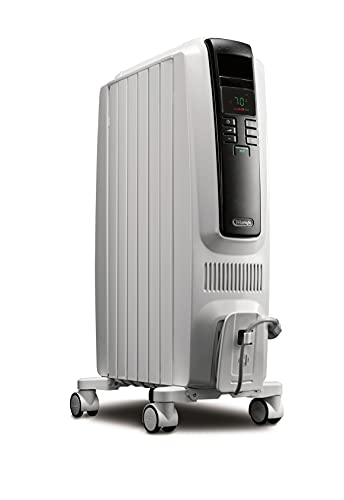
Best for a finished basement you spend hours in
- 1,500 W with a digital thermostat and 24-hour programmable timer
- Silent — no fan, no moving parts
- Sealed oil, anti-freeze setting, thermal cutoff
- Rubber-coated caster wheels for a hard floor
Why buy it: oil-filled radiant heat suits a basement better than anything else here: it is silent, it does not blow dust around, and it holds warmth after the element cuts out.
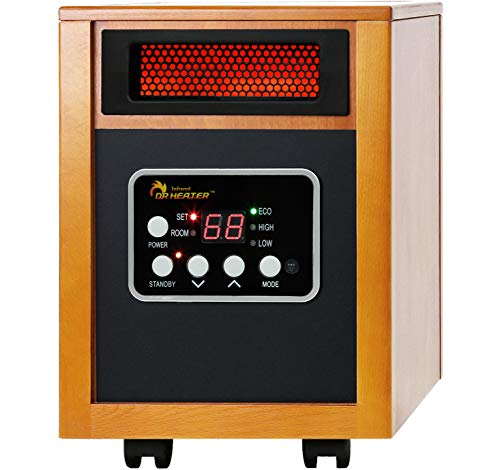
Best for a cold, drafty or partly finished basement
- 1,500 W infrared quartz with a dual heating system
- Warms objects and people rather than air
- Adjustable thermostat with a 12-hour timer
- Cool-touch cabinet on caster wheels
Why buy it: infrared warms you directly instead of heating air that immediately drifts to the ceiling, which is exactly the problem in a basement.
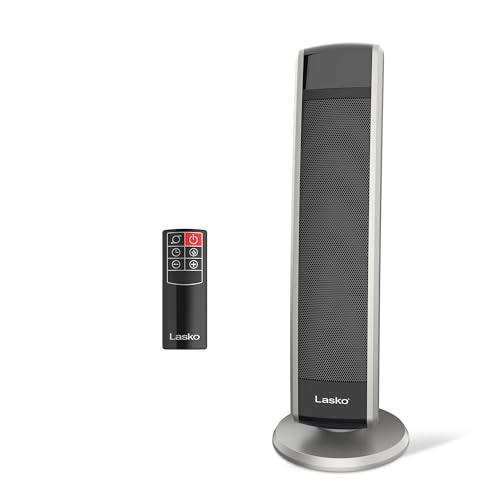
Best for a large open basement that needs air moved as well as warmed
- 1,500 W ceramic with wide oscillation
- Digital thermostat and an 8-hour timer
- Remote control with a slim tower footprint
- Overheat protection and a cool-touch housing
Why buy it: oscillation is genuinely useful in a long basement room where a fixed heater only ever warms one end.
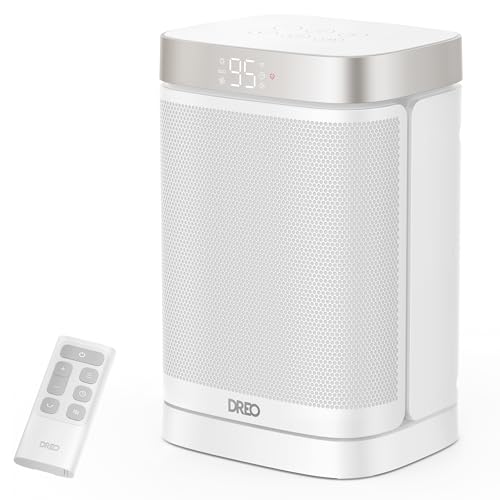
Best for a basement office, craft room or workout corner
- 1,500 W ceramic in a compact body
- 70° oscillation with a digital display
- Remote control, 12-hour timer and ECO mode
- Overheat and tip-over protection
Why buy it: the highest owner ratings on this page, in a heater small enough to sit on a desk or under a bench.
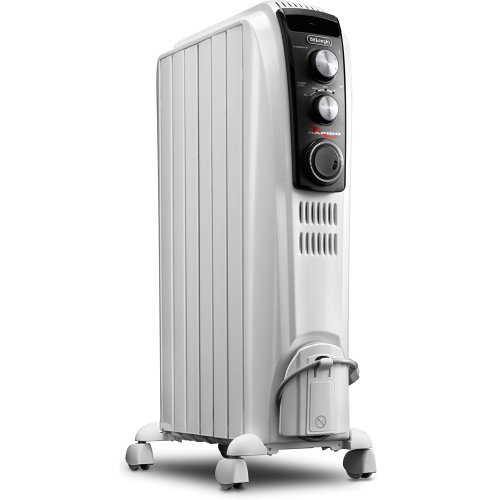
Best for a basement guest room where you set it and forget it
- 1,500 W with a mechanical thermostat dial
- Mechanical 24-hour timer and three heat settings
- Up to 75% more radiant surface than a plain column
- Front and rear handles with caster wheels
Why buy it: no digital panel to fail, which on the owner-review record is the part most likely to go wrong on an oil radiator.

Best for an unfinished basement, workshop or utility space
- 6,000 W on 240 V, roughly 20,500 BTU per hour
- Wall or ceiling bracket with adjustable aim
- Adjustable thermostat and heavy steel housing
- Requires a dedicated 240 V circuit
Why buy it: the only unit here that can genuinely warm a large unfinished basement, because it is the only one not limited by a 120 V outlet.

Quick Comparison
| Product | Best for | Rating | Price | Buy |
|---|---|---|---|---|
| De’Longhi Dragon Digital Oil Filled Radiator Heater, 1500W, TRD40615E | Best Overall | — | Check (paid link) | |
| Dr Infrared Heater DR-968 Portable Space Heater, 1500-Watt | Best Infrared | — | Check (paid link) | |
| Lasko Oscillating Digital Ceramic Tower Heater for Large Rooms | Best Whole-Room Coverage | — | Check (paid link) | |
| DREO Atom One Space Heater with Remote and 70° Oscillation | Best Compact | — | Check (paid link) | |
| De’Longhi TRD40615T 1500-Watt Portable Radiant Radiator Heater with Mechanical Controls | Best Simple Radiator | — | Check (paid link) | |
| DR. INFRARED HEATER DR-988 240V Electric Industrial Garage and Workshop Heater | Best for Large or Unfinished Basements | — | Check (paid link) |
How We Rank
We do not buy or physically handle these heaters. Rankings come from aggregating star ratings and review volume across tens of thousands of verified owner reviews, weighting recent reviews above launch-window ones, checking published wattage, coverage claims, thermostat range, safety certifications and noise reports against manufacturer documentation, and reading negative reviews for the failures that appear after a full winter.
Four factors set the order, and they are weighted for basements specifically. Noise, because basements are where people work and sleep. Whether the heater moves air, which matters in a dusty or musty space. Thermostat quality, because a basement needs holding at temperature rather than blasting. And owner satisfaction weighted by review volume, with attention to second-winter reports. Prices were checked at time of writing. Full method: how we rank.
The Basement Heaters, Reviewed
1. De’Longhi Dragon Digital TRD40615E — Best Overall
Covered above. Consensus Score ████████░░ 8.5. Strengths: silent, moves no dust, holds heat after cutout, a genuine digital thermostat, a programmable timer, and an anti-freeze mode that suits a basement with plumbing. Recurring complaints: the digital control panel is the most reported failure — unresponsive buttons or a blank display while the heater still runs. It is heavy at around 30 pounds and the casters struggle on carpet. Warm-up is slow, which frustrates people expecting instant heat. And a first-use burning smell from manufacturing residue produces a steady stream of alarmed reviews; it clears within a few hours.
2. Dr Infrared DR-968 — Best Infrared
In a cold or drafty basement, the problem with heating air is that the air leaves — up the stairs, through the rim joists, into the ceiling. Infrared sidesteps that by warming the objects and people it shines on, so you feel warm at the desk even though the room air is still cool. Dual heating system, an adjustable thermostat, a 12-hour timer, casters and a cool-touch cabinet.
Consensus Score ████████░░ 8.4 — one of the highest-rated heaters in the whole category, on an enormous review base
Recurring complaints: it has a fan, so it is not silent — most owners describe a soft whoosh, a minority find it intrusive at night. It only warms what it faces, so a room with the heater in one corner has a cold corner. Owners report the remote failing. And the filter needs cleaning more often in a dusty basement than the manual implies.
3. Lasko Oscillating Digital Ceramic Tower — Best Whole-Room Coverage
Basements are frequently long rather than square, and a fixed heater in a long room only warms one end. Oscillation solves that, and this is the model that does it well: 1,500 watts of ceramic heat with a wide sweep, a digital thermostat, an 8-hour timer, a remote and a slim tower footprint that tucks against a wall.
Consensus Score ███████░░░ 7.9 — well rated on a very large review base, with noise the recurring complaint
Recurring complaints: fan noise, consistently. It is a ceramic heater and the fan runs whenever the heat is on. It circulates dust, which in a basement is a real consideration for allergy sufferers. Owners report the oscillation motor becoming noisy over a season or two. And the heat stops the moment the element cuts out, so the temperature swing is wider than an oil radiator's.
4. DREO Atom One — Best Compact
The highest owner ratings on this page, in a heater small enough to sit under a desk or on a workbench. Fifteen hundred watts of ceramic heat, 70-degree oscillation, a digital display, a remote, a 12-hour timer, an ECO mode, and both overheat and tip-over cutoffs. For a basement office, craft corner or home gym it is the sensible choice.
Consensus Score ████████░░ 8.6 — outstanding ratings across a very large review base
Recurring complaints: it is small, and owners who expect it to heat a whole basement are disappointed — this is a personal and small-room heater. The fan is audible. Several owners report the display being too bright in a dark room and the ECO mode cycling more than they would like. And a minority describe a plastic smell in the first few hours of use.
5. De’Longhi TRD40615T — Best Simple Radiator
The same Dragon body and fin geometry as our top pick with mechanical controls: a thermostat dial, three heat settings, and a physical 24-hour timer ring. It costs less and it removes the exact component owners most often report failing on the digital model. For a basement guest room set once and left alone, arguably the smarter purchase.
Consensus Score ████████░░ 8.3 — nearly identical to the digital version with fewer control complaints
Recurring complaints: the dial is unmarked in real temperatures, so setting it accurately takes trial and error. The mechanical timer ring is fiddly and owners report the pins snapping. Same weight and caster issues, and the same slow warm-up.
6. Dr. Infrared DR-988 240V — Best for Large or Unfinished Basements
If the basement is large, unfinished, or doubles as a workshop, no 120-volt heater will do the job — 5,100 BTU disappears into 800 square feet of concrete. The DR-988 runs 6,000 watts on 240 volts for roughly 20,500 BTU, mounts on a wall or ceiling bracket, and tilts so you can aim the airflow at where you actually work.
Consensus Score ████████░░ 8.2 — strong ratings, with the wiring requirement the dominant complaint
Recurring complaints: it needs a dedicated 240-volt circuit, and a lot of owners discover the electrician cost after the heater arrives. The fan is loud — this is shop equipment. Owners describe the thermostat as imprecise, cycling wider than expected. And the mounting hardware attracts criticism as underspecified for the unit's weight.
How to Choose a Basement Space Heater
Deal with the envelope before the appliance. Uninsulated concrete walls and an unsealed rim joist are the two largest heat losses in most basements, and both are fixable with rigid foam and spray foam for a fraction of what a decade of electric heat costs. A well-insulated basement can be held comfortable by a heater half the size an uninsulated one needs.
Then match the format to the space. Finished basement, occupied for hours: oil filled radiator — silent, dust-free, even. Cold or drafty basement, occupied at a desk or bench: infrared, because it heats you rather than air that is going to leave anyway. Long open basement: an oscillating ceramic tower, accepting the fan noise. Large unfinished basement: 240 volts, or nothing.
Check the circuit before you order. Basement receptacles are frequently on long shared circuits that also feed a chest freezer, a sump pump and a workshop bench. A 1,500-watt heater is 12.5 amps, which is 80 percent of a 15-amp branch and the NEC's continuous-load ceiling — it needs the circuit essentially to itself. And never use an extension cord: the CPSC says a heater should never be powered through a cord or power strip, and the US Fire Administration puts heating equipment among the leading causes of home fires.
Finally, do not use a heater to solve a moisture problem. Warming damp air lowers relative humidity but removes no water. If you have condensation, musty smells or white efflorescence on the concrete, fix the water first — grading, gutters, a vapor barrier, a dehumidifier — and then heat the space.
What Owners Actually Complain About
Four themes recur, and two of them are specific to basements.
Underheating a large space is the most common, and it is arithmetic. Fifteen hundred watts is about 5,100 BTU, which is a rough match for 150 square feet of well-insulated room. A 900 square foot unfinished basement needs several times that, and no plug-in heater will get there.
Fan noise is second and it is the reason so many basement owners end up with an oil radiator after starting with a ceramic. A heater running eight hours in a room where you work or sleep has to be quiet, and only the fanless designs are.
Dust circulation is third and it is underappreciated. Basements hold dust, and forced-air heaters distribute it. Owners with allergies consistently report a difference between fan heaters and radiators in how the space feels after a few hours.
And tripped breakers is the fourth, and it is nearly always the circuit rather than the heater. Basement circuits tend to be long and shared, and adding 12.5 amps to a branch already carrying a freezer and a sump pump is exactly how breakers trip at three in the morning. Our guide on why space heaters trip breakers covers the diagnosis.
The Verdict
For a finished basement, buy the De’Longhi Dragon Digital TRD40615E — silent, dust-free, programmable, and it holds a room evenly rather than cycling it. Prefer dials to a display? The mechanical TRD40615T, which removes the part most likely to fail. Cold or drafty space where you work at a bench or desk? The Dr Infrared DR-968 is the right technology. Long open basement? The Lasko oscillating tower. Small corner? The Dreo Atom One is the highest-rated heater here. And for a genuinely large unfinished basement, only the Dr. Infrared DR-988 on 240 volts will actually change the temperature.
Check price on Amazon → (paid link)
Next: compare technologies in oil filled vs ceramic space heaters, size it with what size space heater for a room, see the oil-filled field in best oil filled radiator heater, or seal the space with how to weatherstrip a door.