 Garden

Affiliate Disclosure
Some links on this page are affiliate links. As an Amazon Associate, we earn from qualifying purchases — at no extra cost to you. We do not buy, test, or physically handle the products we cover; our rankings come from aggregated owner reviews, ratings and expert consensus. Commissions never change our verdicts. How we rank · full disclosure.
The short answer: 55°F is the practical floor, and it is the number plumbers, insurers and property managers converge on. The reason is not that water freezes at 55 — it freezes at 32°F. It is that a thermostat measures a hallway at 5 feet, while the pipes at risk sit in exterior wall cavities, crawlspaces, attics and garages that commonly run 20 to 30°F colder than that hallway during a cold snap. Set the house to 55°F and those spaces stay above freezing. Set it to 45°F and some of them do not.
We do not physically handle the equipment we write about; our rankings come from aggregated owner reviews and expert consensus, described in how we rank. The wider category is at the heating and cooling hub.
Why 55°F and not 45 or 50?
Because of where the water actually is. Heat reaches a pipe inside an exterior wall only by conduction through the drywall, and once you drop the interior air temperature the driving force behind that transfer shrinks. Field measurements consistently find wall cavities, unheated basements and vented crawlspaces sitting far below the conditioned space above them. At a 55°F house temperature and a 10°F night outdoors, a wall cavity might hold 35 to 42°F — thin margin, but a margin. At a 45°F house temperature the same cavity can sit at or below freezing.
The University of Illinois Building Research Council studied this and identified a 20°F outdoor "temperature alert threshold" for uninsulated pipes in unconditioned spaces. That figure is what most freeze-prevention guidance is ultimately built on, and it is the reason the advice hardens as soon as a forecast shows a sustained run below 20°F.
What thermostat setting matches what level of risk?
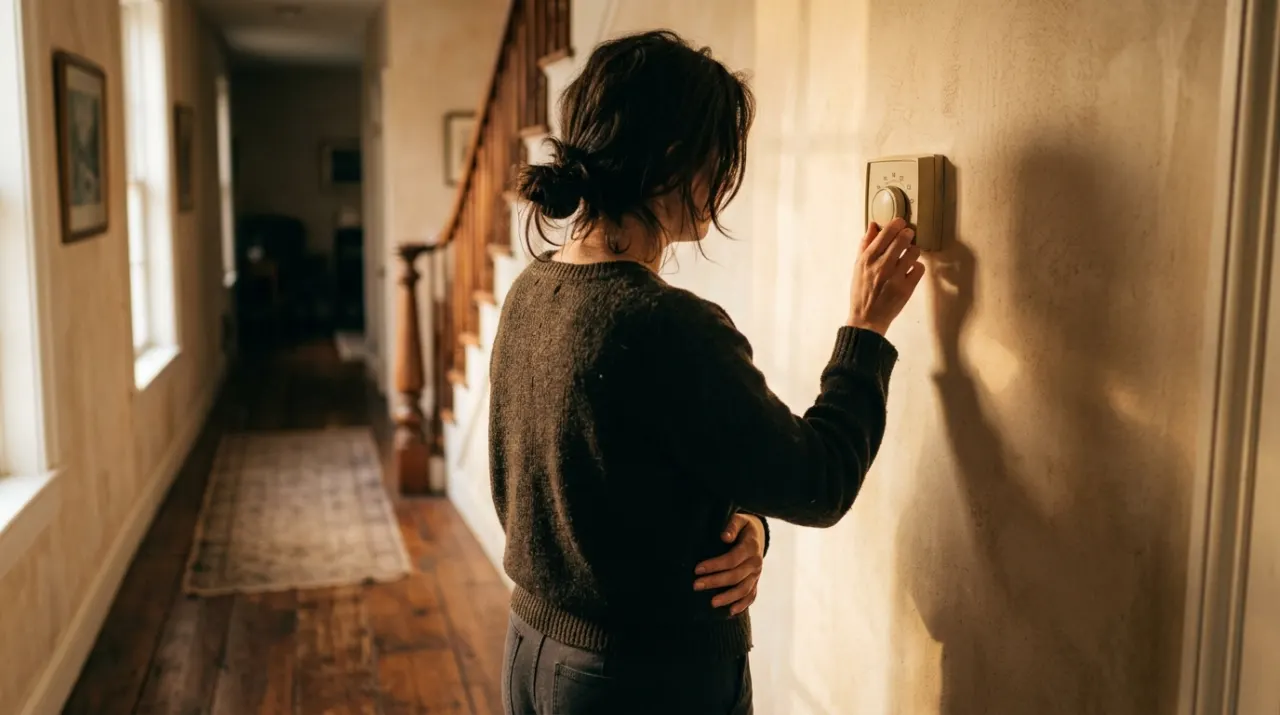
Risk is a function of setting, plumbing layout and how long the cold lasts. A single cold night is rarely the problem; three consecutive days below 20°F is. Use this to decide what your house can tolerate.
| Setting | Well-insulated, interior pipes | Pipes in exterior walls or crawlspace | Verdict |
|---|---|---|---|
| 68°F occupied | No risk | No risk | Normal comfort |
| 60°F | No risk | Low risk | Safe setback, away for a night |
| 55°F | No risk | Low risk in a normal cold snap | Recommended floor for a vacant home |
| 50°F | Low risk | Moderate risk below 20°F outdoors | Only with known-good insulation |
| 45°F | Moderate risk | High risk | Not recommended |
| Heat off | High risk | Near certain in deep cold | Winterize instead — drain the system |
What actually makes a pipe burst?
Pressure, not ice volume. Water expands roughly 9 percent as it freezes, and as an ice plug grows inside a pipe it pushes the still-liquid water ahead of it toward a closed faucet. That trapped column has nowhere to go, and pressure in it can climb into the thousands of PSI — far beyond what copper or PEX is rated for. The failure usually occurs in the trapped section between the plug and the fixture, which is why a burst often appears well away from where the ice formed.
This is precisely why the standard advice works. Opening a faucet to a steady drip — roughly the thickness of a pencil lead, about 5 gallons a day — relieves the pressure by giving the water an exit. It is not warming the pipe. Open the cold and hot side both if the fixture is on an exterior wall, and choose the faucet farthest from where the water enters the house.
What else should I do before a hard freeze?
- Open cabinet doors under kitchen and bathroom sinks on exterior walls so room air reaches the supply lines. Move household chemicals out of reach of children and pets first.
- Disconnect and drain garden hoses and shut the interior valve to outdoor faucets. A connected hose traps water in the sillcock and splits it.
- Insulate exposed runs in crawlspaces, garages and attics with foam sleeves. This is cheap, permanent and the single best return on effort.
- Use only UL-listed heat cable rated for the pipe material and follow the instructions exactly — heat tape misuse is a documented fire cause, and it must never be layered over itself or covered with insulation unless the product specifically allows it.
- Seal air leaks where plumbing enters the house and where crawlspace vents let wind blow directly across pipes. Wind moving over a pipe is worse than still air at the same temperature.
- Know where the main shutoff is and make sure it turns. If a pipe does burst, minutes matter more than anything else on this list.
Does my insurance care what I set it to?
Frequently, yes — and this is the part most guidance skips. Standard homeowners policies typically cover sudden water damage from a burst pipe, but many contain an exclusion for freezing losses in a dwelling that was vacant or unoccupied unless the insured used reasonable care to maintain heat, or shut off the water and drained the system. In practice that means a house left at 45°F with no heat maintenance record is a much weaker claim than one documented at 55°F. Read your own policy language, and if you leave a property empty for weeks in winter, a remote-sensing thermostat that logs indoor temperature and alerts you to a failure is worth having.
A connected thermostat with a low-temperature alert is the cheapest version of that insurance — the savings case for one is in how much does a smart thermostat save per year, with picks in best smart thermostat. If the furnace itself is unreliable heading into winter, deal with that first — see why does my furnace short cycle. And never use an unattended space heater as freeze protection in a vacant house; the cost and the risk are both covered in how much does it cost to run a space heater for 8 hours.