 Garden

Affiliate Disclosure
Some links on this page are affiliate links. As an Amazon Associate, we earn from qualifying purchases — at no extra cost to you. We do not buy, test, or physically handle the products we cover; our rankings come from aggregated owner reviews, ratings and expert consensus. Commissions never change our verdicts. How we rank · full disclosure.
The short answer: an air fryer is a small, fast convection oven, and the choice comes down to portion size. For one to three servings — fries, wings, roasted vegetables, reheating — the air fryer wins on speed, crispiness and energy use, cooking in a preheated-free 10 to 20 minutes while using a fraction of the power. For large meals, baking, and cooking several dishes at once, the oven wins on capacity and even heat. Most people keep both and let the air fryer take the small, quick jobs off the oven.
The debate gets muddled because people compare them as if they cook differently. They do not — both use forced hot air. What differs is scale and how that scale changes speed, texture and cost. Once you see the air fryer as a countertop convection oven, every practical difference falls into place. We do not physically test appliances; this reflects manufacturer specs and the consensus of owner reviews, as explained in how we rank.
The same technology at different scale
A convection oven and an air fryer both cook by circulating hot air with a fan. The air fryer just does it in a chamber a fraction of the size, with a proportionally stronger fan and a perforated basket that lets air reach the underside of the food. That combination — small cavity, fast airflow, all-around exposure — is why the air fryer crisps faster and more evenly on small batches.
This is not marketing spin; a full-size oven set to convection roast produces very similar results, just slower because it heats a cavity many times larger. Understanding this tells you when each tool has the edge, which is almost entirely a question of how much food you are cooking. For the in-house comparison of an air fryer against a countertop oven specifically, see toaster oven vs air fryer.
Speed and preheating
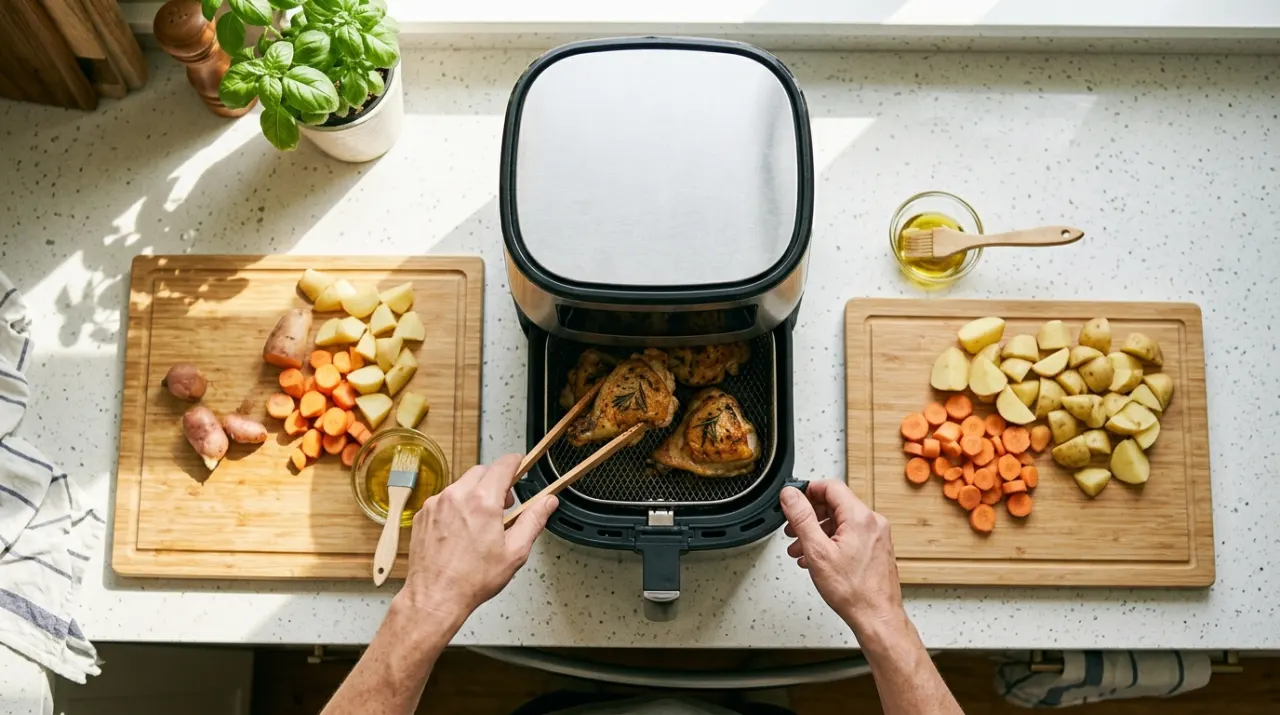
The air fryer's biggest everyday advantage is that it skips the long preheat. A standard oven takes 10 to 15 minutes to reach temperature before you even start cooking; an air fryer's small chamber is up to temperature in two to three minutes, and many recipes skip preheating entirely.
| Food | Air fryer (approx) | Standard oven (approx, incl. preheat) |
|---|---|---|
| Frozen fries (1 serving) | 15 min at 400 F | 25 to 30 min at 425 F |
| Chicken wings (1 lb) | 20 to 25 min | 40 to 45 min |
| Roasted vegetables (1 tray) | 12 to 18 min | 25 to 35 min |
| Reheating leftovers | 3 to 6 min | 15 to 20 min |
For a single portion, the air fryer is often twice as fast door to plate. That gap shrinks as the quantity grows, because you may need to cook multiple air fryer batches while the oven does it all in one load.
Crispiness and texture
For small foods, the air fryer produces the crispier result. The fast, concentrated airflow drives moisture off the surface quickly while the interior stays tender, getting close to deep-fried texture without the oil. Frozen fries, breaded cutlets and wings are where owners consistently report the biggest improvement over a conventional oven.
The oven pulls even, though, when the food is flat and spread out — a full sheet of cookies, a large tray of roasted potatoes, a whole tray of bacon. In those cases the oven's larger, more uniform heat field beats the air fryer's small basket, which crowds food and requires shaking or cooking in batches for even results. Overcrowding an air fryer basket is the number one reason food comes out soggy instead of crisp.

Energy use and running cost
For small meals the air fryer is clearly cheaper to run. It draws roughly 1,400 to 1,700 watts but runs briefly and heats almost no empty space, while an electric oven draws 2,000 to 5,000 watts and wastes energy heating a large cavity, much of it during preheat.
- Single serving: the air fryer can use a quarter to a third of the energy of a full oven for the same food.
- Family-size meal: the advantage disappears — one oven load beats several sequential air fryer batches.
- Summer comfort: the air fryer barely warms the kitchen, so you are not also paying to air-condition away the oven's heat. This is a real, under-counted saving.
The savings are genuine but modest per meal; nobody should buy an air fryer purely for the electric bill. For the detailed numbers see do air fryers use less electricity than an oven.
Capacity and what fits
This is where the oven is untouchable. A standard air fryer holds enough for one or two people — a basket typically cooks one to two servings of fries or four to six wings at a time. An oven cooks a turkey, a sheet cake, three casseroles, or a full tray of cookies at once.
| Task | Better tool | Why |
|---|---|---|
| Fries or wings for 1 to 2 | Air fryer | Faster, crisper, cheaper |
| Dinner for 4 to 6 | Oven | Cooks it all in one load |
| Whole roast or turkey | Oven | Air fryer cannot fit it |
| Baking cakes and bread | Oven | Gentle, even heat and room to rise |
| Reheating a plate | Air fryer | No preheat, keeps food crisp |
| Multiple dishes at once | Oven | Multiple racks and space |
If capacity is your concern, a dual-basket or large-oven-style air fryer narrows the gap; the family-size question is covered in what size air fryer for a family of 4.
Baking and delicate cooking
The oven wins decisively for baking. Cakes, breads, custards and anything that needs to rise slowly and evenly depend on gentle, stable heat and space — exactly what an air fryer's aggressive fan and cramped chamber lack. The strong airflow can blow batter around, brown the top before the center sets, and cook unevenly. An air fryer can bake small items in a pinch, but it is the wrong tool for anything that matters.
The oven also handles low-and-slow cooking, braises and dishes with liquid that would spill in a basket. The air fryer is a high-heat, dry-crisping specialist, not a general baker.
The verdict: it is not either/or
For most households the honest answer is that these are complements, not competitors. Keep the oven for baking, roasts, and feeding a crowd. Use the air fryer for the small, fast, crispy jobs it does better and cheaper — frozen foods, reheating, single-serve roasting, weeknight fries. The air fryer earns its counter space by taking the quick tasks off a slow, power-hungry oven, not by replacing it.
If you cook for one or two and rarely bake, an air fryer can genuinely cover most of your cooking. If you regularly feed a family or bake, the oven stays central and the air fryer is a helpful add-on.
Choosing an air fryer
If the air fryer makes sense for your kitchen, our ranked field is in best air fryers, with size guidance in what size air fryer for a family of 4. If you want one appliance that does both jobs, look at a countertop convection oven — the comparison is in toaster oven vs air fryer, and the energy question is settled in do air fryers use less electricity than an oven. Everything else is at the small kitchen appliances hub, and our method is at how we rank.