 Garden
Affiliate Disclosure
Some links on this page are affiliate links. As an Amazon Associate, we earn from qualifying purchases — at no extra cost to you. We do not buy, test, or physically handle the products we cover; our rankings come from aggregated owner reviews, ratings and expert consensus. Commissions never change our verdicts. How we rank · full disclosure.
Yes, and an 8-inch round or 8-by-8-inch square cake bakes well in most toaster ovens. Two adjustments matter. If the unit is convection, drop the recipe temperature by 25 degrees Fahrenheit, the standard conversion recommended by King Arthur Baking. Whatever the type, start testing for doneness about 10 minutes before the recipe says, because the small cavity and the closeness of the upper element speed the top considerably. Use light-colored metal pans, leave at least an inch of clearance on every side, and tent with foil once the top has browned.
What size pan actually fits?
Measure the cavity, not the box. Countertop ovens are sold by slice count, which tells you nothing useful about bakeware. A four-slice unit is usually too small for anything but muffins; a six-slice takes an 8-inch round; the large 12-slice and air-fryer-oven models take a quarter sheet and sometimes a 9-by-13. Air needs to move around the pan, so subtract an inch from each interior dimension before deciding.
| Pan | Footprint | Minimum oven size |
|---|---|---|
| 6-cup muffin tin | ~10 x 7 in | 4-slice and up |
| 8 x 4 in loaf pan | ~8.5 x 4.5 in | 4-slice and up |
| 8-inch round | ~8 in dia | 6-slice |
| 8 x 8 in square | ~8 x 8 in | 6-slice |
| 9-inch round | ~9 in dia | Large countertop |
| 9 x 13 in sheet | ~9 x 13 in | Full-size countertop only |
How do you adjust the temperature and time?
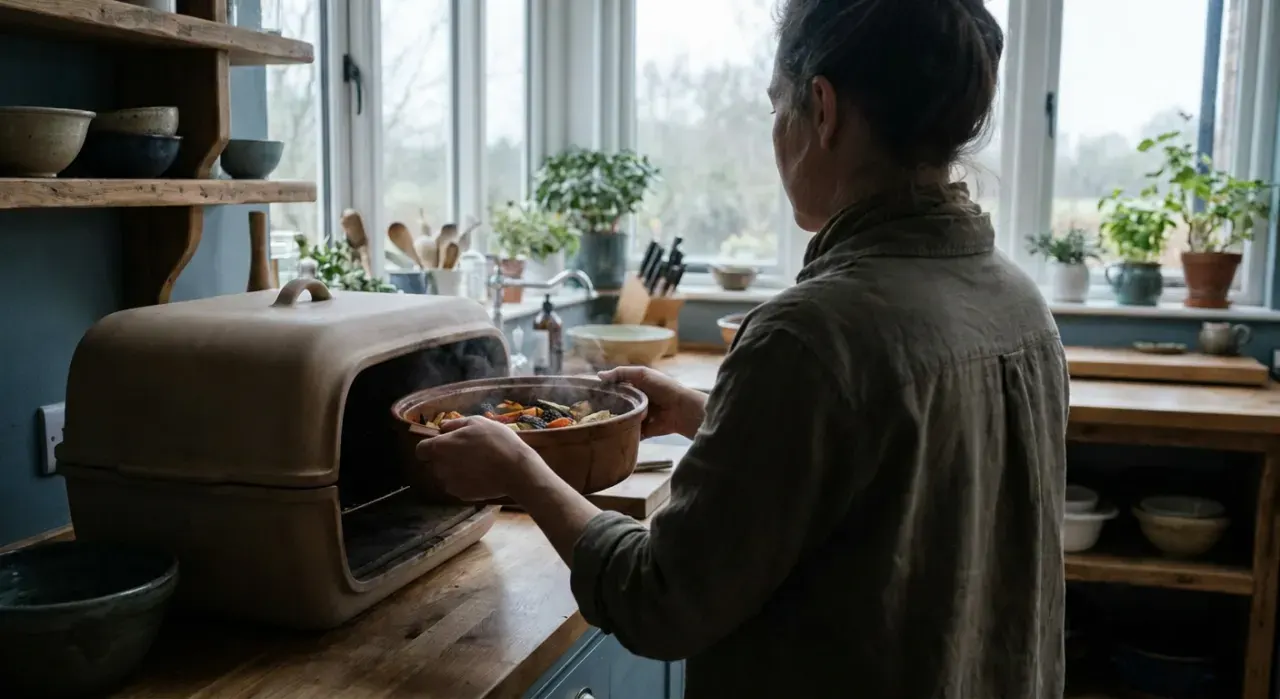
Convection is the only adjustment with a firm rule. Circulating air strips the insulating boundary layer off the batter surface and moves heat faster, so the standard conversion is 25 degrees Fahrenheit lower than the recipe, with time checked roughly 10 minutes early on a 30 to 40 minute bake. On a plain radiant toaster oven, keep the stated temperature but still check early. Either way, judge by the cake rather than the clock: a skewer inserted at the center should come out with moist crumbs and no wet batter, and the cake should spring back when pressed lightly at the center.
Preheat properly. Toaster ovens reach temperature faster than a full oven but the indicator light often clicks off before the cavity walls are actually up to heat. Give it five extra minutes after the light, especially for anything that needs a strong initial rise.
Why does the top brown before the middle sets?
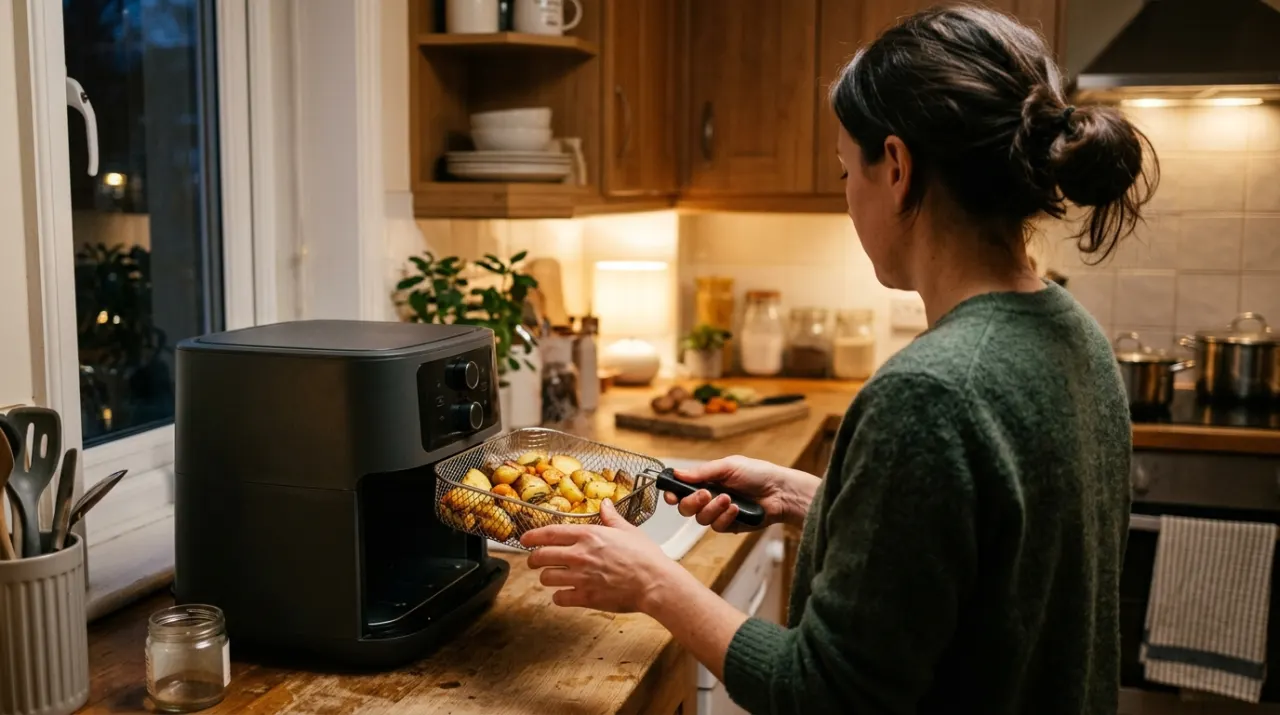
Distance. In a 30-inch wall oven the broil element sits a foot or more above the rack. In a toaster oven it is three to five inches above the pan, so the batter surface takes direct radiant heat at an intensity a full oven never delivers during baking. The result is a dark, domed, sometimes cracked top over an underbaked center.
Three fixes, in order of effectiveness: put the rack in the lowest position that still leaves an inch of air beneath the pan; tent the top loosely with foil once it has taken the color you want, usually at the halfway point; and if your unit lets you select the lower element only, use that setting for the first two-thirds of the bake. Do not lay foil across the rack under the pan, which blocks the airflow the oven depends on.
What bakeware is safe in a small oven?
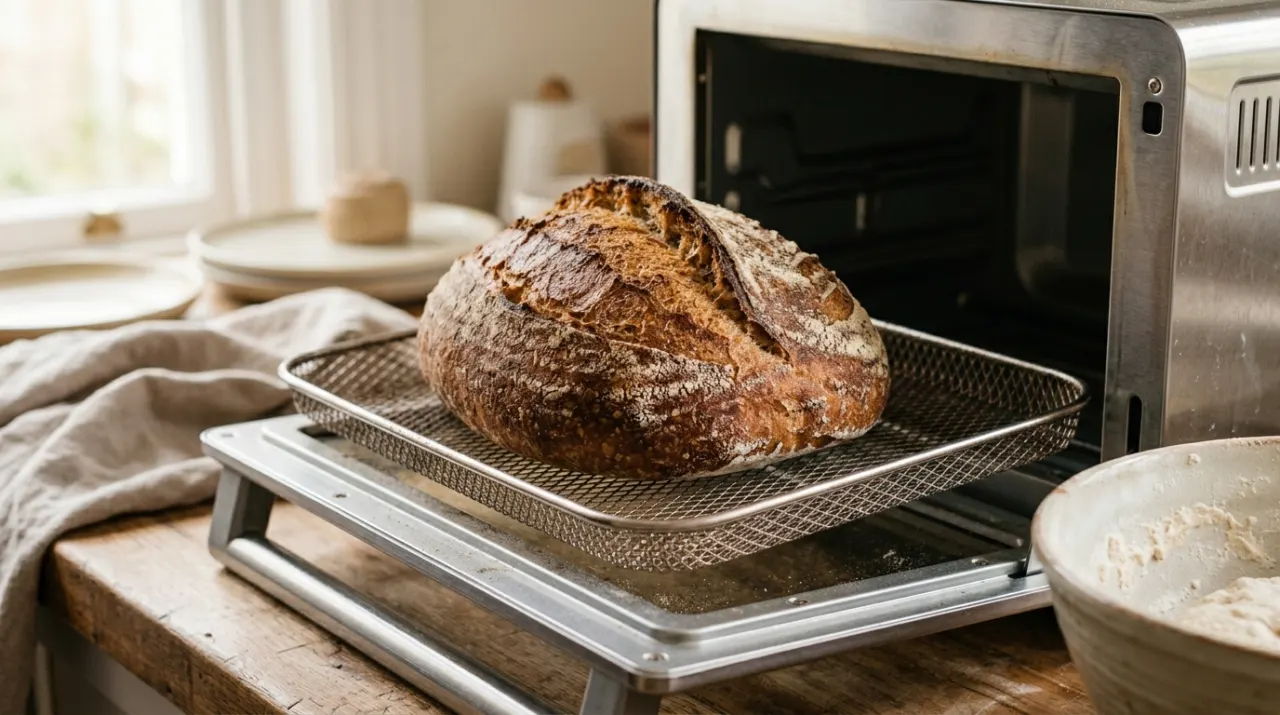
Light-colored aluminum or aluminized steel is the right default. It reflects rather than absorbs radiant heat, so the base browns gently, and it cannot shatter. Dark nonstick pans absorb more energy and over-brown the bottom, which matters more in a small cavity than a large one — drop another 25 degrees if that is all you have.
Glass and ceramic are the caution. Many toaster oven manuals restrict them outright because a dish can end up within an inch or two of a glowing element, and thermal shock in a confined space is a genuine hazard. Check your manual, never place glass under an active broil element, and never move it from refrigerator to preheated oven. Silicone pans are fine but flimsy; put them on a metal tray for support.
Where to go next
If you are deciding between formats, convection versus regular toaster ovens covers the temperature conversion in more depth, and toaster oven versus air fryer explains why a basket air fryer is a poor baking tool. See also toaster oven wattage and how to clean a toaster oven, since spilled batter is the usual reason one starts smoking. Shopping? The best toaster ovens ranks models on aggregated owner ratings, inside the small kitchen appliances hub.
We never buy or physically handle the products we rank — our picks come from aggregated owner reviews and expert consensus, explained on how we rank. Your appliance manual is the final authority on bakeware in your model.