 Garden


Affiliate Disclosure
Some links on this page are affiliate links. As an Amazon Associate, we earn from qualifying purchases — at no extra cost to you. We do not buy, test, or physically handle the products we cover; our rankings come from aggregated owner reviews, ratings and expert consensus. Commissions never change our verdicts. How we rank · full disclosure.
The short answer: a self-propelled mower is worth the extra $100 to $200 if your lawn is over about a quarter acre, has slopes steeper than roughly 5 degrees, or if pushing a 70 to 90 pound machine is genuinely hard work for you. On a flat yard under a quarter acre, a push mower is lighter, cheaper, simpler, and finishes in 20 to 30 minutes anyway. The trade is real on both sides: you gain effort savings, you accept a heavier machine and three extra wear parts in the drive cable, belt and wheel gears.
Yard shape decides this more often than yard size. Our mower rankings come from aggregated owner reviews and reliability reports rather than first-hand testing, as explained in how we rank. More mower comparisons are at the lawn care hub.
When is a self-propelled mower clearly worth it?
Four situations make the case on their own, and any one of them is usually enough:
- Slopes. Pushing uphill is where owners report the biggest difference. Rear-wheel or all-wheel drive holds traction where a push mower slides.
- Quarter acre and up. At 10,000 square feet with a 21 inch deck you walk roughly 1.7 miles per cut, and every foot of it is under load with a push mower.
- Heavy or wet growth. Thick spring grass loads the deck and makes a push mower noticeably harder to move.
- Physical limits. Anyone with joint, back or stamina limitations gets the clearest benefit. This is a general observation and not medical advice; talk to a clinician about your own situation.

When is a push mower the better buy?
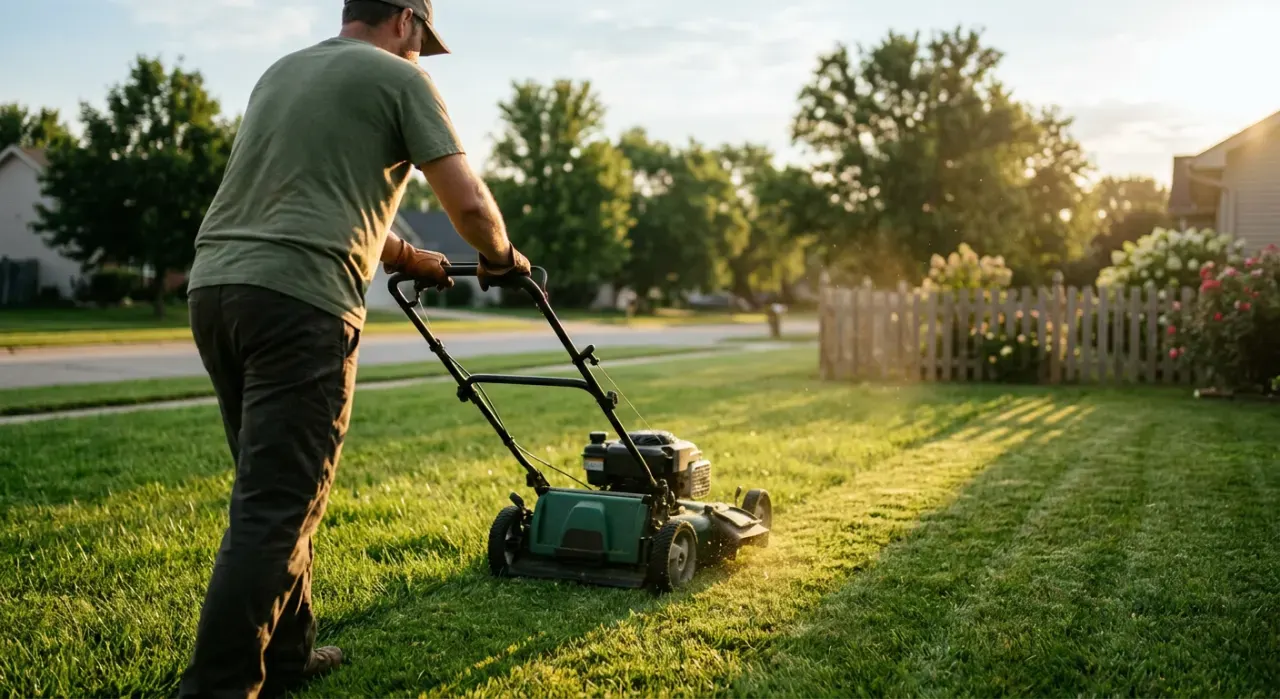
On a flat lawn under about 5,000 square feet, the drive system mostly adds weight, cost and things to fix. Push mowers weigh 55 to 75 pounds against 75 to 95 pounds for a comparable self-propelled model, which makes them easier to turn at row ends, easier to maneuver around beds, and easier to lift into a truck or hang on a garage wall. They are also simpler: no drive cable to stretch, no belt to wear, no wheel gears to pack with grass. For small yards with many obstacles, owners consistently report that a push mower is actually faster, because most of the time is spent turning rather than driving in straight lines.
What does the price difference actually buy?
Prices below are typical current US retail for 21 inch residential walk-behinds. Note that the drive system also adds ongoing parts cost over the machine's life.
| Type | Typical price | Weight | Extra wear parts | Best for |
|---|---|---|---|---|
| Gas push | $200 to $350 | 55 to 75 lb | None beyond engine | Flat yards under 1/4 acre |
| Gas FWD self-propelled | $300 to $450 | 75 to 85 lb | Cable, belt, wheel gears | Flat, obstacle-heavy yards |
| Gas RWD self-propelled | $400 to $650 | 80 to 95 lb | Cable, belt, transmission | Slopes, open lawns, bagging |
| Gas AWD self-propelled | $550 to $900 | 90 to 100 lb | Two drive systems | Steep or terraced ground |
| Battery self-propelled | $450 to $800 | 60 to 80 lb | Drive motor, battery pack | Quiet, low-maintenance, up to 1/2 acre |
Over a decade, budget roughly $50 to $100 in drive parts on a gas self-propelled mower. That is small against the machine price, but it is the part that most often makes an otherwise healthy mower feel broken, as covered in how long lawn mowers last.
What do owners complain about most?
The recurring gripes in owner reviews are consistent across brands: drive cables stretching so the mower stops pulling after a season or two, plastic drive-wheel gears wearing or packing with grass and slipping, single-speed drives set too fast for comfortable walking on rough ground, and the sheer weight when maneuvering in tight spaces or lifting the machine. The first two are cheap fixes; the last two are buying decisions. If you have uneven ground or share the mower between people of different heights, variable speed is worth paying for.
Do self-propelled mowers help on hills?
Yes, and this is the strongest single argument for one. Rear-wheel and all-wheel drive keep power on the wheels carrying weight when the machine is pointed uphill, where front-wheel drive tends to spin. Safety still applies regardless of drive: mow across a slope with a walk-behind rather than up and down, never mow wet slopes, and stop at gradients where you cannot keep secure footing. Manufacturers commonly rate walk-behind mowers for slopes up to about 15 degrees. Model choices for gradient are compared in best self-propelled mower for hills.
If you want the mechanics behind the drive, see how a self-propelled mower works, and for the direct head-to-head see push vs self-propelled lawn mower. Power source is a separate decision covered in gas vs battery mower, and current picks are in best self-propelled mower.