 Garden
Affiliate Disclosure
Some links on this page are affiliate links. As an Amazon Associate, we earn from qualifying purchases — at no extra cost to you. We do not buy, test, or physically handle the products we cover; our rankings come from aggregated owner reviews, ratings and expert consensus. Commissions never change our verdicts. How we rank · full disclosure.
The short answer: the best Kentucky bluegrass seed is Jonathan Green Blue Panther — 100 percent Kentucky bluegrass with no filler species, naturally dark color, and the uniform carpet appearance that is the entire point of choosing bluegrass. It suits northern lawns with at least six hours of sun. For a full lawn, the 25 lb bag drops the cost per thousand square feet sharply, and if water use matters, Pennington Smart Seed Kentucky Blue needs up to 30 percent less once established.
We do not buy, plant, or physically handle any seed. These rankings come from aggregated owner reviews, star ratings, review volume and expert consensus — see how we rank. For the wider field see best grass seed, and for the main alternative, best tall fescue grass seed.
Top Picks at a Glance

Our #1 Pick: Jonathan Green Blue Panther
Kentucky bluegrass is chosen for one reason: it produces the best-looking cool-season lawn there is. Fine leaves, deep color, and — crucially — it spreads. Bluegrass sends out underground rhizomes that knit new shoots between existing plants — Penn State Extension confirms it spreads by rhizomes with good recovery from wear — so the lawn becomes a continuous carpet rather than a collection of clumps, and damage heals without reseeding. No bunch grass can replicate that.
Blue Panther is 100 percent Kentucky bluegrass, which matters more than it sounds. Many bags labeled as bluegrass are blends padded with cheaper perennial ryegrass or annual rye, which germinates fast and makes the bag look effective in week two while contributing nothing to the mature lawn. Buying straight bluegrass means the lawn you get in year two is the lawn you paid for.
Jonathan Green selects for dark color and deep rooting, and reviewers with established Blue Panther lawns consistently describe density and uniformity as the standout characteristics rather than speed.
Which brings us to the complaints, and they are substantial enough that you should read them before buying. Germination is slow — 14 to 30 days, roughly twice perennial rye — and the single largest source of one-star reviews is people who stopped watering at day 12 assuming failure. It takes a full season to fill in, because bluegrass builds rhizomes before density. It needs a lot of water; bluegrass is the thirstiest common lawn grass and goes dormant and brown in summer drought where tall fescue stays green. It fails in shade below about six hours of sun. And it is higher maintenance generally — more nitrogen, more water, and more susceptibility to disease than fescue. Bluegrass rewards effort; it does not tolerate neglect.
Consensus Score █████████░░░ 8.5
Check price on Amazon → (paid link)
The Ranked Field
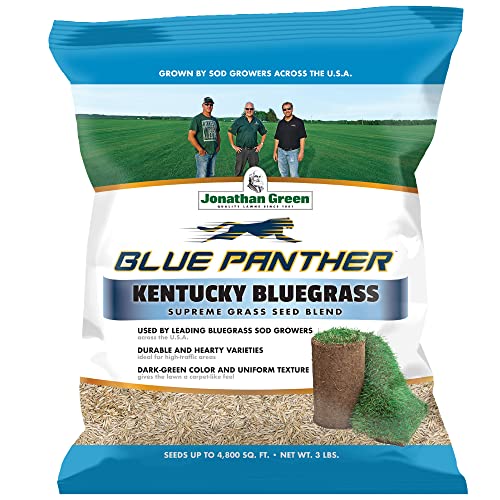
Best for northern lawns wanting the classic dark, dense bluegrass look
- 100% Kentucky bluegrass, not a blend
- Naturally dark green color
- Roots reported to reach up to 4 feet
- Seeds up to 2,400 sq ft when overseeding
Why buy it: straight Kentucky bluegrass with no filler species, which is what gives that uniform carpet look a blend cannot match.

Best for seeding a full northern lawn from scratch
- 25 lb bag seeds up to 20,000 sq ft new lawn
- Up to 40,000 sq ft when overseeding
- 100% Kentucky bluegrass
- High traffic durability once established
Why buy it: bluegrass seed is tiny, so a 25 lb bag genuinely covers a large lawn and the cost per thousand square feet drops sharply.

Best for northern lawns where irrigation is limited or metered
- Uses up to 30% less water once established
- Covers 2,000 sq ft overseeding, 1,000 sq ft new lawn
- Results in 15 to 30 days
- Fertilizer included
Why buy it: bluegrass is the thirstiest common lawn grass, so a drought-selected version fixes its biggest practical weakness.

Best for owners chasing a fine, fairway-style texture
- Blend of multiple Kentucky bluegrass cultivars
- Covers up to 3,000 sq ft
- Fine leaf texture
- Multiple cultivars spread disease risk
Why buy it: blending several bluegrass cultivars rather than relying on one means a disease that hits one variety does not take the lawn.
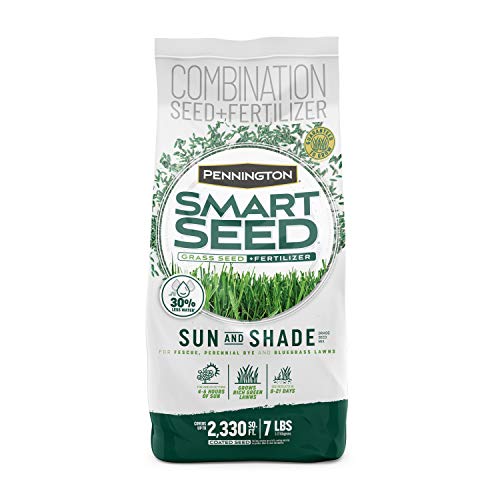
Best for real northern yards with sun in some places and shade in others
- Kentucky bluegrass with tall fescue and perennial rye
- Formulated for northern climates
- Drought tolerant once established
- Fertilizer included in the bag
Why buy it: pure bluegrass fails in shade, and blending it with fescue is how a real yard with trees gets a consistent lawn.

Best for transition-zone lawns that need drought tolerance as well as self-repair
- Turf-type tall fescue with Kentucky bluegrass and perennial rye
- Deep rooting for drought tolerance
- Naturally dark green
- Bluegrass fraction repairs damaged areas
Why buy it: the bluegrass fills damage while the tall fescue survives August, which is the combination most American lawns actually need.
Quick Comparison
| Product | Best for | Rating | Price | Buy |
|---|---|---|---|---|
| Jonathan Green Blue Panther Kentucky Bluegrass Grass Seed (3 lb) | Best Overall | — | Check (paid link) | |
| Jonathan Green Blue Panther Kentucky Bluegrass Grass Seed (25 lb) | Best for Big Lawns | — | Check (paid link) | |
| Pennington Smart Seed Kentucky Blue Grass Mix (3 lb) | Best Water-Saving Pick | — | Check (paid link) | |
| GreenView Pure Grass Seed Kentucky Bluegrass Blend (3 lb) | Best Fairway-Type Blend | — | Check (paid link) | |
| Pennington Smart Sun and Shade Grass Seed Mix North (7 lb) | Best Mixed-Species Blend | — | Check (paid link) | |
| Jonathan Green Black Beauty Ultra Grass Seed (7 lb) | Best Blend With Fescue | — | Check (paid link) |

Bluegrass or Tall Fescue?
These are the two dominant cool-season options and the choice is genuinely regional.
| Kentucky bluegrass | Turf-type tall fescue | |
|---|---|---|
| Appearance | Finest, densest, most uniform | Medium texture, slightly clumpy |
| Self-repair | Yes — spreads by rhizomes | No — bunch grass, gaps stay |
| Root depth | 6–12 inches | 3–4 feet |
| Drought tolerance | Poor — goes dormant and brown | Excellent — stays green |
| Germination | 14–30 days | 8–21 days |
| Shade tolerance | Poor | Moderate |
| Water and fertilizer demand | High | Moderate |
| Best region | Northern tier, Upper Midwest, Northeast | Transition zone, warmer cool-season areas |
The answer most extension services give for anywhere south of the northern tier is a blend of both: tall fescue for drought survival, bluegrass for self-repair. That is why our fifth and sixth picks here are blends rather than pure bluegrass.
The Seeds, Reviewed
1. Jonathan Green Blue Panther (3 lb) — Best Overall
Covered above. Owners praise: uniform carpet appearance, dark color, self-repairing spread, and being genuinely 100 percent bluegrass rather than a padded blend. Owners complain about: slow germination, a full season to fill in, high water demand, shade intolerance, and higher maintenance than fescue.
2. Jonathan Green Blue Panther (25 lb) — Best for Big Lawns
Bluegrass seed is very small — roughly 2.2 million seeds per pound — so 25 lb genuinely seeds up to 20,000 sq ft of new lawn or 40,000 sq ft of overseeding. That makes the big bag the right purchase for anyone doing a full lawn, and the cost per thousand square feet falls a long way below the small pack. Owners praise: coverage, value on large jobs, consistency with the smaller bags, and traffic durability once established. Owners complain about: a large bag that must be used within a season or two before viability drops, up-front cost, and the same slow establishment as all bluegrass.
3. Pennington Smart Seed Kentucky Blue Grass Mix (3 lb) — Best Water-Saving Pick
This addresses bluegrass's single biggest practical weakness. The Smart Seed line is selected for reduced water use — up to 30 percent less once established — which turns the thirstiest common lawn grass into something viable where irrigation is metered or restricted. Fertilizer is included, and results are commonly reported in 15 to 30 days. Owners praise: reduced watering need, included starter feed, decent germination for bluegrass, and color. Owners complain about: being a mix rather than pure bluegrass, modest coverage per bag, and the usual bluegrass wait for full density.
4. GreenView Pure Grass Seed Kentucky Bluegrass Blend — Best Fairway-Type Blend
Blending several bluegrass cultivars rather than relying on a single one is standard practice on golf courses, and for a good reason: disease resistance varies by cultivar, so a blend means an outbreak that hits one variety does not take the whole lawn. This blend targets a fine, fairway-style texture and covers up to 3,000 sq ft. Owners praise: fine texture, disease resilience across seasons, coverage, and color. Owners complain about: patchier availability than the major brands, price, and the same slow germination inherent to bluegrass.
5. Pennington Smart Sun and Shade Mix North — Best Mixed-Species Blend
The pragmatic option for a real yard. Pure bluegrass fails under trees, and most northern properties have both sunny lawn and shaded areas. This combines bluegrass with tall fescue and perennial rye so different parts of the yard are carried by the species that suits them. Owners praise: consistency across mixed light conditions, winter hardiness, included fertilizer, and reduced water need. Owners complain about: less uniform appearance than pure bluegrass, a bluegrass fraction slow to contribute, and shade tolerance below a dedicated fine-fescue mix.
6. Jonathan Green Black Beauty Ultra — Best Blend With Fescue
The combination most transition-zone lawns actually want: turf-type tall fescue for the deep roots that survive August, with a Kentucky bluegrass fraction that repairs damage the fescue cannot. Naturally dark green and disease-resistant. Owners praise: summer color retention, self-repair from the bluegrass, drought performance, and clean seed analysis. Owners complain about: a medium rather than fine texture, price per pound, and a bluegrass component that takes a season to show.
What Owners Actually Complain About
Bluegrass seed reviews are dominated by one issue that is really a knowledge gap. It did not germinate is the top complaint, and the timeline in most of those reviews is 10 to 14 days — which is before Kentucky bluegrass germinates at all. Watering must continue for a full 30 days. Thin coverage in year one is second and is normal: bluegrass invests in rhizomes before density, and the lawn people expected in October arrives the following June. Summer dormancy is third, where a lawn goes brown in July and owners assume it died; bluegrass goes dormant to survive drought and greens up when rain returns. Failure in shade is fourth and is a species limitation. And high water bills are fifth, which is an honest cost of the best-looking cool-season lawn there is.

How to Establish a Bluegrass Lawn
Bluegrass rewards doing this properly more than any other lawn grass.
- Seed in early fall, six to eight weeks before your first hard frost — NC State Extension puts the cool-season seeding window at mid-August to early October. Spring seeding rarely establishes enough root before summer.
- Sow at 2 to 3 lb per 1,000 sq ft for a new lawn. This looks like very little seed; resist the urge to add more.
- Keep the top half-inch moist for 30 full days. Not 14. This is the single decisive factor and it usually means two or three short waterings a day.
- Apply starter fertilizer at seeding — see best fertilizer for new grass.
- Do not mow until 3 inches tall, then remove only the top third.
- Skip pre-emergent weed control for the season, because it prevents grass seed germinating exactly as it prevents weed seed.
- Expect thin coverage until the following spring. The rhizomes are working underground where you cannot see them.
Once established, bluegrass wants roughly an inch of water a week and 3 to 4 lb of nitrogen per 1,000 sq ft a year, split across the season. Mow at 2.5 to 3 inches, well within the 2 inches or above that Penn State Extension recommends for most lawns — see mowing height by grass type.
How We Rank Grass Seed
We never buy or physically handle the products on this site. We read the owner-review record at scale, weighting four things. Seed purity, since bags labeled bluegrass are frequently padded with cheaper rye that flatters the early result and disappears. Germination consistency as owners report it, adjusted for the fact that bluegrass takes 30 days. Appearance at 12 months rather than at eight weeks, which is when a bluegrass lawn actually shows what it is. And seed analysis quality, including weed seed and inert content. Prices and star ratings move; the complaint pattern does not.
The Verdict
Jonathan Green Blue Panther is the Kentucky bluegrass seed the owner-review record supports most strongly — pure bluegrass, dark color, and the self-repairing carpet that is the whole reason to choose this species. Buy the 25 lb bag for a full lawn. If water use is a real constraint, Pennington Smart Seed Kentucky Blue solves bluegrass's worst weakness, and anywhere south of the northern tier, a fescue blend like Black Beauty Ultra is the more reliable lawn.
Next: compare with the alternative in best tall fescue grass seed, get the timing right with the best time of year to plant grass seed, or troubleshoot with how long grass seed takes to germinate.