 Garden

Affiliate Disclosure
Some links on this page are affiliate links. As an Amazon Associate, we earn from qualifying purchases — at no extra cost to you. We do not buy, test, or physically handle the products we cover; our rankings come from aggregated owner reviews, ratings and expert consensus. Commissions never change our verdicts. How we rank · full disclosure.
The most powerful pressure washer is the worst thing you can buy for a roof. Asphalt shingles are protected by a layer of ceramic-coated mineral granules, and those granules are the shingle's ultraviolet shield and part of its fire rating. Pressure removes them. The Asphalt Roofing Manufacturers Association puts it in capitals: "DO NOT use a power washer or any type of brush or broom to clean algae from the roof surface. High-pressure washing systems are likely to damage asphalt roofing."
So this is a ranking of equipment for soft washing — applying a cleaning solution at low pressure, letting it kill the algae, and rinsing gently. Two of the six picks are not pressure washers at all, and one of them is our top choice. If that seems like a strange thing for a page with this title to say, it is the same reason our gutter guard and bug zapper pages talk you out of things: we would rather be useful than agreeable.
Top Picks at a Glance

Why PSI Is the Wrong Number Here
On a driveway, more pressure means faster cleaning and the only cost is water and noise. On a roof, more pressure means less roof. The relationship inverts completely, and almost nothing in the way pressure washers are marketed prepares a buyer for that.
What actually cleans a roof is chemistry plus time. Black streaking on North American roofs is nearly always Gloeocapsa magma, a cyanobacterium that feeds on the limestone filler in asphalt shingles. It is a living colony, not a layer of dirt, and a biocide with fifteen minutes of dwell time kills it. Pressure does not kill it; it knocks the visible top layer off and leaves the colony to regrow within a season, having taken granules with it on the way out.
| Soft washing a roof | Pressure washing a roof | |
|---|---|---|
| Working pressure | 100–500 PSI | 1,500–4,000 PSI |
| Kills the organism | Yes | No |
| Result typically lasts | 2–4 years | Often under a year |
| Granule loss | None | Significant and permanent |
| Water forced under laps | No | Yes, if sprayed upward |
| Warranty position | Consistent with manufacturer guidance | Named as improper maintenance |
Our #1 Pick: Chapin 4-Gallon ProSeries Backpack Sprayer
The best tool for cleaning a roof is not a pressure washer, and pretending otherwise would be the easy version of this page. A 4-gallon backpack sprayer delivers roughly 40 to 60 PSI, which is precisely the pressure a shingle roof wants, and it puts the solution down evenly, which is what actually determines the result.
The ProSeries is the version worth having because of its seals. Roof solutions are chemically aggressive — sodium hypochlorite blends in particular — and the failure that owners of cheap sprayers report over and over is a pump seal or gasket that swells, hardens and starts weeping down their back after one season. Chemical-resistant seals and a poly tank are the difference between a tool and a consumable. The three-stage filtration matters for the same practical reason: a partly clogged nozzle sprays unevenly, and uneven application is what leaves a roof drying in visible bands.
What owners consistently praise is the carry system — a full 4-gallon tank is over 30 pounds, and padded straps with a waist belt are not a luxury when you are working along a roofline. What they consistently gripe about is the manual pumping, which is genuine: on a large roof you are stroking a lever continuously for an hour. That is the case for the battery-powered PetraTools at number two.
At roughly a third the price of a pressure washer, this is also the cheapest correct answer in the category.
Check price on Amazon → (paid link)
The Ranked Field

Best for the correct way to put cleaning solution on a shingle roof
- 4-gallon chemical-resistant poly tank, seals and gaskets
- Manual pump delivers roughly 40–60 PSI — soft-wash territory
- Padded shoulder straps and waist belt for a full tank
- 3-stage filtration and adjustable cone and fan nozzles
Why buy it: a roof is cleaned by chemistry and dwell time, not force, and a pump sprayer delivers exactly that at a pressure no shingle can object to. It is also a third the price of a pressure washer.
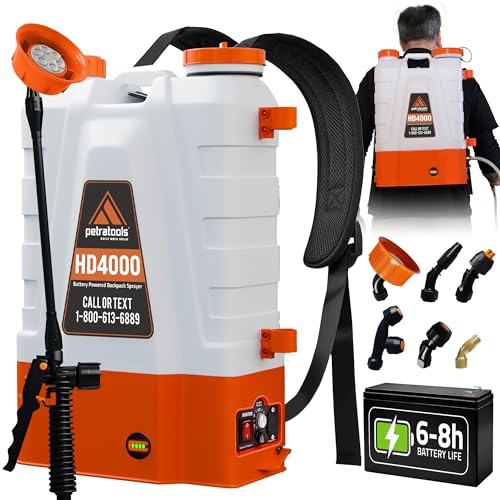
Best for covering a large roof and a whole house without pumping
- Battery pump holds steady pressure with no manual stroking
- Quoted runtime up to 6 hours on a charge
- Six nozzles including a wide fan for even roof coverage
- Adjustable output for solution application and rinsing
Why buy it: constant pressure is what produces an even coat, and an even coat is what stops a roof drying in stripes — the failure mode owners report most from hand-pumped sprayers on big jobs.

Best for homeowners who want one machine, used on the soap tip for roofs
- Two onboard 0.9-gallon detergent tanks with a working low-pressure siphon
- Black soap nozzle drops output to soft-wash pressure
- Total stop system cuts the pump when the trigger is released
- The most-owned electric pressure washer in the United States
Why buy it: if a pressure washer is going anywhere near a roof it must have a genuine low-pressure soap mode, and this one does — with the soap tip fitted it applies solution, and with any other tip it destroys shingles.

Best for treating roof algae once and never going back up
- Bleach-free, phosphate-free concentrate
- No rinsing and no scrubbing — weather does the removal
- Dilutes 5:1, so one jug covers a substantial roof
- Gentler on landscaping than a sodium hypochlorite mix
Why buy it: the rinse trip is the most dangerous part of roof cleaning, because it puts you back on a wet, freshly treated slope. A no-rinse product deletes that trip entirely.

Best for a single-story roof treated from the ground with a garden hose
- Hose-end applicator mixes as it sprays — no separate tank
- Formulated specifically for roof algae and lichen
- No pressure equipment involved at all
- Bleach-free formulation
Why buy it: the lowest-equipment route there is: a garden hose, a still day and no ladder. On a single-story roof this is the whole job.

Best for gutters, fascia, soffits and the first few feet of eave
- Extends to 24 feet from a standing position
- Curved wands for gutter and under-eave angles
- Support belt to carry the pole load at full extension
- Quick-connect tips including the black low-pressure soap nozzle
Why buy it: this replaces a ladder, which is the real hazard in roof work — but it belongs on gutters and eaves with the soap tip fitted, not on the shingle field.
Quick Comparison
| Product | Best for | Rating | Price | Buy |
|---|---|---|---|---|
| Chapin 4-Gallon ProSeries Backpack Sprayer with 3-Stage Filtration | Best Overall for Roofs | — | Check (paid link) | |
| PetraTools HD4000 Battery Powered Backpack Sprayer, 6-Hour Runtime, 6 Nozzles | Best Battery-Powered | — | Check (paid link) | |
| Sun Joe SPX3000 Electric Pressure Washer, 2030 Max PSI, 1.76 GPM | Best Pressure Washer for the Job | — | Check (paid link) | |
| Wet & Forget Moss, Mold, Mildew and Algae Stain Remover Multi-Surface Outdoor Cleaner Concentrate | Best No-Rinse Solution | — | Check (paid link) | |
| Spray & Forget 1-Quart Hose End Concentrated Roof Cleaner | Best Roof-Specific Ready-to-Spray | — | Check (paid link) | |
| RIDGE WASHER 24 FT Telescoping Pressure Washer Wand with 3 Curved Wands and Gutter Attachment | Best Ground-Based Reach | — | Check (paid link) |
If You Are Buying a Pressure Washer Anyway
Plenty of people arrive here already owning a machine, or wanting one for the driveway and the deck as well. That is reasonable — a pressure washer is a genuinely useful tool for the surfaces it suits. The roof-specific buying rule is narrow:
- Buy for detergent delivery, not pressure. The feature that matters is a working low-pressure soap siphon and a black soap nozzle. Without it the machine cannot apply solution at all, because detergent siphons only draw at low pressure.
- Ignore the PSI badge. A 4,000 PSI machine with the soap tip fitted behaves identically to a 1,600 PSI one with the soap tip fitted. The extra pressure is dead weight for this job and a hazard if the wrong tip goes on.
- Electric over gas. Roof work happens close to the house and often on a ladder-adjacent footing. A quiet machine with no exhaust and no pull start is easier to manage, and no roof job needs 2.5 GPM.
- Never fit 0°, 15° or a turbo nozzle on a roof. Not for a stubborn patch, not "just for a second". Black soap tip for applying, 40° white held well back for rinsing, nothing else.
Our full field is in best pressure washer, and best electric pressure washer covers the class that suits this work.
How We Rank
We do not buy, run or test this equipment. Rankings come from aggregated owner ratings across the most-owned roof cleaning gear, weighted toward long-ownership reviews where seal degradation and pump failure appear, and cross-checked against published specifications and the guidance of the Asphalt Roofing Manufacturers Association. Four things carry the weight here: appropriate working pressure, meaning low and controllable rather than high; chemical resistance, because roof solutions destroy sprayers that were not built for them; even coverage, since a striped application is the most common visible failure; and whether the tool keeps the user off the roof, which is the safety question that outranks all the others. Prices were checked at the time of writing. Full method: how we rank.

The Field, Reviewed
1. Chapin 4-Gallon ProSeries Backpack Sprayer — Best Overall for Roofs
Covered above. Owners praise: chemical-resistant seals that survive bleach mixes, a comfortable carry system under a full tank, and the filtration that keeps nozzles clear. Owners gripe about: continuous manual pumping on big jobs, occasional wand shut-off leaks that need a replacement assembly, and a hose that stiffens in cold weather. Check price (paid link).
2. PetraTools HD4000 Battery Backpack Sprayer — Best Battery-Powered
The upgrade that matters on a large roof. A battery pump holds constant pressure, and constant pressure is what produces an even coat; hand-pumped sprayers drift up and down as the operator tires, which is exactly how a roof ends up drying in bands.
Owners praise: genuinely long runtime on a charge, steady output across a whole house and roof in one session, and the relief of not pumping. Owners gripe about: the price against a manual sprayer, battery life dropping after a couple of seasons, and the need to flush the system after bleach-based solutions or the pump suffers. Check price (paid link).
3. Sun Joe SPX3000 — Best Pressure Washer for the Job
If a pressure washer is going to be part of this, it should be this class of machine: modest pressure, two onboard detergent tanks, a soap siphon that actually works, and total-stop operation. With the black soap tip fitted it applies solution at soft-wash pressure; with the 40° white tip and a long standoff it rinses.
It is also the most-owned electric pressure washer in the country, which means its failure modes are documented by an enormous body of long-term owners rather than a handful of reviewers.
Owners praise: the dual detergent tanks, the price, and how well it handles the driveway and deck jobs it is genuinely designed for. Owners gripe about: leaking plastic hose fittings, a short power cord, and pressure loss after a winter if the pump was stored without draining. Check price (paid link).
4. Wet & Forget Concentrate — Best No-Rinse Solution
The product that removes the most dangerous step. Applied once and left, it works with rain and weather over following weeks, so there is no return trip onto a slick, freshly treated roof to rinse. It is bleach-free, which also makes it far kinder to the planting beds below.
Owners praise: that streaking genuinely disappears without scrubbing, the dilution ratio going a long way, and results holding for a couple of years. Owners gripe about: the wait — this is not a same-day transformation, and impatient buyers leave the one-star reviews — plus a need to reapply in heavily shaded, humid locations. Check price (paid link).
5. Spray & Forget Hose-End Roof Cleaner — Best Roof-Specific Ready-to-Spray
The minimum-equipment route. It screws onto a garden hose, mixes as it sprays, and on a single-story roof on a still day it is the entire job — no tank, no pump, no ladder, no machine.
Owners praise: how little there is to set up, roof-specific formulation, and no rinsing. Owners gripe about: limited reach on two-story homes, hose-end applicators that mix inconsistently as the bottle empties, and the same patience requirement as any no-rinse product. Check price (paid link).
6. RIDGE WASHER 24 FT Telescoping Wand — Best Ground-Based Reach
Ranked here for what it prevents rather than what it cleans. The serious injuries in roof work come from ladders, and a 24-foot pole from a standing position removes the ladder from gutters, fascia, soffits and the eave courses.
Its limits are real and worth stating. At full extension the tip is out of your sightline, so standoff distance becomes guesswork, and spraying upward from ground level drives water under the shingle laps. Fit the black soap tip, keep it to edge work, and put the solution on the field with a sprayer.
Owners praise: the reach, the curved wands for gutter angles, and getting off ladders entirely. Owners gripe about: how heavy an aluminum pole feels at full extension with water in it, wobble at the top section, and leaks at the pole joints as the seals age. Check price (paid link).
What Owners Actually Complain About
Seals, not pumps. The dominant complaint across sprayers is a seal or gasket that fails after exposure to a bleach-based solution. Buying a chemical-resistant model and flushing it with clean water after every use prevents most of it.
Impatience with no-rinse products. A large share of one-star reviews on no-rinse cleaners describe a product working exactly as designed while the buyer expected a same-day result. Read the label before you buy, not after.
Uneven coverage. Roofs that dry in stripes are almost always an application problem — a fading manual pump, a partly blocked nozzle, or working in sun so the solution dried before it acted.
Landscaping damage. The most expensive mistake. Sodium hypochlorite is not selective and will kill anything green it lands on. Soak the beds before, keep them wet, rinse after.
The Part That Is Not About Equipment
ARMA "recommends that only trained professionals engage in such activity", and warns that "this solution application and rinse process will make the roof slippery." That is the manufacturers' own trade body advising homeowners off their own roofs. Ladder falls are a serious, well-documented injury category — CDC's report on occupational ladder fall injuries in the United States counted 113 deaths and roughly 34,000 emergency-department-treated injuries in a single year, among people who climb ladders for a living.
Add a live pressure washer wand, which recoils continuously and changes load without warning when the fan catches an edge, and the risk compounds. Never operate a running wand from a ladder. And if a high-pressure jet ever breaks your skin, go to an emergency department immediately and say the words "high-pressure injection injury" — the reasons are set out in are pressure washers dangerous.
The Verdict
Buy the Chapin ProSeries backpack sprayer and a cleaning solution, and you have the correct roof cleaning setup for under $120. Step up to the PetraTools HD4000 if the roof is large enough that an hour of manual pumping is a real deterrent. Add the Sun Joe SPX3000 if you want a pressure washer for the driveway, the deck and the siding — and use it on the roof only through the soap tip, if at all. What you should not do is buy the highest-PSI machine you can afford and point it at your shingles. That is the one purchase in this category that reliably costs more than it saves.
Check price on Amazon → (paid link)
More from this hub: leaf blowers & yard cleanup · how to pressure wash a roof · what is soft washing · best pressure washer soap · best pressure washer nozzles · how we rank.