 Garden
Affiliate Disclosure
Some links on this page are affiliate links. As an Amazon Associate, we earn from qualifying purchases — at no extra cost to you. We do not buy, test, or physically handle the products we cover; our rankings come from aggregated owner reviews, ratings and expert consensus. Commissions never change our verdicts. How we rank · full disclosure.
A flat top is not a grill with the grates removed — it is a different cooking surface that makes different food possible. Grates let fat fall away and give you sear marks and smoke. A griddle keeps every drop of fat and juice pressed against the food, which is precisely why smash burgers get a lacy brown crust, why eggs and pancakes work at all outdoors, and why diced onions, fried rice and delicate fish belong on steel rather than bars.
One thing to know before the rankings: Amazon's selection of full-size outdoor griddle stations is thinner than the category's popularity suggests. Large propane griddles mostly sell through big-box stores and hardware chains, and only a couple of station-sized models on Amazon carry an owner record deep enough to say anything confident about. Cast iron plates and inserts are the opposite — tens of thousands of owners each, going back over a decade. This ranking reflects that: it names the two stations that genuinely have evidence behind them and then covers the plate-and-insert route honestly, rather than padding the list with obscure listings.
Top Picks at a Glance
Three Routes to a Flat Top, Priced Honestly
| Route | Typical cost | Cook surface | The catch |
|---|---|---|---|
| Dedicated propane station, 36 in | $300–$400 | ~720 sq in | A second appliance to store and cover |
| Dedicated propane station, 28 in | $300–$400 | ~470 sq in | Two burners means less zone control |
| Cast iron plate on an existing grill | $45–$70 | ~250–400 sq in | Heavy; heat evenness depends on your grill |
| Electric griddle | $50–$90 | ~180–250 sq in | Rarely gets hot enough for a true smash-burger crust |
| Cast iron across two stove burners | $35–$55 | ~200 sq in | Indoor smoke; needs a working range hood |
Our #1 Pick: The 36-inch Four-Burner Station
Four independently controlled burners under 720 square inches of rolled steel is the configuration that makes a big griddle worth owning. On a single-burner or two-burner plate, the surface is one temperature; on this, you hold a 500°F searing zone at one end, a 350°F working zone in the middle and a warm holding zone at the other, and you cook a whole breakfast in one pass. That is the actual reason 36-inch griddles took over backyards, and it is not obvious from the spec sheet.
It is also the most-owned full-size flat top on Amazon by a distance, which is why we can talk about how it ages. Owners consistently report that the surface takes a genuine hour of setup before first use — scrub off the shipping coating, then build three to five thin layers of seasoning — and that people who skip this step are the ones who report rust and sticking within a month. The rear grease drain and cup work well; the cup is also where owners most often let things go wrong, and a full cup is a fire.
The recurring complaints are consistent. The steel plate can develop a slight crown or bow when heated hard from cold, which is normal thermal behavior in a large plate and settles as it heats through — light it on medium for five minutes before going to high. Wind steals a lot of heat from an open griddle, so a windscreen or a sheltered corner matters more than it does with a lidded grill. And it does rust, quickly, if it is stored uncovered or put away damp. A fitted cover is not optional on this appliance; see our grill cover picks.
Check price on Amazon → (paid link)
The Ranked Field

Best for the full flat-top experience — smash burgers, breakfast for eight, hibachi night
- 720 sq in of rolled steel cooking surface
- Four independently controlled burners, 60,000 BTU total
- Rear grease drain into a removable cup
- Foldable legs and wheels for storage
Why buy it: four separate heat zones is what makes a griddle this size actually usable — you hold a searing zone, a holding zone and a warm zone at once, which no single-burner design can do.

Best for a patio that cannot spare 36 inches, or a cook who wants a lid
- Roughly 470 sq in over two independently controlled burners
- Hood traps heat for melting and steaming
- Counter-height shelves that hold a full sheet tray
- Powder-coated steel frame with a rear grease channel
Why buy it: the hood is the real upgrade — melting cheese, steaming buns and cooking thicker food all need trapped heat, and an open griddle cannot provide it.

Best for adding a flat top without adding an appliance
- 25 x 16 inch pre-seasoned cast iron that drops onto existing grates
- Reversible — flat griddle one side, ridged grill the other
- Grease channel with a corner drain
- Works on gas, charcoal and most kamados
Why buy it: the sensible first move if you already own a grill — a fraction of the price and the storage footprint of a dedicated station, with most of the capability.

Best for apartments, balconies where open flame is banned, and indoor breakfast
- Large nonstick surface with a controlled thermostat
- Removable probe so the plate is fully immersible for washing
- Even heat with no hot spot over a single burner
- Drip tray at the rear
Why buy it: the only design here that can legally run on most apartment balconies and indoors, and the removable control means the whole plate goes in the sink.

Best for cooking flat-top indoors across two stove burners year-round
- 20 x 10.5 inch pre-seasoned cast iron spanning two burners
- Flat griddle on one face, ridged grill on the other
- Oven safe to any temperature; broiler safe
- Loop handles at both ends
Why buy it: the winter answer — a cast iron plate across two burners does smash burgers and pancakes as well as any outdoor griddle, indoors, in February.

Best for trying flat-top cooking before committing to a station
- 16.75 x 9.5 inch reversible cast iron
- Fits a single large burner or a small grill
- Pre-seasoned and improves with use
- Effectively indestructible
Why buy it: one of the most-owned pieces of cast iron in America — the cheapest honest way to find out whether you actually want a flat top before buying one.
Quick Comparison
| Product | Best for | Rating | Price | Buy |
|---|---|---|---|---|
| 36-inch 4-Burner 60,000 BTU Steel Griddle Cooking Station with Foldable Legs | Best Overall | — | Check (paid link) | |
| Original 28-inch Omnivore Griddle with Hood and Counter-Height Side Shelves | Best Mid-Size | — | Check (paid link) | |
| Cast Iron Griddle Plate for Gas and Charcoal Grills, 25 x 16 inch, Pre-Seasoned | Best for an Existing Grill | — | Check (paid link) | |
| XL Electric Griddle with Removable Temperature Control, Immersible Flat Top | Best Electric | — | Check (paid link) | |
| Pro-Grid Reversible Cast Iron Grill and Griddle, 20 x 10.5 inch | Best Two-Burner Stovetop | — | Check (paid link) | |
| Reversible Cast Iron Grill/Griddle Pan, 16.75 x 9.5 inch, Pre-Seasoned | Best Budget | — | Check (paid link) |
Seasoning: The Step That Decides Everything
More griddle disappointment traces to seasoning than to any hardware fault. New rolled steel arrives with a protective oil coating that is not food seasoning and must come off — hot soapy water and a scrub pad, once, and only once in the griddle's life. Then:
- Dry the plate completely and heat it until it darkens slightly.
- Pour about a tablespoon of high-smoke-point oil — flaxseed, grapeseed, canola or a dedicated griddle conditioner — and spread it edge to edge with a paper towel in tongs.
- Wipe most of it back off. The coat should look almost dry. This is the step people get wrong; a thick coat polymerizes into a sticky, flaking mess.
- Leave it on high until it stops smoking, then repeat three to five times. The plate goes from silver to bronze to near-black.
After each cook, scrape, steam with a little water, wipe, and put a whisper of oil on while the plate is still warm. Do that and the surface gets better every month. Skip it twice in a damp fall and you will be sanding rust off in the spring.
Surface Temperatures Worth Knowing
| Food | Surface temperature | Note |
|---|---|---|
| Smash burgers | 450–500°F | Crust must form before the patty steams — about 45–60 seconds |
| Steak and chops | 450–500°F | Then move to a cooler zone to finish |
| Onions, peppers, fried rice | 350–400°F | Hot enough to brown, cool enough not to scorch |
| Pancakes and eggs | 325–375°F | Above 400°F pancakes brown before the center sets |
| Bacon | ~325°F | Render slowly; the fat then seasons the plate |
| Delicate fish | 375–400°F | Oil the plate, not the fish |
An infrared surface thermometer, about $20, turns all of this from guesswork into repeatable cooking. It reads the plate, not the food — for the food you still need a probe.
Food Safety and Fire Safety on a Griddle
Griddles cook a lot of ground beef, and ground beef is the cut where the food-safety rules are strictest. Grinding distributes surface bacteria through the whole patty, which is why USDA FSIS sets ground meats at 160°F while whole cuts of beef, pork, veal and lamb are safe at 145°F with a three-minute rest. Poultry is 165°F throughout. A smash burger is thin and cooks fast, but thin does not mean automatically done — and color is not a check. USDA is explicit that the only reliable way to know is a food thermometer in the thickest part; roughly one burger in four browns through before it reaches a safe temperature. Our meat thermometer picks cover the tools for it.
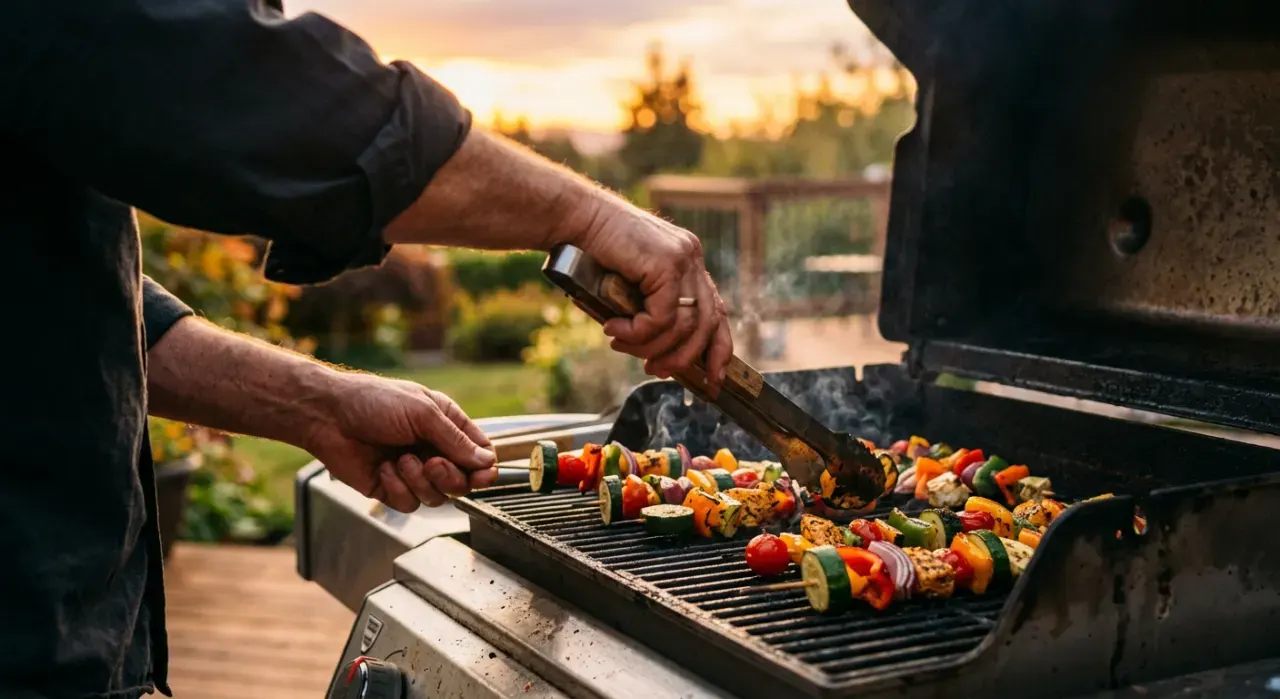
On fire: a griddle carries more liquid fat in one place than a grill does, all of it draining to a cup. Empty the grease cup after every cook and never let it fill. Keep a lid or a sheet pan nearby to smother a grease flare, and never put water on burning grease. And, as with every fuel-burning cooker: never run a propane griddle in a garage, under a carport, on a covered balcony or in any enclosed or partly enclosed space. Propane combustion produces carbon monoxide, which the CPSC describes as odorless and colorless, and leaking propane collects at floor level in enclosed spaces instead of dispersing. An open garage door does not make a garage outdoors.
How We Rank
We do not buy or test these griddles. Rankings come from aggregated owner ratings, weighted toward reviews from owners past their first season where rust, warping and grease-management problems appear, and cross-checked against published specifications. Where a format's ownership record on Amazon is genuinely thin — which is the case for full-size propane stations — we say so rather than presenting confidence we do not have. Four things carry the weight: heat zone control, the difference between a large griddle and a usable one; plate material and thickness, which drives evenness and warping; grease management, the most common design complaint and a real fire consideration; and rust behavior, which is mostly about seasoning but partly about the steel. Prices were checked at the time of writing. Full method: how we rank.
What Owners Actually Complain About
Rust, and almost always from skipped seasoning. The single largest complaint category, and largely self-inflicted. Season properly, oil after every cook, and keep it covered.
Plate warping or crowning. Large steel plates move when heated fast from cold. Preheat on medium, not high, and let the whole plate come up together.
Wind. An open griddle loses far more heat to wind than a lidded grill. A windy corner can cost 100°F of surface temperature.
Grease cups. Overflowing cups, cups that are hard to reach, cups that drip down a leg. Read the grease-path design before buying, and empty it every time.
Cheap inserts warping. Thin stamped-steel griddle plates for existing grills bow badly over a burner. Cast iron costs more, weighs more, and does not do this.
The Verdict
If you want the full flat-top experience and have the space, the 36-inch four-burner station is the pick with the deepest owner record and the zone control that makes a big plate worth having. If your patio is small or you want a hood, the 28-inch model is the same idea in less space. But the underrated answer for most households is the cast iron griddle plate on a grill you already own — a fifth of the price, no extra appliance to store, and enough surface for a family's worth of smash burgers. Whichever you buy, the seasoning routine matters more than the badge on the front. Check price on Amazon → (paid link)
More from this hub: outdoor living & grills · best gas grill · best meat thermometer · best grill brush · seasoning cast iron grates · how we rank.