 Garden

Affiliate Disclosure
Some links on this page are affiliate links. As an Amazon Associate, we earn from qualifying purchases — at no extra cost to you. We do not buy, test, or physically handle the products we cover; our rankings come from aggregated owner reviews, ratings and expert consensus. Commissions never change our verdicts. How we rank · full disclosure.
Seasoning a grill is two jobs: a 20 to 30 minute empty burn-in that removes factory residue, and an oil-and-heat cycle that puts a slick, rust-resisting layer on the grates. The whole thing takes about an hour and costs nothing but a spoonful of oil. It matters on cast iron and bare steel, where the layer is genuinely functional; on porcelain and stainless grates there is no layer to build, and a light oil wipe before cooking is all that is useful. On a gas grill, leak-test the connection with soapy water before you light anything.
What seasoning actually is
Seasoning is not a coating of oil. It is polymerized oil — thin films of fat heated past their smoke point until they cross-link into a hard, plastic-like layer bonded to the metal. That layer does two things: it fills the microscopic texture of the iron so food releases instead of sticking, and it seals the metal from moisture so it does not rust.
Two consequences follow from that, and they explain most seasoning mistakes. Thin is essential — a heavy coat cannot fully polymerize, so it stays tacky and traps grit. And repetition beats effort: three whisper-thin cycles produce a far better surface than one greasy one.
Stage 1: burning in a new grill
New grills leave the factory carrying stamping and cutting oils, packing dust, and often an anti-corrosion coating on the grates. None of it belongs on food.
- Assemble fully and check the gas. On propane, connect the tank, open the valve with all burner knobs off, and brush soapy water on the hose and regulator connections. Bubbles mean a leak — close the valve and fix it. Never check with a flame.
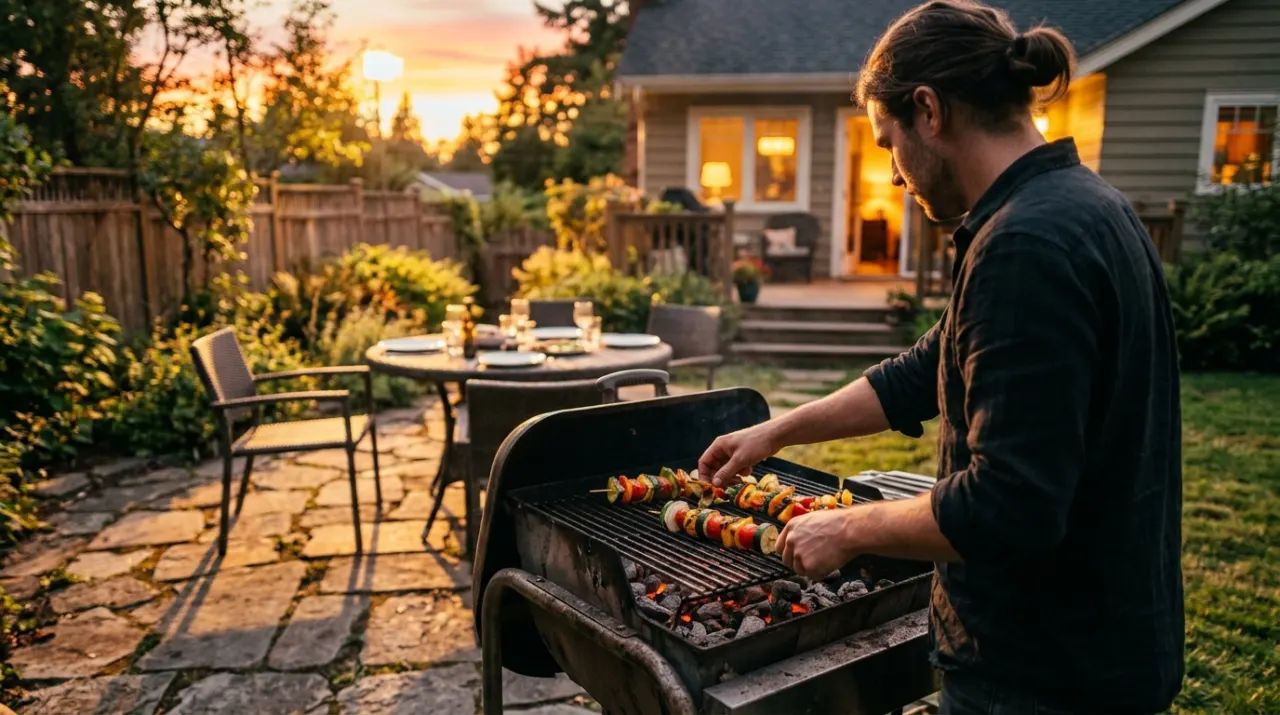
- Run it empty and hot. All burners on high, lid closed, 20 to 30 minutes. On charcoal, light a full chimney, spread it, and close the lid with the vents open for the same period. Follow your manual if it specifies a different time.
- Expect light smoke and a faint chemical smell for the first several minutes. It should fade well before the burn-in ends. Heavy smoke still pouring out at 20 minutes means something was left inside — shut down and look.
- Shut off and let it cool to a temperature you can work at safely.
Stage 2: seasoning the grates
What you do here depends entirely on what the grates are made of, and the packaging does not always say clearly. Cast iron is heavy and dull gray or black when bare. Porcelain-coated cast iron is heavy with a glossy black or gray glaze. Stainless is lighter, shiny and does not rust.
| Grate material | Builds seasoning? | What to do | What kills it |
|---|---|---|---|
| Bare cast iron | Yes — essential | Oil thin, heat past smoking, repeat 2–3 times | Soap, soaking, storing damp |
| Porcelain-coated cast iron | No | Light oil wipe on the hot grate before cooking | Chips from metal tools and wire brushes |
| Stainless steel | Barely | Oil wipe before cooking as a release agent | Abrasive pads scratching the finish |
| Bare or chrome-plated steel | Yes, weakly | Oil after every clean; expect to replace eventually | Rust once the plating wears |
| Rolled-steel griddle plate | Yes — essential | 4–6 build cycles, then oil after every cook | Water left on the plate, acidic foods early on |
For cast iron and bare steel, the cycle is simple. Wipe on a paper-thin film of high-smoke-point oil with a cloth or folded paper towel held in tongs. Wipe it back off, so the metal looks barely damp rather than wet. Heat the grates — burners on medium-high, lid closed — until the smoking stops, usually 15 to 20 minutes. That means the oil has polymerized. Let it cool, and repeat two or three times. The grates will darken with each pass, which is the visible sign it is working.
Which oil, and why smoke point matters
Polymerization happens above the oil's smoke point, so an oil that smokes at a low temperature turns gummy in the range a grill runs at rather than hardening cleanly.
| Oil | Approx. smoke point | Verdict for grill grates |
|---|---|---|
| Avocado oil, refined | ~520F | Best all-round choice |
| Grapeseed oil | ~420F | Excellent, widely used |
| Canola oil | ~400F | Fine, cheap, what most people use |
| Refined peanut oil | ~450F | Good; check for allergies before serving |
| Flaxseed oil | ~225F | Hardest layer, but flakes under direct grill flame |
| Extra virgin olive oil | ~375F | Avoid — goes sticky rather than hard |
| Butter or bacon fat | Low, with solids | Avoid — the solids burn and carbonize |
Griddles are a different job
A flat-top griddle is a large sheet of bare rolled steel with nothing protecting it, so seasoning is not an improvement — it is the only thing standing between the plate and rust. Wash the factory anti-corrosion coating off once with soapy water, dry it over the burners, then run four to six oil-and-heat cycles, using so little oil each time that you have to look closely to see it. The plate goes from silver to bronze to near-black over those cycles.
After that, maintenance is a habit rather than a project: scrape the plate while it is hot, wipe it with a paper towel, and leave a light film of oil before the cover goes on. Avoid acidic foods like tomato and citrus for the first several cooks, since they strip a young seasoning layer.
Reviving rusty grates
Rust is not the end of a cast-iron grate. Scrub it back to clean gray metal with a coil brush, grill stone or nylon abrasive pad, using steel wool on stubborn patches. Wash with hot water — soap is acceptable here because you are rebuilding the layer from scratch anyway — then dry immediately and completely over heat. Bare cast iron left wet will rust again within hours.
Then run the standard cycle three times. If the grate has pitted deeply or cracked through, replace it; heavily pitted iron never seasons evenly and will keep shedding rust into food. Replacement grates for common grills cost far less than most people assume, and are a much better investment than replacing the grill — see how long gas grills last for when repair stops making sense.

Keeping the seasoning once you have it
- Scrape hot, not cold. Burn residue off with the lid closed for 10 to 15 minutes, then scrape. Cold residue does not release, so you scrub harder and take the seasoning with it.
- Skip the soap on seasoned cast iron in routine cleaning. Heat and a brush do the job.
- Re-oil after every clean. Thirty seconds with a rag and tongs.
- Never put cast-iron grates in a dishwasher, and never use oven cleaner on them — both strip the layer to bare metal.
- Cover the grill and keep the grates dry between cooks. Moisture is the enemy, and a fitted cover is the cheapest life extension available for any grill.
- Do a full re-season two or three times a season, and always after a deep clean. Our grill cleaning guide covers the deep clean that should precede it.
Safety notes
Leak-test propane connections with soapy water and never with a flame, close the cylinder valve before disconnecting the regulator, and never store a spare cylinder indoors, in a basement or in an attached garage. Do the burn-in and every seasoning cycle outdoors in the open — never in a garage, carport or covered balcony, even with a door open. Charcoal and propane both produce carbon monoxide, which is colorless and odorless, and the CPSC records roughly 20 deaths and about 400 emergency-room-treated injuries in the United States each year from carbon monoxide produced by charcoal, noting explicitly that ventilation does not make it safe (CPSC, Carbon Monoxide Information Center). Keep the grill well clear of the house, railings and overhanging branches while it runs, as the NFPA grilling guidance advises. Seasoning produces real smoke, so do it somewhere it will disperse.
Where to go next
Seasoning is the last step of assembling a new grill and the first step of using an old one properly. If you are setting up from the box, assembling a gas grill comes first and the gas-specific burn-in guide goes deeper. If your grates are past saving, seasoning cast-iron grates covers replacements in detail.
More from this hub: outdoor living & grills · best gas grill · best charcoal grill · what temperature to grill chicken · how we rank.