 Garden
Affiliate Disclosure
Some links on this page are affiliate links. As an Amazon Associate, we earn from qualifying purchases — at no extra cost to you. We do not buy, test, or physically handle the products we cover; our rankings come from aggregated owner reviews, ratings and expert consensus. Commissions never change our verdicts. How we rank · full disclosure.
Grill boneless chicken over direct heat at 400 to 450F, and bone-in chicken indirect at 350 to 375F — but the number that decides whether it is done is 165F internal, measured with a thermometer in the thickest part away from bone. That is the USDA safe minimum for all poultry, with no rest time required. Boneless breasts take roughly 10 to 14 minutes; bone-in thighs take 30 to 40. Chicken is the cut where grill temperature and internal temperature are most often confused, and where the confusion produces the most dry breasts and the most undercooked thighs.
Two temperatures, two jobs
Grill temperature controls the outside: browning, skin rendering, char. Internal temperature controls safety and texture. They are not related in any simple way, which is why "cook chicken at 165F" — a sentence people genuinely say — is meaningless. A grill at 165F would take hours and never brown anything.
The USDA's Safe Minimum Internal Temperature Chart sets poultry at 165F, ground meats at 160F, and whole cuts of beef, pork, veal and lamb at 145F with a three-minute rest. Poultry is the one that carries no rest requirement — it is safe the moment it reaches 165F throughout. Ground chicken follows the poultry number, 165F, not the 160F that applies to ground beef and pork.
Grill temperature and time by cut
| Cut | Grill temp | Method | Approx. time | Internal target |
|---|---|---|---|---|
| Boneless skinless breast | 400–450F | Direct, turned once | 10–14 min | 165F |
| Boneless skinless thigh | 400–450F | Direct | 8–12 min | 165F (better at 175F) |
| Bone-in split breast | 350–375F | Indirect, sear to finish | 35–45 min | 165F |
| Bone-in thigh / drumstick | 350–375F | Indirect, sear to finish | 30–40 min | 165F (better at 175–185F) |
| Wings | 400–425F | Indirect then direct | 20–30 min | 165F |
| Spatchcocked whole chicken | 375–400F | Indirect, skin up | 45–60 min | 165F in the thigh |
| Whole chicken, upright | 350–375F | Indirect | 60–90 min | 165F in the thigh |
| Chicken burgers (ground) | 375–400F | Direct | 10–12 min | 165F |
| Kebabs / tenders | 400F | Direct, turned often | 8–10 min | 165F |
One note on thighs that surprises people: dark meat is better above the safe minimum. Thigh meat is full of connective tissue that keeps rendering up to about 175 to 185F, so a thigh at 180F is more tender and juicier than one pulled at 165F. Breast meat is the opposite — every degree past 165F costs moisture, which is why the same 15 minutes produces a perfect thigh and a dry breast.
Why two zones solve almost every chicken problem
The classic failure is chicken that is black outside and pink at the bone. It happens because bone-in pieces need 30 to 45 minutes to reach 165F in the center, and nothing survives 45 minutes over direct flame.
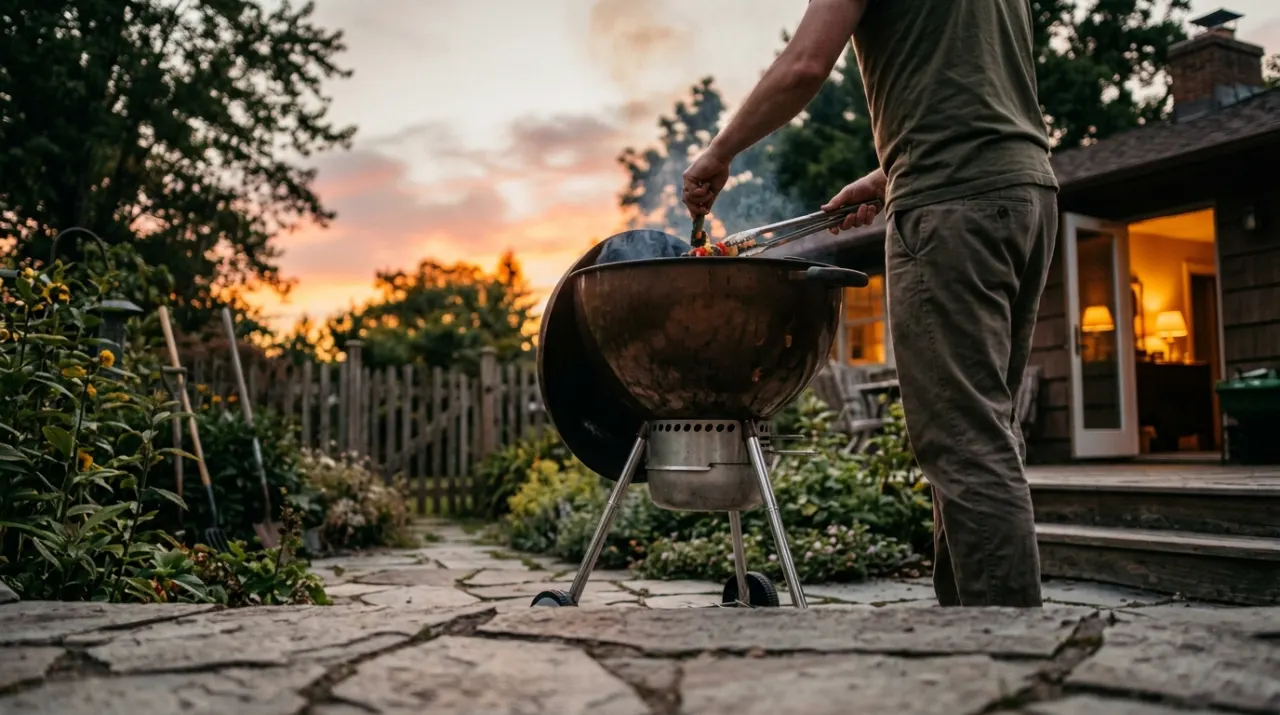
Set the grill up with a hot side and a cool side. On a gas grill, light half the burners and leave the rest off. On a charcoal grill, bank all the coals to one side. Then cook bone-in pieces on the cool side with the lid down, which turns the grill into a convection oven at 350 to 375F, and move them over the flame for the last few minutes to crisp the skin. Skin-side up on the indirect side, so rendering fat is not dripping into the fire.
This is also the answer to flare-ups. Fat dripping onto a burner produces a column of flame that chars skin in seconds; on the indirect side there is nothing beneath the food to catch. If you are getting flare-ups on the hot side, that is usually a grease build-up issue as much as a technique issue — see how to clean a grill.
The thermometer is not optional
The USDA's grilling food safety guidance is unambiguous that color and juices are not reliable indicators of doneness. Chicken can look fully cooked and be 150F inside, and it can retain a pink tinge near the bone at 175F because of pigment released from the marrow, which is harmless and has nothing to do with doneness.
Two types are worth owning. An instant-read probe for spot checks — this is the one that changes results, because it takes three seconds and you will actually use it on every piece. A leave-in probe for long indirect cooks, where the value is not having to open the lid at all. Opening the lid on a whole bird costs several minutes of cooking time each go.

Best for checking every piece in a few seconds without opening the lid for long
- Reads in about 2 to 3 seconds
- Foldable probe with a magnetic back
- Backlit display for evening cooks
- Calibration function
Why buy it: the highest-rated instant-read thermometer in the category, and instant-read is the type that actually changes how chicken turns out.

Best for whole birds and bone-in pieces cooked indirect
- Fully wireless probe — no cable through the lid
- Reads internal and ambient temperature at once
- App alerts and estimated finish time
- 165 ft Bluetooth range
Why buy it: a leave-in probe means the lid stays shut on a 90-minute indirect cook, which is exactly where opening the grill costs you the most.
Check the thickest part, angle in from the side, and stay off the bone — bone conducts heat and reads high. Check at least two pieces, since packaged chicken varies enough in thickness that one being done tells you very little about the next. Our grill thermometer rankings cover the wider field.
Safe handling before it hits the grill
Most chicken-related illness starts before cooking, not during it.
- Do not rinse raw chicken. Rinsing spreads bacteria in aerosolized droplets around the sink and countertop. Cooking to 165F is what makes it safe; washing does nothing useful.
- Never reuse the plate. The platter that carried raw chicken to the grill cannot carry it back. This is the single most common cross-contamination route in backyard cooking.
- Marinade is not a sauce. Marinade that touched raw chicken must be boiled for several minutes before it goes anywhere near cooked food, or thrown away. Reserve a clean portion before marinating if you want a finishing sauce.
- Marinate in the refrigerator, never on the counter, and no more than two days.
- Do not partially cook ahead. Part-cooking chicken and finishing it later holds it in the temperature danger zone. If you precook in the oven or microwave, take it straight to the grill.
- Get leftovers refrigerated within two hours, or within one hour if it is above 90F outside.
Five things that cause dry, unevenly cooked chicken
Grilling straight from the refrigerator. Twenty to thirty minutes at room temperature before cooking evens out the start, so the outside is not overcooked by the time the middle catches up.
Uneven thickness. A breast that is 1.5 inches at one end and 0.5 at the other cannot cook evenly. Pound it to a consistent thickness or butterfly it, and it becomes a 10-minute cook that finishes together.
Cooking breasts to a thigh temperature. If they are on the grill together, pull the breasts as they hit 165F and leave the thighs longer.
Sugary sauce applied too early. Barbecue sauce contains sugar, which burns well below the temperature it takes to finish chicken. Brush it on during the last 5 to 10 minutes only.
Flipping constantly. Boneless pieces need one turn. Every lift interrupts browning and every lid opening drops the grill temperature.
Grill safety while you are at it
Never grill in a garage, on a covered balcony, in a breezeway or in any enclosed or partly enclosed space. Charcoal and propane both produce carbon monoxide, which is odorless, and the CPSC records roughly 20 deaths and about 400 emergency-room-treated injuries in the United States each year from carbon monoxide produced by charcoal, stating plainly that ventilation does not make it safe (CPSC, Carbon Monoxide Information Center). On propane, check connections with soapy water rather than a flame, close the tank valve before disconnecting, and never store a spare cylinder indoors or in an attached garage.
Where to go next
If your grill will not hold 400F, start with why a gas grill will not get hot. For charcoal, controlling temperature on a charcoal grill is the companion piece, and our thermometer picks cover the tool this whole page depends on.
More from this hub: outdoor living & grills · best gas grill · best smoker · how we rank.