 Garden
Affiliate Disclosure
Some links on this page are affiliate links. As an Amazon Associate, we earn from qualifying purchases — at no extra cost to you. We do not buy, test, or physically handle the products we cover; our rankings come from aggregated owner reviews, ratings and expert consensus. Commissions never change our verdicts. How we rank · full disclosure.
The short version: this page is about selective herbicides — the ones that kill the weed and leave the grass standing. That distinction, set out in Penn State Extension’s herbicide primer, is the whole point. Reach for a general-purpose weed killer on a lawn and you will get a brown patch shaped exactly like your spray pattern. After weighing six of the most-used lawn-safe products in the US on aggregated ratings, active ingredient and owner reports, our #1 pick is Ortho Weed B Gon Plus Crabgrass Control, because it is the rare homeowner concentrate that handles broadleaf weeds and crabgrass in one bottle.
If you want no mixing at all, the Spectracide ready-to-use gallon does the same job with a wand. If your lawn is St. Augustine or centipede, skip both and go straight to the southern-turf formulation — this is the mistake that costs southern homeowners a lawn every summer. For driveways, gravel, fence lines and clearing beds you want a non-selective product instead, and those are covered in our flagship best weed killers roundup.
Top Picks at a Glance
Our #1 Pick: Ortho Weed B Gon Plus Crabgrass Control
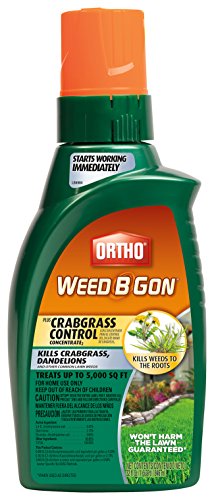
Most homeowner lawn herbicides do one of two jobs. Broadleaf products based on 2,4-D and its partners kill dandelion, clover, plantain and chickweed but ignore grassy weeds entirely. Crabgrass killers do the reverse. Weed B Gon Plus Crabgrass Control is the mainstream concentrate that covers both, which for most lawns means one bottle, one mixing session and one pass rather than two of everything.
Owners consistently describe the same pattern: visible curling on broadleaf weeds within a day or two, full die-back over a couple of weeks, and grass that stays green throughout. Crabgrass takes longer and mature plants often need a second application, which the label anticipates.
The limitations are real and worth stating. It is a concentrate, so you need a sprayer and you need to mix at the labeled rate — stronger is not better and will stress the turf. It is not labeled for every grass type, and southern lawns need the atrazine formulation instead. And it does not distinguish between a weed and a garden plant, so drift onto beds will do damage.
Check price on Amazon → (paid link)
The Ranked Field
Best for broadleaf weeds and crabgrass in one selective spray
- Selective — kills listed weeds, not the turf
- Handles broadleaf weeds and grassy crabgrass together
- Mixes into a pump or backpack sprayer
- Labeled for most northern and many southern grasses
Why buy it: the only mainstream homeowner concentrate that covers both broadleaf weeds and crabgrass without a second product.

Best for spot treating without mixing anything
- Ready to use — no dilution, no sprayer needed
- Selective for listed lawn weeds
- Comfort wand for targeted application
- Visible results on most broadleaf weeds within days
Why buy it: the lowest-effort way to kill a dandelion without killing the grass around it — open, point, spray.
Best for large lawns with a broadleaf weed problem and nothing else
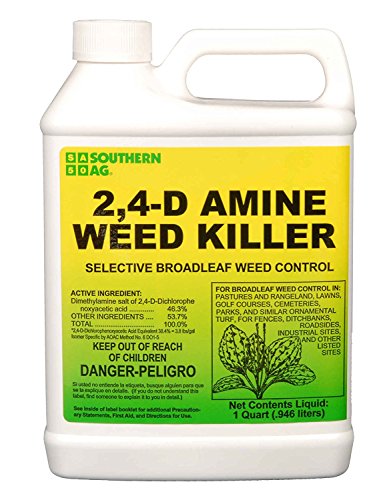
- Low-volatile amine formulation of 2,4-D
- Very low use rate — a quart treats a lot of lawn
- Controls dandelion, clover, plantain and many others
- Cheapest cost per treated area on this page
Why buy it: the classic broadleaf active at professional economics — pennies per thousand square feet, if you can measure and mix.
Best for weeds nothing else touches, and lawns being reseeded
- Mesotrione — works pre-emergent and post-emergent
- The rare selective safe to apply at seeding time
- Treated weeds turn white before dying
- Very low use rate per gallon of spray
Why buy it: the only common selective that lets you seed and treat in the same pass, and the one that finally kills nimblewill and creeping charlie.
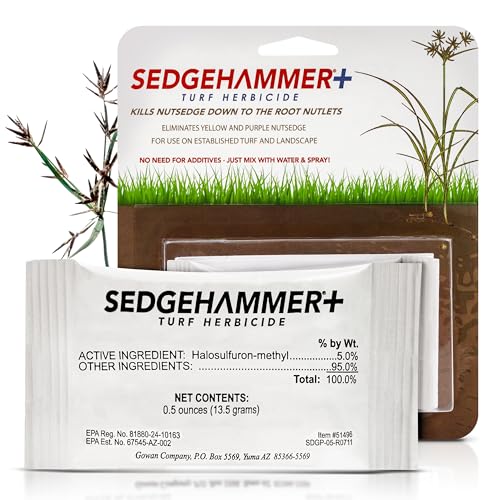
Best for the shiny yellow-green triangular weed nothing else kills
- Halosulfuron, specific to purple and yellow nutsedge
- Surfactant already mixed into the packet
- Pre-measured single-use packets
- Labeled for use on established residential lawns
Why buy it: nutsedge is a sedge rather than a grass or a broadleaf, so ordinary lawn weed killers ignore it — this is the product that works.
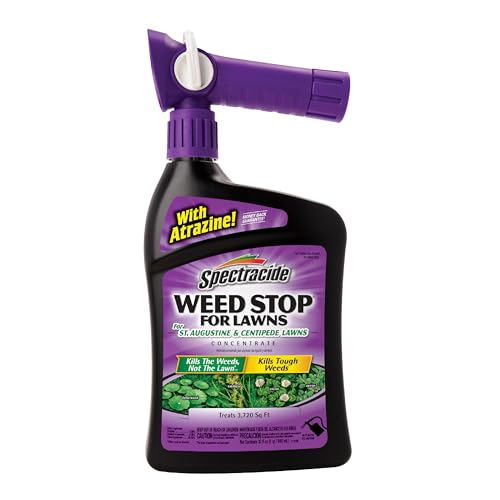
Best for St. Augustine and centipede turf that 2,4-D products damage
- Atrazine-based, formulated for southern turf
- Hose-end sprayer, no mixing
- Controls dollarweed, betony and other southern weeds
- Apply below 90°F to avoid turf stress
Why buy it: standard lawn weed killers will thin St. Augustine badly — this is the formulation written for that grass rather than against it.
Quick Comparison
| Product | Best for | Rating | Price | Buy |
|---|---|---|---|---|
| Ortho Weed B Gon Plus Crabgrass Control Concentrate, 32 oz | Best Overall | — | Check (paid link) | |
| Spectracide Weed Stop For Lawns Plus Crabgrass Killer, 1 Gallon | Best Ready-to-Use | — | Check (paid link) | |
| Southern Ag Amine 2,4-D Weed Killer, 32 oz | Best Value Concentrate | — | Check (paid link) | |
| Syngenta Tenacity Herbicide, 8 oz | Best for Tough Weeds | — | Check (paid link) | |
| SedgeHammer Plus Turf Herbicide, 4-Pack of 13.5 g Packets | Best for Nutsedge | — | Check (paid link) | |
| Spectracide Weed Stop For Lawns for St. Augustine & Centipede, 32 oz | Best for Southern Lawns | — | Check (paid link) |
Specifications Side by Side
| Product | Type | Targets | Form | Grass caution |
|---|---|---|---|---|
| Ortho Weed B Gon Plus | Selective | Broadleaf and crabgrass | Concentrate | Check label for southern grasses |
| Spectracide Weed Stop RTU | Selective | Broadleaf and crabgrass | Ready to use | Check label for southern grasses |
| Southern Ag 2,4-D Amine | Selective | Broadleaf only | Concentrate | Not for St. Augustine or centipede |
| Syngenta Tenacity | Selective | Broadleaf and many grassy weeds | Concentrate | Not labeled for all warm-season turf |
| SedgeHammer Plus | Selective | Nutsedge and kyllinga | Pre-measured packets | Broadly turf tolerant |
| Spectracide for St. Augustine | Selective | Southern broadleaf weeds | Hose-end sprayer | For St. Augustine and centipede only |
How We Rank
We do not buy or spray these products, and we would rather say that plainly than invent a test plot. The ranking is built from aggregated owner ratings across the six products here, weighted toward reviews written weeks after application rather than on delivery, because a herbicide can only be judged once the weeds have had time to die or regrow. Four factors carry the weight. Selectivity and label breadth — which weeds it controls and which grasses it can safely go on, taken from the published label. Reported effectiveness on the weeds owners actually have, separated by weed type where the reviews allow. Rating strength against review volume. And ease of correct application, because over-concentration and heat-of-day spraying cause more turf damage than any product defect. Prices were checked at the time of writing. Full method: how we rank.
The Lawn Weed Killers, Reviewed
1. Ortho Weed B Gon Plus Crabgrass Control — Best Overall
Covered above. Owners praise: killing both broadleaf and grassy weeds from one bottle, fast visible action, and grass that comes through unharmed. Owners gripe about: needing a sprayer and correct mixing, mature crabgrass surviving a single pass, and turf yellowing when applied in hot weather. Check price (paid link).
2. Spectracide Weed Stop For Lawns Plus Crabgrass Killer — Best Ready-to-Use
Ready-to-use products trade cost efficiency for convenience, and for a small lawn or occasional spot treatment that is the right trade. The comfort wand means no bending, no mixing and no sprayer to clean, and a gallon covers a lot of individual dandelions. It is the product to keep in the garage for the weed you notice on a Saturday morning.
Owners praise: zero preparation, the wand applicator, quick results on young broadleaf weeds, and a low price. Owners gripe about: weak performance on mature crabgrass, needing repeat applications, wand nozzles clogging, and covering far less ground than a concentrate for the money. Check price (paid link).
3. Southern Ag Amine 2,4-D — Best Value Concentrate
This is the plain, unglamorous broadleaf herbicide that has been controlling dandelion and clover in American lawns for generations, sold without a consumer markup. The use rate is very low, so a quart bottle treats a large lawn several times over, and the low-volatile amine formulation reduces the vapor drift risk that the old ester formulations were notorious for.
It does one job. It will not touch crabgrass or any other grassy weed, and it is not for St. Augustine or centipede turf. Owners who understand that describe it as the best value in lawn care; owners who expected it to kill everything are the negative reviews.
Owners praise: outstanding value, effective on a wide list of broadleaf weeds, and a low use rate that makes a bottle last years. Owners gripe about: no effect on grassy weeds, a strong smell, requiring accurate measurement of small volumes, and turf damage when used on the wrong grass. Check price (paid link).
4. Syngenta Tenacity — Best for Tough Weeds
Tenacity is the product people reach for when nothing else has worked. Mesotrione blocks pigment production, so treated weeds turn a startling bleached white before dying — an unnerving but genuinely useful indicator that the spray landed where you aimed. It handles weeds that defeat conventional selectives, including nimblewill, creeping charlie and bentgrass, and it works both before and after germination.
Its other unusual property matters for renovations: it is safe to apply at seeding time on labeled grasses, so you can kill weeds and establish new turf in the same pass. Nothing else here allows that.
Owners praise: killing weeds nothing else touches, safe seeding, the visible whitening as confirmation, and a very low use rate. Owners gripe about: the price, needing a surfactant added, temporary white patches in the lawn, and being unforgiving of over-application. Check price (paid link).
5. SedgeHammer Plus — Best for Nutsedge
Nutsedge is the shiny, yellow-green, stiffly upright weed that grows faster than the lawn and reappears three days after mowing. It is a sedge — neither a grass nor a broadleaf — which is exactly why ordinary lawn weed killers do nothing to it. Halosulfuron does, and SedgeHammer Plus comes in pre-measured packets with the surfactant already included so there is nothing to calculate.
Patience is required. Treated nutsedge yellows over about a week and dies over two to three, and the tubers underground mean a second application later in the season is common. Owners who expected same-week results write the impatient reviews.
Owners praise: actually killing nutsedge when nothing else did, pre-measured convenience, and turf that is unaffected. Owners gripe about: slow visible results, needing repeat treatment for established patches, the cost per packet, and no effect on ordinary lawn weeds. Check price (paid link).
6. Spectracide Weed Stop for St. Augustine & Centipede — Best for Southern Lawns
This is the most important product on the page for anyone in the Gulf South. St. Augustine and centipede grass are sensitive to the herbicide combinations that northern lawns tolerate easily, and a standard bottle of lawn weed killer will thin or brown them badly. This atrazine-based formulation is written for those grasses and targets the weeds that actually turn up in them — dollarweed, Florida betony, sandspur.
Temperature is the critical instruction. The label calls for application below 90°F, and in the southern summer that means early morning in spring or fall rather than a July afternoon. Owners who ignored it are most of the turf damage reports.
Owners praise: working on southern weeds that other products miss, safety on St. Augustine when used as directed, and a hose-end sprayer that needs no mixing. Owners gripe about: turf yellowing when applied in heat, a narrow application window, and hose-end sprayers being hard to apply evenly. Check price (paid link).
What Owners Actually Complain About
Killing their own lawn is the complaint that hurts most, and it has two causes. The first is using a non-selective product — glyphosate and vegetation killers — on turf, which is what the selective vs non-selective guide exists to prevent. The second is using a selective product on a grass it is not labeled for, which is overwhelmingly a St. Augustine and centipede problem.
Heat damage is next. Turf under heat stress absorbs more herbicide and recovers more slowly, which is why almost every label caps application around 85 to 90°F. Spray in the morning, on a day forecast to stay mild, and on a lawn that is not already drought-stressed.
Rain washing it off wastes an entire application. Every label states a rainfast period — usually a few hours — and spraying ahead of a storm is throwing money on the grass. Conversely, weeds absorb best when actively growing, so a lawn watered the day before treatment responds better than a parched one.
Regrowth is usually not a product failure. Mature perennial weeds with deep taproots and grassy weeds past the tillering stage frequently survive one application, and the label anticipates a follow-up. Killing weeds in spring while they are small is far more effective than fighting them in August, and University of Minnesota Extension rates fall the best window of all for perennial broadleaf weeds — and preventing them entirely with a pre-emergent herbicide is easier than either.
How to Choose a Lawn Weed Killer
Identify the weed first. Broadleaf weeds — dandelion, clover, plantain, chickweed — need a 2,4-D style product. Grassy weeds like crabgrass need a crabgrass-specific active. Nutsedge needs halosulfuron and will laugh at everything else. Buying before identifying is how people end up with three bottles and a lawn full of sedge. Common lawn weeds identified is the two-minute version.
Then check your grass type against the label. This is not optional — the EPA makes using a product inconsistently with its labeling a violation of federal law — and it is the difference between a clean lawn and a dead one. Cool-season grasses — fescue, bluegrass, ryegrass — tolerate most products here. St. Augustine and centipede do not.
Then pick a format that matches the scale. Ready-to-use for a handful of weeds. Concentrate and a pump sprayer for a whole lawn. Hose-end sprayers are convenient but hard to apply evenly, which is why they show up in complaints about patchy results.
Finally, fix the cause. A thick, correctly mown, properly fed lawn crowds weeds out on its own — Penn State Extension puts that cultural control first — and herbicide is a treatment rather than a cure. If you are treating the same weeds every year, the underlying problem is usually mowing too short, watering too shallowly or a thin stand of grass. Households avoiding chemistry altogether should read how to kill weeds without chemicals, and anyone with dogs should check are weed killers safe for pets for what re-entry intervals actually mean.
The Verdict
Ortho Weed B Gon Plus Crabgrass Control is the lawn weed killer we would recommend to most homeowners: selective, effective on both broadleaf and grassy weeds, and widely enough used that the owner consensus is deep. For occasional spot treatment, the Spectracide ready-to-use gallon is easier. For a large lawn with a broadleaf problem, Southern Ag 2,4-D is unbeatable value. Nutsedge needs SedgeHammer Plus and nothing else will do. And if your lawn is St. Augustine or centipede, buy the southern-turf formulation and nothing on this page above it. Check price on Amazon → (paid link)
More from this hub: pest & weed control · best weed killers · best pre-emergent herbicides · selective vs non-selective herbicides · how we rank.