 Garden
Affiliate Disclosure
Some links on this page are affiliate links. As an Amazon Associate, we earn from qualifying purchases — at no extra cost to you. We do not buy, test, or physically handle the products we cover; our rankings come from aggregated owner reviews, ratings and expert consensus. Commissions never change our verdicts. How we rank · full disclosure.
The most effective way to get rid of Japanese beetles is to hand-pick them into soapy water in the cool of early morning, when they are sluggish and drop from the plant rather than fly. Do this daily during the six-to-eight-week adult season, protect high-value plants with netting or neem oil, skip the pheromone traps (they attract more beetles than they catch), and treat the lawn grubs in late summer to reduce next year's emergence. There is no single spray that ends the problem, but this combination reliably cuts damage to a tolerable level.
Japanese beetles (Popillia japonica) are the metallic green-and-copper beetles that skeletonize leaves and roses across the eastern and midwestern United States each summer. Below is what genuinely works, what wastes money, and the timing that matters. Our guidance draws on university extension research and aggregated gardener experience rather than first-hand trials, as described in how we rank.
Hand-Picking Japanese Beetles: The Method That Actually Works
Unglamorous but effective, hand-picking is the control that extension entomologists recommend first for home gardens, and for good reason: it removes beetles instantly, harms no pollinators, and costs nothing.
- Go out at dawn or dusk, when beetles are cold and slow. In the heat of midday they fly off the moment you approach.
- Hold a container of soapy water under a cluster — a wide jar or small bucket with a squirt of dish soap works. The soap breaks surface tension so beetles sink and drown instead of crawling out.
- Tap or shake the branch. Startled beetles reflexively drop straight down; catch them as they fall.
- Repeat daily through peak season. Beetles release aggregation pheromones and feeding attractants, so removing them promptly makes your plants less of a beacon to newcomers.
On a bad infestation this can mean hundreds of beetles a day for a week or two, then a steady decline. It sounds tedious, but fifteen minutes each morning protects a rose bed or a young fruit tree far better than any trap.
Why Japanese Beetle Traps Make It Worse
The bag-style traps sold everywhere use a floral scent plus a sex pheromone that is extraordinarily attractive. That is exactly the problem. Research from the University of Kentucky and others found that traps draw many more beetles toward your yard than they actually capture, so plants in the vicinity suffer heavier feeding than they would with no trap at all.
If a neighbor runs a trap, the beetles it pulls in will happily detour onto your garden. If you insist on using one, place it at the far edge of your property, downwind and well away from anything you value, and empty it often. Better still, encourage the neighbor with the trap to move it away from the shared boundary.
Protecting high-value plants
Some plants are beetle magnets — roses, grapes, raspberries, lindens, Japanese maples, and birches top the list. For a few prized specimens, physical and botanical protection beats broad spraying.
| Method | Best for | Notes |
|---|---|---|
| Fine insect netting or floating row cover | Vegetables, small fruit, young trees | The only near-total protection; remove flowering crops' covers when pollination is needed |
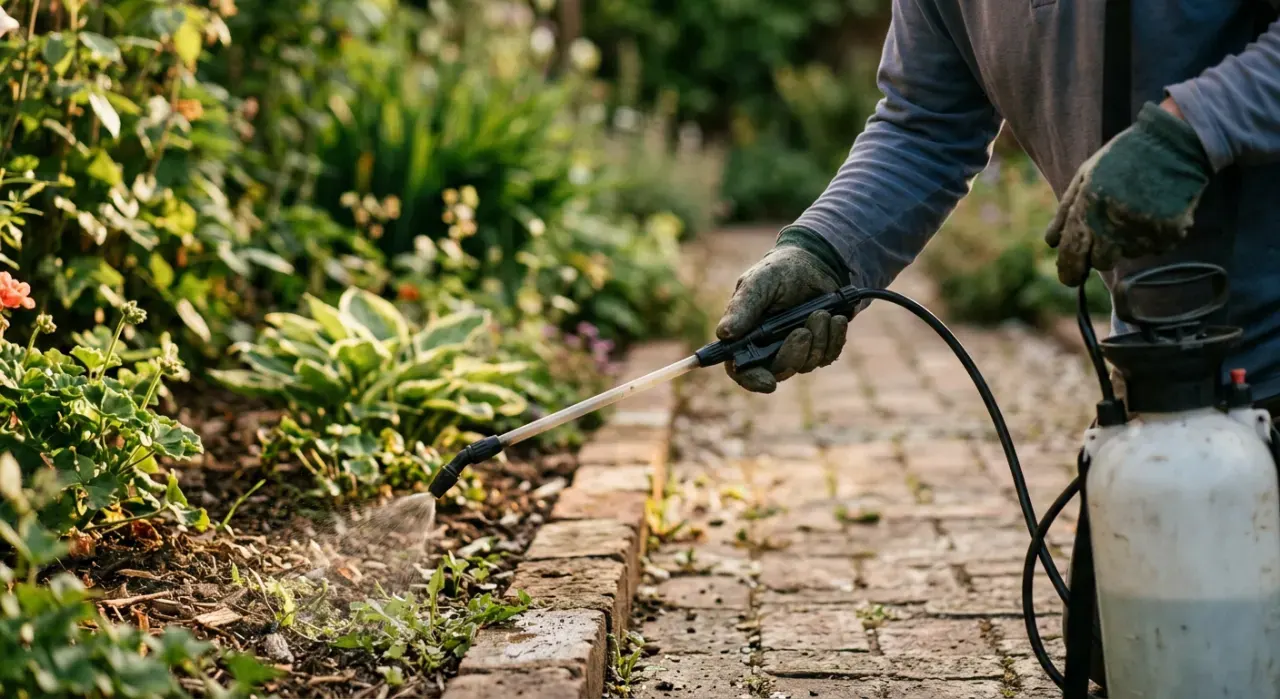
| Neem oil spray | Roses, ornamentals | Disrupts feeding and egg-laying over repeated use; reapply after rain, spray at dusk to spare bees |
| Hand-picking plus soapy water | Everything | Most reliable; do it daily |
| Choosing resistant plants | New plantings | Beetles largely ignore boxwood, holly, lilac, magnolia, and most conifers |
Avoid spraying open blooms with any insecticide during the day — Japanese beetle season overlaps peak pollinator activity, and carbaryl in particular is highly toxic to bees. If you must use a contact insecticide, apply at dusk after bees have left the flowers.
Understand the Japanese Beetle Life Cycle to Break It
Killing adults only treats the symptom. The beetle spends most of the year underground as a grub, and that is where next year's outbreak is decided.
- Early to midsummer: adults emerge, feed on foliage and flowers, and mate for six to eight weeks.
- Mid to late summer: females lay eggs in moist turf and soil, a few at a time, returning to feed between visits.
- Late summer to fall: eggs hatch into small white C-shaped grubs that feed on grass roots — this is when lawn damage and animal digging appear.
- Winter: grubs burrow deep below the frost line and go dormant.
- Spring: they rise, feed briefly, pupate, and the cycle restarts.
The two windows worth targeting are the adult feeding season (hand-picking) and the young-grub stage in late summer (lawn treatment). The details of grub timing are in how to get rid of grubs.
Treating the grubs in late summer
Because females lay eggs in the same lawns each year, reducing the grub population lowers how many adults emerge locally the following June. Timing is everything: treat when grubs are small and feeding near the surface, which in most of the country means late July through August.
- Confirm you have grubs. Cut and peel back a square foot of turf; more than about 10 grubs per square foot warrants treatment. Skunk and raccoon digging or spongy, easily lifted turf are also signs.
- Choose the right product for the timing. Preventive products applied in early summer stop the new generation; curative products target grubs already present in late summer. Applying the wrong type at the wrong time is the most common failure.
- Water it in. Grub controls must be irrigated into the root zone to reach the grubs; a dry application does little.
- Consider beneficial nematodes (Heterorhabditis bacteriophora) as a biological option, applied to moist soil in late summer and kept watered.
For the timing decision specifically, see when to apply grub control.
Natural and low-toxicity options
If you want to avoid synthetic insecticides entirely, several approaches help, though none match hand-picking for immediate results.
- Neem oil is the most useful botanical: it deters feeding, interferes with the beetles' hormones, and reduces egg-laying with repeated use.
- Beneficial nematodes and milky spore target grubs biologically. Nematodes act within a season; milky spore is a slow, multi-year soil measure that works only on Japanese beetle grubs.
- Companion and repellent plants such as catnip, garlic, chives, and tansy modestly discourage beetles nearby.
- Encourage predators. Birds, particularly starlings and grackles, and predatory insects eat grubs and adults; a bird-friendly yard helps over time.
For a broader look at chemical-free tactics across pests, see controlling garden problems without chemicals.
Common mistakes
A handful of errors turn a manageable beetle year into a ruined garden.
- Hanging a trap near your roses. It concentrates beetles exactly where you least want them.
- Spraying flowers midday. This kills the pollinators you need and often the natural predators of the beetles too.
- Expecting one treatment to end it. Adults fly in from surrounding areas all season; control is ongoing, not a one-shot fix.
- Mistiming grub control. A curative product in spring or a preventive one in fall largely wastes the application.
- Ignoring the lawn. Skipping grub management simply guarantees a fresh crop of adults next summer.
For the closely related soft-bodied pests that plague the same plants, see how to get rid of aphids, and if you would rather reach for a ready-made product, the ranked field is in best yard insect killer. Everything else is at the pest and weed control hub.