 Garden


Affiliate Disclosure
Some links on this page are affiliate links. As an Amazon Associate, we earn from qualifying purchases — at no extra cost to you. We do not buy, test, or physically handle the products we cover; our rankings come from aggregated owner reviews, ratings and expert consensus. Commissions never change our verdicts. How we rank · full disclosure.
Carbon dioxide is the primary signal. A mosquito detects the plume of CO2 in your breath from tens of feet away and flies upwind along it. Closer in, it switches to body heat, water vapor and skin odor — mainly lactic acid, ammonia and the carboxylic acids produced by bacteria living on your skin — and finally to visual cues, favoring red, orange and black over white and green. For a yard rather than a person, the attractant is different and simpler: standing water to breed in, and cool damp shade to rest in.
Which cues matter most, in order?
Mosquito host-seeking runs as a sequence, each cue taking over as the range closes. That layering is why no single trick makes you invisible: defeating one cue still leaves the next in play. The ranking below reflects the order a mosquito actually uses them.
| Cue | Effective range | Strength | Can you change it? |
|---|---|---|---|
| Exhaled carbon dioxide | Tens of feet | Primary trigger | No — but a fan disperses the plume |
| Skin odor (lactic acid, ammonia, carboxylic acids) | Several feet | Decides who gets bitten | Barely; largely genetic |
| Body heat and water vapor | Roughly 3 feet | Strong at close range | No |
| Visual contrast and color | Several feet, after CO2 | Moderate | Yes — light, loose clothing |
| Sweat and recent exercise | Close range | Moderate boost | Yes — rinse off |
| Alcohol consumption | Close range | Small but measured | Yes |
| Blood type | On contact | Minor | No |

Why does one person in a group get eaten alive?
Because skin odor varies enormously between individuals and barely at all within one. The volatile compounds that make you attractive are produced largely by the bacterial communities on your skin, and that community is stable and substantially genetic — which is why the person who got bitten most at last year's barbecue will get bitten most at this one.
Output raises the signal too. Anyone breathing harder is broadcasting more CO2: larger adults, people who have just been exercising, and pregnant women. A study of Anopheles gambiae in The Gambia, published in 2000 in the Transactions of the Royal Society of Tropical Medicine and Hygiene, found that pregnant women attracted roughly twice as many mosquitoes as non-pregnant women, and exhaled about 21% more breath volume. Beer has a measured effect as well: a 2010 study in PLoS ONE found volunteers became more attractive to mosquitoes after drinking it.
None of this is fixable. That is precisely why the practical answer is a repellent rather than a lifestyle change — an EPA-registered active masks or disrupts the cues rather than trying to eliminate them. Our best mosquito repellent guide covers the actives the CDC actually lists, and DEET vs picaridin compares the two mainstream options.
Does what you wear really matter?
More than most people expect, and the mechanism was pinned down recently. Research from the University of Washington published in Nature Communications in 2022 showed that mosquitoes ignore visual cues entirely until they detect carbon dioxide — the CO2 plume switches the visual system on. Once triggered, they fly toward long-wavelength colors: red, orange, black and cyan. Green, purple, blue and white drew little response. Human skin, across every tone, reflects a red-orange signal in those wavelengths.
The takeaway is modest but free: light, loose, light-colored clothing that covers skin is a genuine small advantage, and it stacks with everything else. Treating that clothing with 0.5% permethrin turns it into an active layer instead of a passive one, which is the CDC-recommended approach in tick country — see best tick repellent.

What attracts them to the yard in the first place?
Two things, and neither is you. First, standing water, because every mosquito develops there and the required quantity is almost nothing — the CDC advises emptying, scrubbing, covering or throwing out water-holding items weekly, and specifically notes how little water is needed. Egg to biting adult takes about eight to ten days in warm weather, which is why a single clogged gutter can undo a whole season of spraying.
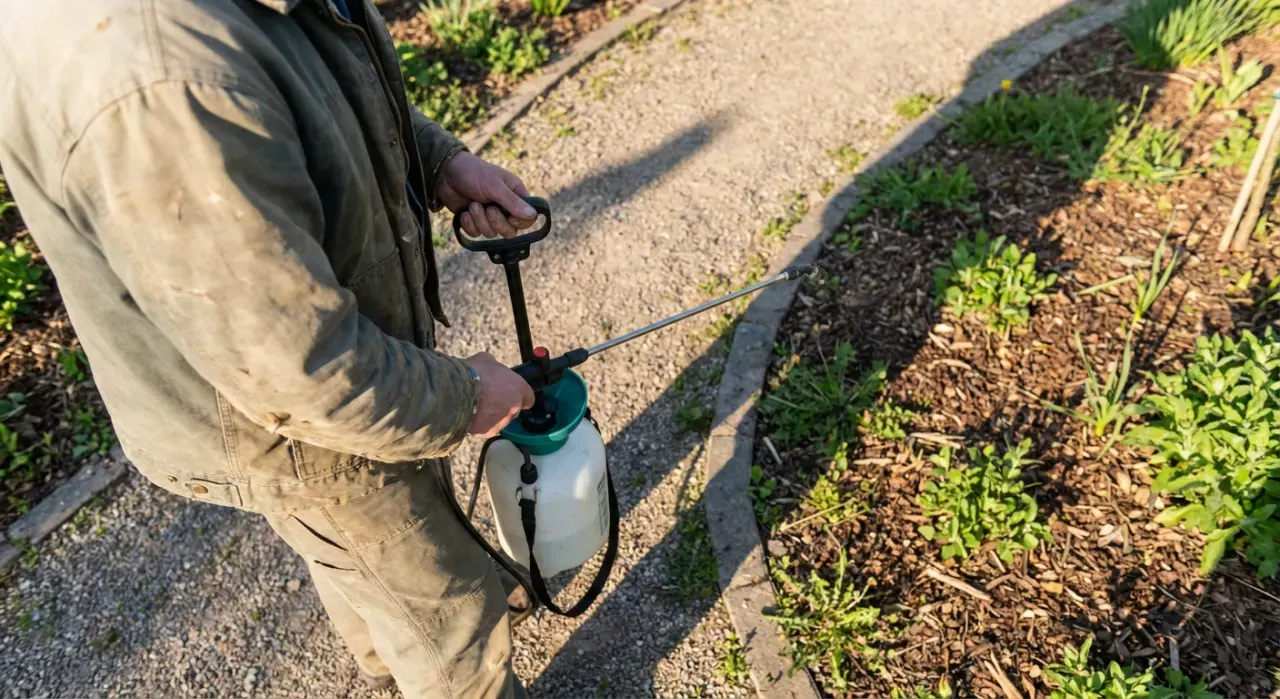
Second, cool damp shade. Adults do not sit in open sun; they rest in dense shrubs, tall grass, ground cover, under decks and along shaded fence lines, and emerge at dawn and dusk. That is also exactly where a barrier treatment belongs, and why blanketing a sunny lawn accomplishes nothing but pollinator harm.
The full sequence is in how to get rid of mosquitoes in the yard, and the product layers in best mosquito repellent for a yard.
What does not attract or repel them?
Bananas do not attract mosquitoes. Vitamin B1, brewer's yeast and garlic supplements do not repel them — controlled studies of B1 have found no protective effect. Ultrasonic devices do not repel them. Potted citronella plants release almost no repellent oil into the air. Bug zappers do not meaningfully reduce mosquitoes either; the classic residential study by Frick and Tallamy at the University of Delaware found biting insects made up a fraction of one percent of the roughly 14,000 insects six homeowner zappers killed over a summer, with the rest largely harmless or beneficial. We go through that in do bug zappers work on mosquitoes.
One genuinely useful counter-measure costs nothing: a fan. Mosquitoes are weak fliers, and moving air both prevents landing and scatters the CO2 plume that guides them to you — attacking the primary cue directly.
More from this hub: pest & weed control · best patio mosquito repellent · best mosquito trap · how we rank.