 Garden


Affiliate Disclosure
Some links on this page are affiliate links. As an Amazon Associate, we earn from qualifying purchases — at no extra cost to you. We do not buy, test, or physically handle the products we cover; our rankings come from aggregated owner reviews, ratings and expert consensus. Commissions never change our verdicts. How we rank · full disclosure.
A residential chlorine pool wants free chlorine 2 to 4 ppm, pH 7.4 to 7.6, total alkalinity 80 to 120 ppm, calcium hardness 200 to 400 ppm, and cyanuric acid 30 to 50 ppm. Adjust them in that order — alkalinity, then pH, then hardness, then sanitizer — because alkalinity is the buffer that holds pH steady, and correcting pH first just means it drifts back. Test before you dose, add one product at a time, and never mix chemicals or combine chlorine with acid.
Nearly every pool problem people describe as bad luck is a chemistry number that drifted and stayed drifted. The good news is that there are only five numbers, they move slowly except for two, and once you understand what each one actually does, maintenance stops being guesswork.
The five numbers and their target ranges
| Measure | Target | Acceptable | What it controls |
|---|---|---|---|
| Free chlorine | 2 to 4 ppm | 1 to 5 ppm | Sanitation — kills bacteria and algae |
| pH | 7.4 to 7.6 | 7.2 to 7.8 | How effective that chlorine is, plus comfort and corrosion |
| Total alkalinity | 80 to 120 ppm | 60 to 180 ppm | Buffers pH against swinging |
| Calcium hardness | 200 to 400 ppm plaster; 175 to 275 ppm vinyl | 150 to 400 ppm | Protects plaster, grout and equipment from etching or scale |
| Cyanuric acid | 30 to 50 ppm | 20 to 80 ppm | Shields chlorine from sunlight |
Salt pools add one more: 2,700 to 3,400 ppm salt, or whatever the generator manufacturer specifies. A salt chlorine generator does not replace chlorine — it manufactures ordinary chlorine continuously from dissolved salt, so every target above still applies. The CDC Model Aquatic Health Code, the reference most US health departments build their pool codes from, treats 1 ppm free chlorine as the floor for a pool to count as sanitized and pH 7.2 to 7.8 as the working band.
Handling the chemicals safely
This section matters more than the rest of the page, because the mistakes here send people to hospital rather than merely turning the water green.
- Never mix pool chemicals with each other. Not in a bucket, not in a scoop, not in the skimmer. Dose one product, run the pump, wait the interval on the label, then dose the next.
- Never combine any chlorine product with an acid. Chlorine and muriatic acid together release chlorine gas. This is the single most common way pool owners are seriously injured.
- Never mix two different chlorine types. Cal-hypo shock in contact with trichlor tablet residue can ignite. Use separate scoops, separate buckets, separate shelves.
- Always add the chemical to water, never water to the chemical. Pouring water into a container of concentrated product can cause a violent reaction and splash-back.
- Add to the deep end with the pump running, downwind of yourself, wearing eye protection and gloves. Granular products go in slowly and spread out, not in one pile on a vinyl liner.
- Store products dry, sealed, cool and separated, and keep them out of reach of children. A damp bag of cal-hypo is a genuine fire risk.
Test before you dose, every time. Adding chlorine to a pool that already has plenty, or acid to water that is already at 7.4, is how people end up chasing their own tail for a fortnight.
Why alkalinity gets adjusted first
Total alkalinity is the water's resistance to pH change. When it sits below about 60 ppm, pH becomes unstable — it swings several tenths after a rainstorm or a busy weekend, and no amount of acid or soda ash keeps it put. When it climbs above about 180 ppm, pH becomes stubbornly stuck high, and you find yourself adding acid weekly with nothing to show for it.
So the sequence is:
- Total alkalinity into 80 to 120 ppm. Raise it with sodium bicarbonate. Lower it with muriatic acid or dry acid added slowly over several days, retesting between doses.
- pH into 7.4 to 7.6. With alkalinity correct, this is usually a small nudge. Soda ash raises pH; muriatic acid lowers it.
- Calcium hardness into range. Raise it with calcium chloride. It can only be lowered by draining and refilling with softer water, so overshooting is expensive.
- Cyanuric acid to 30 to 50 ppm, then free chlorine to 2 to 4 ppm. Stabilizer dissolves slowly — expect several days before the reading settles.
What pH actually does to your chlorine
pH is not a comfort setting. It decides how much of your chlorine exists as hypochlorous acid, the form that does the killing, versus hypochlorite ion, which is far weaker. At pH 7.4 a healthy majority of your free chlorine is in the active form. By pH 8.0 most of it is not. This is why a pool can test at a respectable 3 ppm free chlorine and still grow algae: the chlorine is present but chemically asleep.
The practical consequence is that when you shock a green pool, correcting pH down to about 7.2 first makes the shock dramatically more effective than dosing into pH 8.0 water. It is also why pH drifting high in a salt pool — which it does naturally, because chlorine generation is a pH-raising process — needs regular attention rather than being written off as harmless.
Cyanuric acid: the number that ruins pools quietly
Stabilizer is genuinely useful. Unprotected chlorine in direct summer sun can lose a large share of its strength within a couple of hours, and 30 to 50 ppm of cyanuric acid slows that dramatically. The trouble is what happens next.
Every stabilized chlorine tablet — trichlor, the standard 3-inch puck — adds cyanuric acid along with the chlorine, and cyanuric acid does not evaporate, break down or get consumed. It only leaves the pool through dilution. A pool run entirely on tablets therefore climbs a little every season until, somewhere above 100 ppm, so much of the chlorine is locked to stabilizer that the pool behaves as though it has none. Owners in this situation describe exactly the same symptom: the test says there is chlorine, the water still goes cloudy or green, and adding more chlorine does nothing.
The only real fix is dilution. Drain and refill a portion of the water — often a quarter to a third — and switch part of your routine sanitation to an unstabilized source such as liquid chlorine or cal-hypo so the number stops climbing. If a pool has an unexplained chlorine problem, test cyanuric acid before doing anything else.
Testing well enough to trust the numbers
Strips are fine for management and poor for diagnosis. They tell you which direction things are drifting, which is what weekly maintenance needs, but they are a visual color comparison and two people can read the same strip differently. They also fail predictably: at very high chlorine the pad bleaches and can read low or blank, a bottle left open or stored humid is ruined, and expired strips drift.
Sample properly, whichever method you use. Draw the water elbow-deep, away from a return jet, away from a floating dispenser, and test promptly rather than leaving the sample in the sun. For a stubborn problem, a FAS-DPD titration kit measures rather than estimates and keeps working at shock-level chlorine.
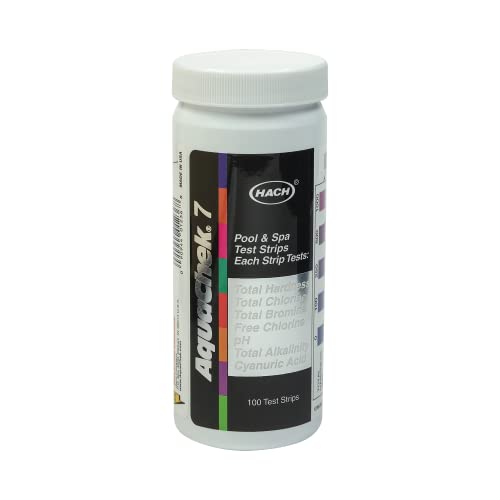
Best for the twice-weekly check that keeps a pool out of trouble
- Reads free chlorine, total chlorine, bromine, pH, total alkalinity, hardness and cyanuric acid
- Cyanuric acid pad, which most budget strips leave off
- 100 strips per bottle
- Result in roughly 15 seconds
Why buy it: it is the only widely stocked strip that reads stabilizer alongside everything else, and stabilizer is the number that quietly disables a pool’s chlorine.

Best for diagnosing a stubborn problem, or testing at shock-level chlorine
- FAS-DPD titration reads free chlorine to 0.2 ppm
- Separate acid demand and base demand tests tell you how much to add
- Covers alkalinity, calcium hardness and cyanuric acid
- Large 2 oz reagent bottles
Why buy it: a titration measures rather than estimates, so it keeps working at the high chlorine levels where every test strip bleaches out and reads blank.
We do not buy or physically handle the products we rank — every verdict comes from aggregated owner ratings and expert consensus, and the method is set out on how we rank. The ranked field is in the best pool test strips.
A workable routine
| Frequency | Do this |
|---|---|
| Twice weekly | Test free chlorine and pH; adjust; empty skimmer and pump baskets |
| Weekly | Test total alkalinity; brush walls, steps and shaded corners; vacuum |
| Monthly | Test calcium hardness and cyanuric acid; clean or backwash the filter |
| After heavy rain or a party | Retest chlorine and pH the same day — both move fast under load |
Where to go next
If your numbers are already off and the water has gone green or hazy, work through pool algae treatment or cloudy pool water. Thinking about switching sanitation systems? Saltwater vs chlorine compares them honestly. For the specific pH and chlorine question see what pool pH and chlorine levels should be, and if chlorine keeps disappearing, why my pool keeps losing chlorine. Everything else sits under the pools and spas hub.