 Garden

Affiliate Disclosure
Some links on this page are affiliate links. As an Amazon Associate, we earn from qualifying purchases — at no extra cost to you. We do not buy, test, or physically handle the products we cover; our rankings come from aggregated owner reviews, ratings and expert consensus. Commissions never change our verdicts. How we rank · full disclosure.
The reason to buy a dual fuel generator has almost nothing to do with fuel prices. It is that gasoline is the single most common cause of a backup generator that will not start when you need it. US pump gas is typically E10, containing up to 10% ethanol, and ethanol attracts water and begins breaking down within about 30 days. In a small carburetor with jets measured in thousandths of an inch, the varnish it leaves behind blocks the fuel path completely — the engine cranks, and nothing happens. That is what small-engine shops spend most of hurricane season fixing.
Propane does not do any of this. It does not absorb water, it does not oxidize, it does not leave varnish, and a tank stored in the yard for three years starts the machine on the first try. For a generator whose whole job is to work reliably after months of doing nothing, that is a more valuable property than any specification on the carton.
What it costs you is about 10% of the rated output, consistently, across every brand — because it is chemistry, not engineering. Size on the propane figure and the trade is fine.
Top Picks at a Glance

Our #1 Pick: Westinghouse 12500 Watt Dual Fuel
At 9,500 running watts on gasoline this covers a normal house comfortably — furnace, refrigerator, freezer, well pump, sump pump, lighting and the outlets that matter, with headroom for a window air conditioner. Fed through a transfer switch it is the closest a portable machine gets to replacing the grid.
We rank it first for the same reason we rank any most-owned product first: the size of the ownership record. When tens of thousands of American households have run the same generator through the same storm seasons, the picture you get of year-three behavior is something no specification sheet can produce. What that record shows is a machine with two consistent themes. Owners who run it on propane and exercise it monthly describe years of trouble-free starts. Owners who left gasoline in it over a summer describe exactly the carburetor problem above.
Remote electric start earns its keep here more than on any smaller machine. At 250-odd pounds this is not something you wrestle with in the dark, and a key fob that starts it from the back door in freezing rain changes the experience of an outage.
The honest limitations: it is heavy enough that the wheel kit is essential and moving it up a step is a two-person job; propane output drops to roughly 8,500 running watts; and it is an open-frame machine, so it is loud — expect 70 to 74 dBA under load, which your neighbors will notice.
Check price on Amazon → (paid link)
The Ranked Field

Best for whole-home backup where you want gasoline power and propane reliability
- 12500 peak / 9500 running watts on gasoline
- About 11500 peak / 8500 running on propane
- Transfer-switch-ready 50A and 30A 240V outlets
- Remote electric start with a key fob
Why buy it: the most-owned large dual fuel generator in America, and the ownership record is the reason to buy it — its failure modes are documented by tens of thousands of long-term owners.

Best for homes with a natural gas line that also want gasoline and propane as fallbacks
- 14500 peak watts on gasoline, with propane and natural gas modes
- Natural gas connection means it never needs refueling
- Transfer-switch-ready 240V outlets
- Remote electric start
Why buy it: a natural gas hookup removes the one genuine weakness of every portable generator — that somebody has to go out in a storm with a gas can.

Best for job sites, farms and anyone who wants a steel frame and a serviceable engine
- 13000 peak / 10500 running watts on gasoline
- 500cc DuroMax OHV engine with a heavy steel frame
- Full outlet panel including a 50A 240V receptacle
- Copper windings rather than aluminum
Why buy it: DuroMax builds a frame and an engine you can actually service, which is the difference between a machine that lasts a decade and one that is scrap when a part fails.

Best for essentials backup in a neighborhood where noise gets you complaints
- 5000 peak / 4500 running watts on gasoline
- Inverter output — clean sine wave for electronics
- Rated around 52 dBA at quarter load
- Remote electric start, 30A RV-ready outlet
Why buy it: the quietest genuinely useful dual fuel machine here, and clean enough output to run a variable-speed furnace board without a second thought.
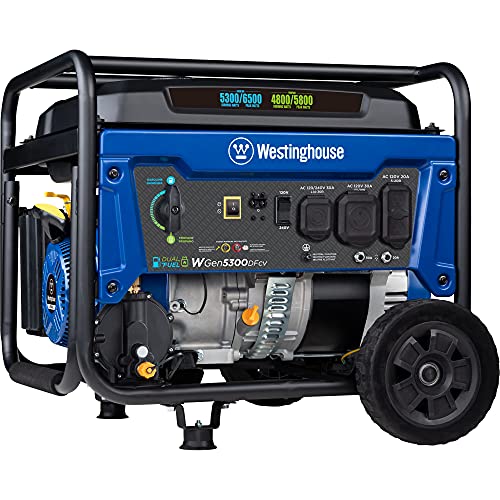
Best for a transfer-switch panel of eight to ten circuits including a well pump
- 6500 running watts on gasoline, around 5800 on propane
- Transfer-switch-ready L14-30R 240V outlet
- RV-ready 30A TT-30R outlet as well
- Runs a 3/4 hp well pump plus the usual essentials
Why buy it: the size most homes actually land on once the circuits are counted, and it is the least money you can spend and still cover a well pump surge.

Best for essentials-only backup on a budget, with 240V capability
- 4750 surge / 3800 running watts on gasoline
- Both 120V and 240V outlets including L14-30R
- Electric start with a recoil backup
- Wheel kit included
Why buy it: 240V output and dual fuel at a price that usually buys neither — the compromise is a smaller tank and a louder open-frame body.

Quick Comparison
| Product | Best for | Rating | Price | Buy |
|---|---|---|---|---|
| Westinghouse 12500 Watt Dual Fuel Home Backup Portable Generator, Remote Electric Start, Transfer Switch Ready | Best Overall | — | Check (paid link) | |
| Westinghouse 14500 Peak Watt Tri-Fuel Home Backup Portable Generator, Remote Electric Start, Transfer Switch Ready | Best Tri-Fuel | — | Check (paid link) | |
| DuroMax XP13000EH 13,000-Watt Dual Fuel Portable Generator, Gas and Propane, Electric Start | Best Heavy Duty | — | Check (paid link) | |
| Westinghouse 5000 Peak Watt Super Quiet Dual Fuel Portable Inverter Generator, Remote Electric Start | Best Quiet Dual Fuel | — | Check (paid link) | |
| Westinghouse 6500 Watt Dual Fuel Home Backup Portable Generator, Transfer Switch Ready 30A Outlet, RV Ready | Best Mid-Size | — | Check (paid link) | |
| WEN 4,750-Watt 120V/240V Dual Fuel Portable Generator with Wheel Kit and Electric Start (DF475T) | Best Value | — | Check (paid link) |
The fuel comparison, honestly
| Gasoline | Propane | Natural gas | |
|---|---|---|---|
| Output vs rated | 100% | About 90% | About 80–85% |
| Shelf life | 30 days untreated, up to 24 months stabilized | Indefinite | Not stored |
| Storage safety | Flammable liquid, vapor pools low | Pressurized, but sealed and stable | Piped, nothing on site |
| Availability in an outage | Poor — pumps need power | Good if tanks are pre-filled | Usually uninterrupted |
| Carburetor deposits | Significant | Almost none | Almost none |
| Cold-weather behavior | Reliable | Vaporization slows below about 20°F | Reliable |
| Requires professional install | No | No (portable tanks) | Yes — licensed gas fitter |
The cold-weather line matters more than it looks. Propane must vaporize inside the tank to feed the engine, and vaporization rate depends on liquid surface area and temperature. A 20 lb tank in single-digit weather may not sustain a heavy load — the tank frosts over and the regulator starves. In cold climates use a larger tank, or two tanks with a changeover regulator, and keep gasoline as the deep-winter option. That is a genuine argument for dual fuel rather than propane-only.
How We Rank
We do not buy, run or physically handle these generators. Rankings come from aggregated owner ratings across the most-owned dual fuel models, weighted toward reviews written after a full season or more, because starting reliability, regulator failures and warranty experience only surface with time. Those are cross-checked against published specifications for running and surge watts on both fuels, tank capacity, outlet configuration and engine displacement. Four things carry the weight: real running capacity on the fuel you will actually use; starting reliability after long storage, the dominant failure mode in backup service; outlet configuration, since a machine without a transfer-switch-ready 240V receptacle cannot do home backup at any wattage; and serviceability and parts availability. Prices were checked at the time of writing. Full method: how we rank.

The Field, Reviewed
1. Westinghouse 12500 Watt Dual Fuel — Best Overall
Covered above. Owners praise: capacity that genuinely covers a house, remote start in bad weather, propane starts after long layups, and a full 240V outlet set. Owners gripe about: weight, open-frame noise, the propane output drop, and an oil drain that is awkward without a ramp. Check price (paid link).
2. Westinghouse 14500 Tri-Fuel — Best Tri-Fuel
The natural gas option is the whole argument. Connected to a house gas line by a licensed gas fitter, this machine never needs refueling and never has a fuel storage problem, which is the one genuine advantage a permanently installed standby generator holds over a portable — obtained here for a fraction of the price.
Owners praise: unlimited runtime on natural gas, the highest aggregated rating in this field, and remote start. Owners gripe about: the natural gas hookup being professional work with its own permit, roughly 15% lower output on gas, and considerable weight. Check price (paid link).
3. DuroMax XP13000EH — Best Heavy Duty
Built like job-site equipment rather than a homeowner appliance. The 500cc engine, steel frame and copper windings are what you are paying for, and they are the parts that determine whether a generator is repairable in year eight.
Owners praise: build quality, the full outlet panel including a 50A receptacle, and strong output under sustained load. Owners gripe about: serious weight, noise that is genuinely loud, and a machine that is difficult to move on soft ground. Check price (paid link).
4. Westinghouse 5000 Peak Watt Inverter — Best Quiet Dual Fuel
A different proposition: dual fuel reliability in an inverter body, at a size that covers essentials rather than the whole house. At roughly 52 dBA at quarter load it is quiet enough to run overnight without a complaint, and its inverter output is clean enough for variable-speed furnace boards and computers.
Owners praise: low noise for the output, clean power, propane reliability, and remote start. Owners gripe about: 4,500 running watts not covering central AC, an awkward oil fill, and a price premium over conventional machines of the same output. Check price (paid link).
5. Westinghouse 6500 Watt — Best Mid-Size
The most common landing spot once an electrician has counted the circuits. 6,500 running watts clears a 3/4 hp well pump surge with the furnace already running, which is the arithmetic that defeats 5,000-watt machines.
Owners praise: the size-to-price ratio, transfer-switch-ready outlet, and dual fuel flexibility. Owners gripe about: recoil start on some configurations, open-frame noise, and a fuel gauge that is hard to read. Check price (paid link).
6. WEN DF475T — Best Value
240V output and dual fuel for the price of a basic gasoline machine. 3,800 running watts is essentials-only — fridge, freezer, furnace, lights, not all at once with a well pump — but the L14-30R outlet means it can feed a transfer switch, which most machines at this price cannot.
Owners praise: the price, electric start, and 240V capability at this size. Owners gripe about: a small tank that shortens runtime, noise, and a build that is clearly to a budget. Check price (paid link).
What Owners Actually Complain About
The propane output drop catches people out. Buyers size on the gasoline number, run on propane, and find themselves 10% short. Size on the fuel you will actually use.
Regulator and hose problems. The propane regulator hose is the part most often reported as leaking or hardening, usually after a few years of UV exposure. It is a cheap replacement and worth inspecting annually.
Stale gasoline, still. Owning a dual fuel machine does not protect you if you leave gasoline in it. The fix is the same: stabilizer at every fill, fuel shut-off closed to run the bowl dry before storage, monthly exercise under load.
Weight nobody planned for. A 9,500-watt open-frame generator with a full tank is a 250 to 300 pound object. Owners consistently report underestimating what it takes to move it across a lawn.
Noise. Open-frame dual fuel machines run 70 to 78 dBA under load. Buyers who expected the quiet of an inverter are frequently disappointed, and neighbors more so.
The Verdict
For whole-home backup the Westinghouse 12500 Watt dual fuel remains the sensible buy — best-understood machine in its class, enough capacity to cover a real house, and propane to make sure it starts. If a natural gas line reaches your property, the tri-fuel 14500 is worth the extra because it removes refueling entirely. If your needs are essentials-only and your neighbors are close, the Westinghouse 5000 inverter does the job at a fraction of the noise. Whichever you pick, run it on propane between emergencies and exercise it monthly — that habit, not the model, determines whether it starts. Check price on Amazon → (paid link)
More from this hub: power tools & workshop · best generators for home backup · what size generator do I need · how to connect a generator to your house · how to store a generator long term · how we rank.