 Garden


Affiliate Disclosure
Some links on this page are affiliate links. As an Amazon Associate, we earn from qualifying purchases — at no extra cost to you. We do not buy, test, or physically handle the products we cover; our rankings come from aggregated owner reviews, ratings and expert consensus. Commissions never change our verdicts. How we rank · full disclosure.
The generator cord is the component people treat as an accessory and then discover is a specification. Get the plug type wrong and it does not connect. Get the gauge wrong and voltage drop makes every motor in the house run hot. Get the length wrong and you cannot site the generator the 20 feet from the building that carbon monoxide safety requires — which is the failure with actual consequences.
The good news is that the decision has only three variables: the plug on your generator, 10 AWG or heavier, and a length that lets you put the machine where it belongs. Everything else is jacket quality and whether the ends light up.
Top Picks at a Glance
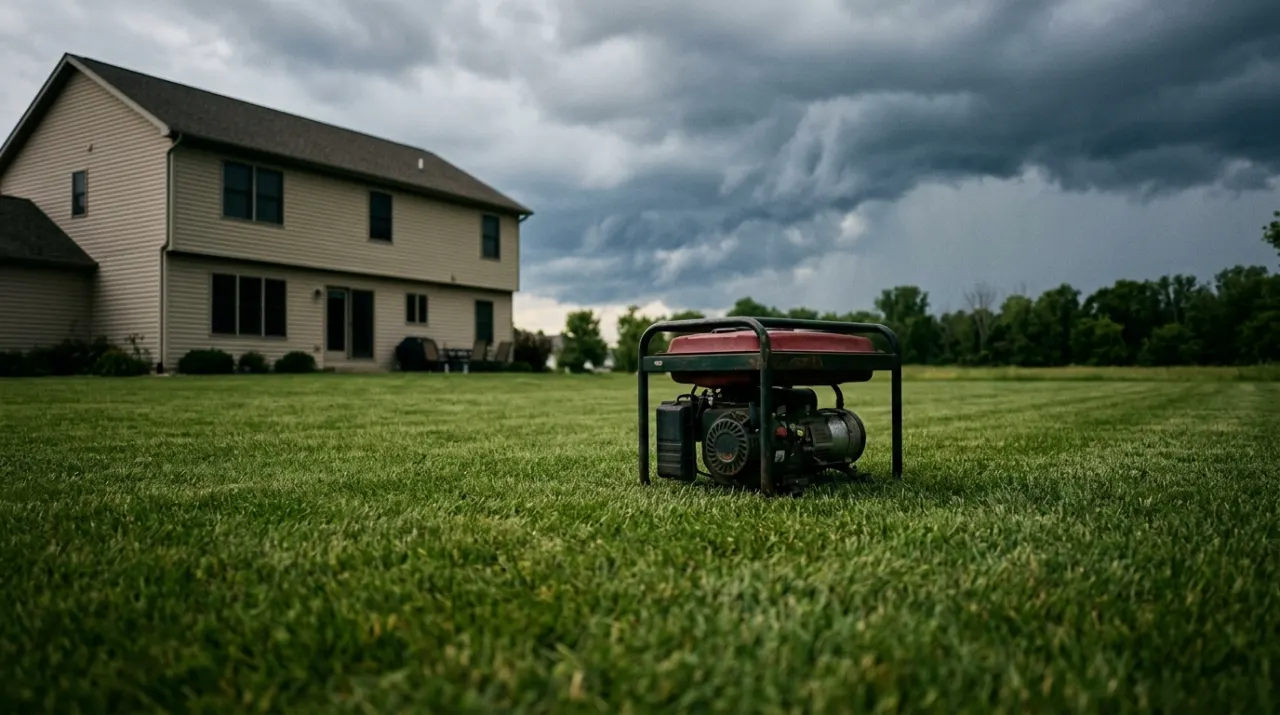
First: which plug does your generator have?
This decides everything. Look at the generator's control panel and find the largest round twist-lock receptacle.
| Receptacle | Prongs | Voltage | Capacity | Use |
|---|---|---|---|---|
| 5-20R | 3, straight blade | 120V | 20 A / 2,400 W | Ordinary cords to appliances |
| L5-30R | 3, twist-lock | 120V | 30 A / 3,750 W | 120V-only transfer switches, breakout cords |
| TT-30R | 3, RV style | 120V | 30 A / 3,600 W | RV shore power |
| L14-30R | 4, twist-lock | 120/240V | 30 A / 7,500 W | Transfer switches, 240V loads |
| 14-50R | 4, straight blade | 120/240V | 50 A / 12,500 W | Large transfer switches, RV 50A |
The critical distinction is L5-30 versus L14-30. An L5-30 carries a single 120V leg and cannot power a well pump, a water heater or any other 240V load at any wattage. An L14-30 carries both legs. They look similar at a glance and they are not interchangeable — and no adapter turns a 120V-only generator into a 240V source.
The Ranked Field

Best for connecting a 240V generator to a transfer switch inlet box
- 25 feet of 10/4 STW cable
- NEMA L14-30P to L14-30R twist-lock connectors
- Rated 125/250V, 30A, 7,500 watts
- ETL listed with a molded, weather-resistant jacket
Why buy it: the four-conductor L14-30 cord is what a transfer switch actually needs, and this is the most-owned example of it — 25 feet clears the 20-foot carbon monoxide minimum with room to route around a corner.

Best for siting the generator genuinely away from the house rather than just outside it
- 50 feet of 10 AWG four-conductor STW cable
- L14-30P to L14-30R twist-lock connectors
- Rated 125/250V, 30A, 7,500 watts
- Jacket that stays flexible in cold weather
Why buy it: the 20-foot CO clearance is a minimum, not a target — 50 feet lets you put the exhaust genuinely downwind of the house and out of earshot of a bedroom window.
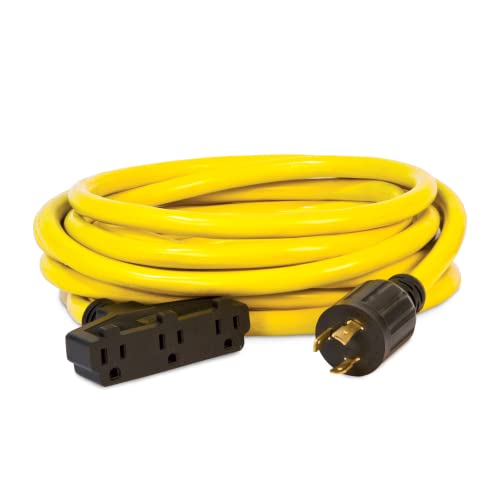
Best for machines with an L5-30R outlet feeding several ordinary appliances
- 25 feet, 30 amp, 125V, 10 AWG
- L5-30P twist-lock into four 5-20R household receptacles
- Fan-style breakout so four cords can leave from one point
- Lighted ends to show power is present
Why buy it: it takes one 30-amp 120V circuit and splits it into four household outlets, which is exactly what you want when you are not running a transfer switch.

Best for a 240V generator being used for ordinary 120V appliances during an outage
- 25 feet of 10 AWG cable
- L14-30P into four 5-20R household receptacles
- Splits the two 120V legs across the outlets
- Lighted receptacle ends
Why buy it: most large generators only give you one high-capacity outlet and a couple of household sockets — this uses the big one properly and balances both legs while it does it.

Best for a transfer switch or interlock install that did not include a cord and inlet
- 25 feet of 10/4 STW cable with L14-30 twist-lock ends
- Weatherproof recessed power inlet box included
- Rated 125/250V, 30A, 7,500 watts
- ETL listed
Why buy it: buying the cord and the inlet as a matched pair removes the most common install headache, which is a connector that does not fit the box already mounted on the wall.

Best for more reach than 25 feet without paying 50-foot money
- 40 feet of 10 AWG four-conductor cable
- L14-30P to L14-30R twist-lock connectors
- Rated 125/250V, 30A, 7,500 watts
- Lighted end indicating live power
Why buy it: forty feet is the length most people wish they had bought, and at 10 AWG the voltage drop over that run is still comfortably inside tolerance.

Quick Comparison
| Product | Best for | Rating | Price | Buy |
|---|---|---|---|---|
| RVGUARD 4 Prong 30 Amp 25 Foot Generator Extension Cord, ETL Listed, NEMA L14-30P/L14-30R, 125/250V | Best Overall | — | Check (paid link) | |
| PlugSaf 50FT 30 Amp Generator Extension Cord 4 Prong, NEMA L14-30P/L14-30R, 10 Gauge STW 125/250V | Best Long Cord | — | Check (paid link) | |
| Champion Power Equipment 25-Foot 30-Amp 125-Volt Fan-Style Generator Extension Cord (L5-30P to four 5-20R) | Best for 3-Prong 120V Generators | — | Check (paid link) | |
| S7 25FT 30 Amp Generator Extension Cord, NEMA L14-30P to 4X 5-20R Generator Adapter Cord, 10 Gauge | Best Breakout for 4-Prong Generators | — | Check (paid link) | |
| CircleCord 4 Prong 25 Feet 30 Amp Generator Extension Cord and Inlet Box with Locking Connector | Best Cord and Inlet Kit | — | Check (paid link) | |
| Kohree 30 Amp Generator Extension Cord 4 Prong 40FT, NEMA L14-30P/L14-30R, 125/250V 7500W 10 Gauge | Best Value Long Cord | — | Check (paid link) |
Gauge, length and voltage drop
Voltage drop is the reason cord gauge is a specification rather than a preference. Every foot of conductor has resistance, and resistance under load turns supply voltage into heat in the cord instead of work at the appliance. A motor supplied at reduced voltage compensates by drawing more current, which makes it run hotter — and heat is what kills compressors and pump motors.
The common engineering target for branch circuits is to keep voltage drop under 3%. At 30 amps, that works out roughly as follows.
| Length | 10 AWG at 30 A | 8 AWG at 30 A | Verdict |
|---|---|---|---|
| 25 feet | ~1.5% drop | ~1.0% | 10 AWG is ample |
| 40 feet | ~2.4% | ~1.5% | 10 AWG fine |
| 50 feet | ~3.0% | ~1.9% | 10 AWG at the limit |
| 75 feet | ~4.5% | ~2.8% | Use 8 AWG |
| 100 feet | ~6.0% | ~3.8% | 8 AWG minimum |
Figures are approximate and depend on conductor temperature and load, but the shape is right: 10 AWG is the correct choice to about 50 feet on a 30-amp circuit, and beyond that you want 8 AWG. For ordinary 120V appliance cords from the generator's household outlets, 12 AWG covers most needs to about 50 feet and 10 AWG beyond.
Jacket types worth knowing
- SJTW — junior service, thermoplastic, weather-resistant. Common on household outdoor cords, adequate for light generator use.
- STW — full service thickness, thermoplastic, weather-resistant. Heavier and more abrasion-resistant; what most purpose-made generator cords use.
- SOOW — oil-resistant rubber jacket and insulation. The most flexible in cold weather and the most durable, and correspondingly the most expensive. Worth it for a cord that lives outdoors in winter.
The practical difference shows up in January. A thermoplastic jacket at 10°F goes stiff enough to be genuinely awkward to uncoil, and repeated coiling of a cold, stiff cord is how jackets crack. If your outages come in ice storms, the rubber-jacketed option earns its money.

How We Rank
We do not buy or physically handle these cords. Rankings come from aggregated owner ratings across the most-owned generator cords, weighted toward reviews describing use over multiple seasons — because the failures that matter here are jacket cracking, connector wear and strain-relief pull-out, and none of them appear in week one. Those are cross-checked against published specifications for conductor gauge, conductor count, jacket type, amperage and safety listing. What carries the weight: correct conductor gauge for the rated current; a listing from a recognized testing laboratory such as UL or ETL, which we treat as a threshold rather than a bonus; jacket durability and cold flexibility; and connector and strain-relief quality, since that is where cords actually fail. Prices were checked at the time of writing. Full method: how we rank.
And the cord length is a carbon monoxide control. A portable generator emits as much CO as hundreds of cars, and the CPSC links more than 100 US deaths a year to generator carbon monoxide. It is colorless and odorless. Run it outdoors only — never in a garage, basement, shed or under a carport, and an open door does not make it safe — at least 20 feet from the house with exhaust pointed away from doors, windows and vents, and fit CO alarms on every level indoors. See the CPSC Carbon Monoxide Information Center. A cord too short to reach 20 feet is a safety defect, not an inconvenience.
What Owners Actually Complain About
Stiffness in the cold. The single most common complaint across every brand. Thermoplastic jackets go rigid below freezing, and a cord that will not uncoil at 5 a.m. in an ice storm is a real problem. Rubber-jacketed cords are notably better and cost more.
Twist-lock connectors that loosen. After enough connect-disconnect cycles the locking ring wears and the connection becomes intermittent. Owners report this as flickering or heat at the plug. Any scorching at the contacts means the cord is retired, not repaired.
Buying the wrong plug. A remarkable share of one-star reviews on generator cords describe a product working exactly as specified while the buyer needed the other twist-lock type. Check the receptacle on your generator before ordering.
Too short. The most common regret. Twenty-five feet is enough to satisfy the CO clearance only if the inlet box is on the correct wall, and it usually is not.
Chaining two cords. People join two 25-foot cords instead of buying one 50-foot cord, then have a live connection lying on wet ground and additional resistance at the joint. Buy the length you need.
The Verdict
For a generator feeding a transfer switch, the RVGUARD 25-foot L14-30 cord is the straightforward buy — correct four-conductor configuration, 10 AWG, and the most-owned example of the type. If the inlet box is anywhere awkward, spend the extra on the PlugSaf 50-foot and put the exhaust genuinely downwind. If you are running appliances directly rather than through a switch, a breakout cord — the Champion fan-style for 120V machines or the S7 L14-30 breakout for 240V ones — turns one high-capacity outlet into four usable sockets. Whatever you buy, buy it long enough to keep the generator 20 feet away. Check price on Amazon → (paid link)
More from this hub: power tools & workshop · how to connect a generator to your house · how to ground a portable generator · best generators for home backup · can you run a generator in the rain · how we rank.