 Garden


Affiliate Disclosure
Some links on this page are affiliate links. As an Amazon Associate, we earn from qualifying purchases — at no extra cost to you. We do not buy, test, or physically handle the products we cover; our rankings come from aggregated owner reviews, ratings and expert consensus. Commissions never change our verdicts. How we rank · full disclosure.
Camping is the one power application where the smallest machine usually wins. Nobody at a campsite needs 7,000 watts. What they need is something that fits in the trunk with the tent, does not get them a complaint from three sites over, and starts in May after sitting all winter. That reframes the whole category: weight, noise rating and starting reliability outrank output almost every time.
The exception is the RV owner running a rooftop air conditioner, which is a genuinely demanding load and forces you up into the 3,500-running-watt class. And there is a third route that is not a generator at all — a lithium battery power station, which makes no noise, produces no carbon monoxide, and is permitted at sites where combustion generators are banned outright.
Top Picks at a Glance

Our #1 Pick: WEN 2350-Watt Super Quiet Inverter
Almost everything a camper needs from a generator is a constraint rather than a capability, and this machine satisfies more of them at once than anything else near its price. Around 39 pounds means one person loads it. A rated 51 dBA at quarter load clears the 60 dBA limit most campgrounds set with room to spare. And 1,900 running watts covers a 12V fridge on an inverter, string lights, a fan, laptops and a full night of device charging without the engine ever leaving economy mode.
The feature that matters most in the long run is the least glamorous: a fuel shut-off valve. Camping generators sit unused for months, and stale ethanol-blended gasoline in a small carburetor is what kills them. Closing the valve and letting the engine run until it stops empties the float bowl, which is the single most effective thing you can do to make sure the machine starts next season. Owners who use it consistently report exactly that; owners who do not are the ones writing the "will not start after winter" reviews.
What it will not do is run a rooftop air conditioner, a microwave and a coffee maker at once, or start any of them at the same time as something else. It is honest about being a 1,900-watt machine. If your list includes a 13,500 BTU RV AC, skip to the Westinghouse 4000.
Check price on Amazon → (paid link)
The Ranked Field
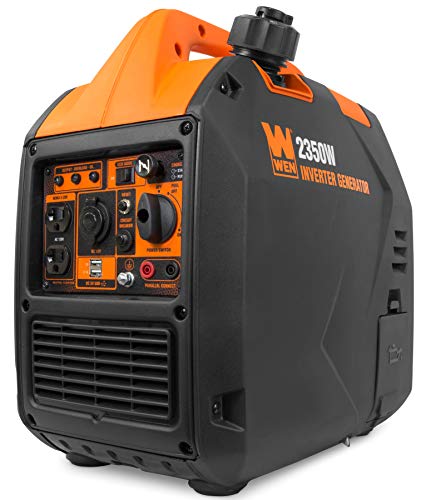
Best for car camping and tailgating where weight and campground noise limits both matter
- 2350 surge / 1900 running watts
- About 39 lb, carried comfortably in one hand
- Rated around 51 dBA at quarter load
- Fuel shut-off valve to run the carburetor dry before storage
Why buy it: it clears almost every campground noise limit, weighs less than a loaded cooler, and still runs a portable fridge, lights and device charging all night.

Best for anyone carrying the generator any real distance from the vehicle
- 2500 starting / 1850 running watts
- Around 39 lb with a folding handle
- Economy mode drops engine speed at light load
- Three-year warranty with lifetime technical support
Why buy it: Champion backs it with a real US service network, which matters far more on a machine that lives in a truck bed and gets used a dozen weekends a year.

Best for starting a 13,500 BTU rooftop RV air conditioner in July
- 4000 peak / 3500 running watts on gasoline
- Dual fuel — runs on propane straight from a 20 lb tank
- Remote electric start with a key fob
- 30A TT-30R RV outlet, no adapter needed
Why buy it: the propane option is the real camping feature: a tank in the storage bay never goes stale, so the machine starts after a winter in the driveway.

Best for tent camping, national parks and anywhere combustion generators are banned
- 292Wh capacity, 300W continuous AC output
- Completely silent with zero emissions
- Recharges from a solar panel, a wall outlet or a car socket
- Pure sine wave AC plus USB-C PD and 12V outputs
Why buy it: it produces no carbon monoxide at all, which makes it the only category here that can legally and safely sit inside a tent, van or RV while it runs.

Best for multi-day trips running a 12V fridge, laptops and camera gear off solar
- 1070Wh LiFePO4 battery, 1500W continuous AC
- LiFePO4 chemistry rated for thousands of cycles
- One-hour fast charge from a wall outlet
- Silent, emission-free, usable indoors
Why buy it: LiFePO4 cells last several times as many cycles as the older lithium chemistry, which is the difference between a battery that lasts three seasons and one that lasts a decade.

Best for small trailers and teardrops that need a 30A outlet but not 4,000 watts
- 2550 peak / 2000 running watts
- RV-ready 30A TT-30R outlet built in
- Parallel-capable with a second unit
- Around 48 lb with a carry handle
Why buy it: the RV outlet on a machine this small saves an adapter and a failure point, and pairing two of them later is cheaper than replacing one with a bigger unit.
Quick Comparison
| Product | Best for | Rating | Price | Buy |
|---|---|---|---|---|
| WEN Super Quiet 2350-Watt Portable Inverter Generator with Fuel Shut Off, Gasoline Power, Ultra Lightweight | Best Overall | — | Check (paid link) | |
| Champion Power Equipment 2500-Watt Ultralight Portable Inverter Generator with Quiet Technology | Best Ultralight | — | Check (paid link) | |
| Westinghouse 4000 Peak Watt Super Quiet Dual Fuel Portable Inverter Generator, Remote Electric Start | Best for RV Air Conditioning | — | Check (paid link) | |
| Jackery Explorer 300 Portable Power Station, 292Wh, Backup LiFePO4 Battery, Solar Generator for Outdoors | Best Silent Option | — | Check (paid link) | |
| Jackery Explorer 1000 v2 Portable Power Station, 1070Wh, 1500W, LiFePO4 Battery, 100W USB-C | Best Battery for Van Life | — | Check (paid link) | |
| Westinghouse 2550 Peak Watt Super Quiet & Lightweight Portable Inverter Generator, RV Ready 30A Outlet | Best Small RV Generator | — | Check (paid link) |

What a campsite actually draws
| Load | Running watts | Starting surge |
|---|---|---|
| 12V portable fridge / cooler | 45–60 | 150 |
| String lights and lanterns (LED) | 20–60 | — |
| Laptop and phone charging | 60–150 | — |
| Box fan | 50–100 | 200 |
| Electric griddle | 1,200–1,600 | 1,600 |
| Coffee maker | 800–1,200 | 1,200 |
| Microwave, 700 W output | 1,000–1,200 | 1,200 |
| CPAP machine (no humidifier) | 30–60 | — |
| CPAP with heated humidifier | 60–120 | — |
| RV rooftop AC, 13,500 BTU | 1,300–1,800 | 2,800–3,500 |
| RV rooftop AC, 15,000 BTU | 1,800–2,000 | 3,300–4,000 |
| RV converter / battery charger | 300–800 | 800 |
Read that table and the shape of the category is obvious. Everything a tent camper runs adds up to a few hundred watts, which a 300Wh battery station handles silently for a night. Everything an RV owner runs is dominated by one load — the air conditioner — and that single item determines the machine.
Campground rules you should check before you buy
Generator rules are not standardized, and the assumption that "quiet enough" is a technical question rather than a policy one causes a lot of wasted money. Three things vary by site:
- Decibel caps. Commonly 60 dBA at 50 feet, sometimes 65. An inverter clears it; an open-frame machine does not.
- Quiet hours. Typically 10 p.m. to 6 or 8 a.m., during which no combustion generator may run at all regardless of how quiet it is. This is the single strongest argument for a battery station if you need overnight power for a CPAP.
- Outright bans. Many National Park Service campgrounds, most walk-in and primitive sites, and a growing number of private parks prohibit gas generators entirely. Battery power stations are almost never restricted.
Fire restrictions matter too. During high fire danger, jurisdictions across the western states restrict internal-combustion equipment in wildland areas, and a generator with a hot muffler falls under those rules. Check current conditions with the managing agency before a trip.
How We Rank
We do not buy, run or physically handle these machines. Rankings come from aggregated owner ratings across the most-owned camping generators and power stations, weighted toward reviews written after a full season, because starting reliability after storage and battery degradation both take time to appear. Those are cross-checked against published specifications for running watts, surge watts, weight, rated noise and battery capacity. What carries the weight: portability, measured in pounds rather than adjectives; rated noise against real campground limits; starting reliability after months idle, the dominant failure mode in seasonal use; and the right outlet for the job, since an RV without a TT-30R connection needs an adapter and every adapter is a failure point. Prices were checked at the time of writing. Full method: how we rank.

The Field, Reviewed
1. WEN 2350-Watt Super Quiet — Best Overall
Covered above. Owners praise: the weight, the noise level, the price, and the fuel shut-off. Owners gripe about: a small tank that limits runtime under heavy load, recoil start only, and 120V-only output that rules out any 240V load. Check price (paid link).
2. Champion 2500-Watt Ultralight — Best Ultralight
Effectively the same size and weight class as the WEN, chosen for a different reason: Champion's US parts and service network. On a machine that gets used a dozen weekends a year and stored badly for the rest, being able to get a carburetor five years from now is worth more than a spec-sheet advantage.
Owners praise: the warranty and reachable support, the folding handle, and economy-mode behavior. Owners gripe about: price against equivalent-wattage rivals, and a fuel gauge that is hard to read. Check price (paid link).
3. Westinghouse 4000 Peak Watt Dual Fuel — Best for RV Air Conditioning
The machine that clears a 13,500 BTU rooftop unit without a soft-start kit. The dual fuel capability is more valuable in an RV than anywhere else, because a propane tank already lives on board and propane does not degrade in storage the way gasoline does.
Owners praise: starting the AC on the first try, remote electric start, and reliable propane starts after long layups. Owners gripe about: the roughly 10% output drop on propane, weight approaching 100 pounds, and noise that climbs noticeably once the AC compressor loads it. Check price (paid link).
4. Jackery Explorer 300 — Best Silent Option
Not a generator in the combustion sense, and that is the point. It is silent, emits nothing, and is the only product in this list that can legally and safely operate inside a tent or camper. For a CPAP user camping through quiet hours it is not a nice-to-have, it is the whole solution.
Owners praise: total silence, safe indoor use, USB-C fast charging, and the ability to top up from a solar panel. Owners gripe about: 292Wh runs out fast on anything with a heating element, solar recharge times measured in hours, and an AC output that cannot start a compressor. Check price (paid link).
5. Jackery Explorer 1000 v2 — Best Battery for Van Life
The size at which a battery station stops being a device charger and starts being a power system. 1,070Wh runs a 12V fridge for a couple of days, charges camera batteries and laptops, and handles a small induction burner briefly. The LiFePO4 chemistry is the specification worth paying for — it tolerates several times the cycle count of older lithium packs.
Owners praise: cycle life, one-hour wall charging, and silent operation inside a van. Owners gripe about: weight around 24 pounds, price, and that 200W of solar takes most of a good day to refill it. Check price (paid link).
6. Westinghouse 2550 Peak Watt — Best Small RV Generator
A small inverter with a proper 30A RV outlet, which is unusual at this size and removes an adapter from the chain. Parallel capability means a second unit later gets you to RV air conditioning without replacing the first.
Owners praise: the built-in TT-30R, compact size, and parallel expansion. Owners gripe about: output that is genuinely marginal for anything with a compressor, and a rating that sits slightly below its rivals in the aggregated owner record. Check price (paid link).
What Owners Actually Complain About
It will not start in spring. By a wide margin the most common camping-generator complaint, and almost always stale fuel rather than a failed engine. US pump gasoline is typically E10, and ethanol absorbs water and begins separating within about 30 days — the varnish left in a carburetor with jets thousandths of an inch across blocks fuel entirely. Add a stabilizer at every fill, close the fuel shut-off and run the bowl dry before storage, and start the machine under load for 20 minutes monthly.
The RV air conditioner will not start. Usually a machine sized on running watts when the compressor inrush is the real requirement. A soft-start kit on the AC often solves it for less than the price of a bigger generator.
Noise complaints from neighbors. Manufacturer decibel figures are measured at quarter load at 23 feet. Under real load the same machine is meaningfully louder than the number on the box.
Battery stations running out faster than expected. Anything with a heating element — kettle, griddle, coffee maker, hair dryer — empties a 300Wh pack in minutes. Watt-hours, not watts, is the number to plan around.
The Verdict
For most campers the WEN 2350-watt inverter is the right machine: light, quiet enough for the rules, and cheap enough that it does not have to justify itself. RV owners running a rooftop air conditioner should go straight to the Westinghouse 4000 Peak Watt dual fuel, where the propane option also solves the seasonal starting problem. And if you camp in a tent, in a national park, or through quiet hours with a CPAP, the honest answer is that no gas generator belongs there — take the Jackery Explorer 300. Check price on Amazon → (paid link)
More from this hub: power tools & workshop · best inverter generators · what size generator do I need · how to store a generator long term · how we rank.