 Garden

Affiliate Disclosure
Some links on this page are affiliate links. As an Amazon Associate, we earn from qualifying purchases — at no extra cost to you. We do not buy, test, or physically handle the products we cover; our rankings come from aggregated owner reviews, ratings and expert consensus. Commissions never change our verdicts. How we rank · full disclosure.
Before anything else — the two rules that kill people every storm season.
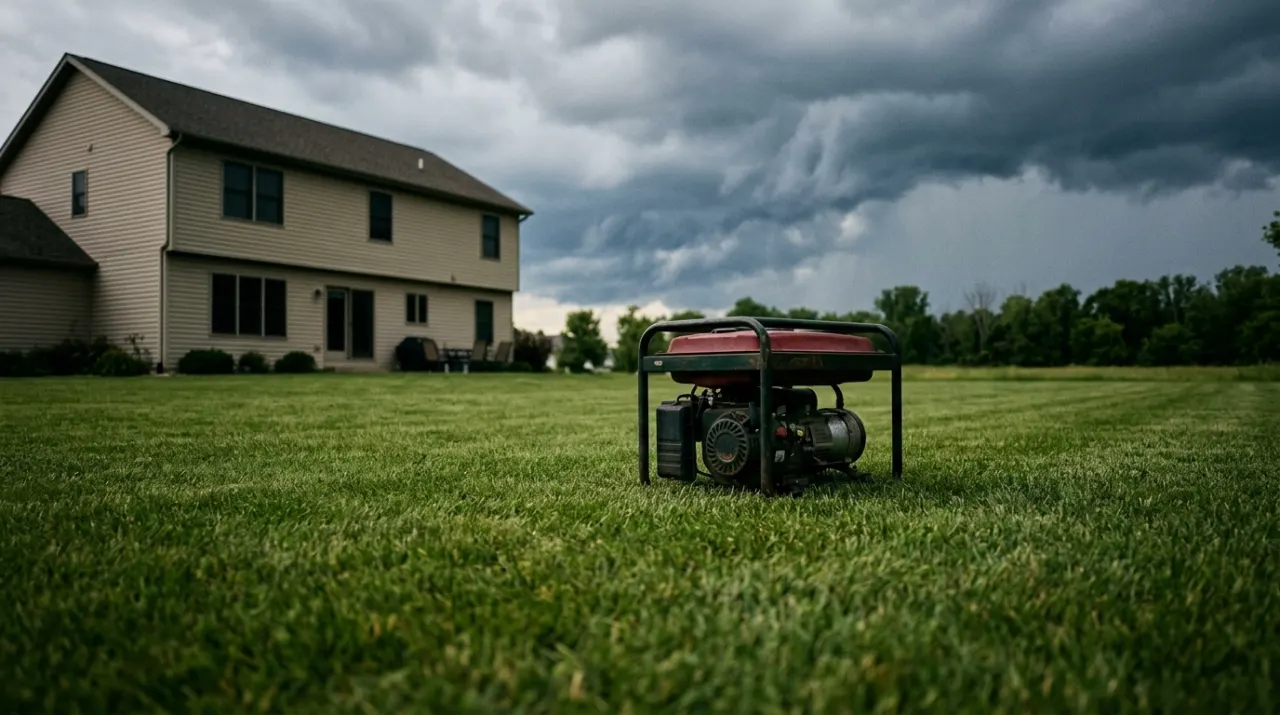
1. Carbon monoxide. Run a generator outdoors only, at least 20 feet from the house, with the exhaust pointed away from doors, windows and vents. Never in a garage, a basement, a shed or under a carport, even with the door open. The US Consumer Product Safety Commission states that one portable generator can produce as much carbon monoxide as hundreds of cars, and links more than 100 US deaths a year to generator CO. It is colorless and odorless — there is no warning, and people lose consciousness before they realize anything is wrong. Fit CO alarms on every level of the home.
2. Never plug a generator into a wall outlet. Backfeeding energizes the utility line and can electrocute the line workers restoring your power. A transfer switch or interlock kit installed by a licensed electrician is the only correct method. There is no safe shortcut, and we will not describe one.
Almost every generator sizing mistake is the same mistake: buying on the big number. The wattage printed largest on the carton is peak or surge watts, a figure the engine can hold for a couple of seconds. The number that determines whether your house works is running watts, and it is typically 20 to 25 percent lower. A "9,500 watt" generator is a 7,500 watt generator in every sense that matters.
Top Picks at a Glance

Running Watts, Surge Watts, and How to Size Honestly
Sizing is a two-part calculation and skipping the second part is what leaves people sitting in the dark with a generator that keeps tripping.
Step one: add up running watts. Every appliance you want on at the same time, at its steady draw.
Step two: find your single largest surge and add it on top. Motors — compressors, pumps, well pumps, air conditioners — draw three to six times their running wattage for the first fraction of a second. You do not add every surge, because they will not all start at the same instant, but you must have headroom for the biggest one starting while everything else is already running.
| Load | Running watts | Startup surge |
|---|---|---|
| Refrigerator / freezer | 150–200W | 800–1,200W |
| Chest freezer | 100–150W | 600–1,000W |
| Gas furnace blower (1/2 hp) | 600–800W | 1,500–2,400W |
| Sump pump (1/3 hp) | 500–800W | 1,300–2,400W |
| Well pump (1/2 hp submersible) | 800–1,050W | 2,000–3,000W |
| Well pump (1 hp submersible) | 1,500–2,000W | 4,000–6,000W |
| Central AC (3 ton) | 3,500–4,000W | 8,000–12,000W |
| Window AC (10,000 BTU) | 900–1,200W | 1,800–2,800W |
| Electric water heater | 4,000–4,500W | None |
| Microwave | 1,000–1,700W | None |
| Lights, router, phones, TV | 300–600W total | None |
| Coffee maker | 800–1,200W | None |
Work a real example. A house wanting fridge (200W), freezer (150W), furnace blower (700W), sump pump (600W) and 500W of lights and electronics runs at 2,150 watts. The largest surge is the sump pump at up to 2,400W, and the well-behaved way to cover it is roughly 2,150 − 600 + 2,400 = about 3,950 watts of headroom. A 5,000 running-watt generator handles that comfortably; a 3,600 running-watt unit will manage it only if the pump and the blower never start together, which they eventually will at three in the morning.
Our #1 Pick: Westinghouse 12500 Peak Watt Dual Fuel
This is the unit that covers the case most people are actually buying for — a multi-day outage in a house with a furnace, a well and a freezer that must not thaw — without stepping up to installed standby equipment. At 9,500 running watts on gasoline it has the headroom to start a well pump while the furnace is already running, which is precisely the scenario that defeats a 5,000-watt machine.
Dual fuel is more consequential on a home backup unit than it sounds. Gasoline degrades in months, and the single most common reason a generator fails to start when a storm arrives is stale fuel gumming a carburetor jet. Propane stores indefinitely. A machine kept on propane starts after two years in the corner of a garage, and the gasoline option is still there when you want the extra 10 percent of output. Expect roughly 8 to 12 percent less power on propane than on gasoline — that is normal, not a fault.
Owners consistently report the remote electric start as the feature they use most in genuinely bad weather, and the recurring complaints are consistent and fair: it is heavy enough that moving it on soft ground is a two-person job, and it is loud, because an open-frame 9,500-watt generator is loud by physics. If noise is your priority, read our quiet generator picks instead and accept less power.
Check price on Amazon → (paid link)
The Ranked Field

Best for genuine home backup — furnace, well pump, fridge and freezer together
- 12,500 peak / 9,500 running watts on gasoline, slightly less on propane
- Dual fuel — runs on gasoline or a standard 20lb propane tank
- Transfer switch ready with a 30A L14-30R and a 50A outlet
- Remote electric start with a key fob and a battery on board
Why buy it: the size where a portable generator stops being an extension cord exercise and starts genuinely backing up a house — and it is the most-owned unit at that size by a long way.
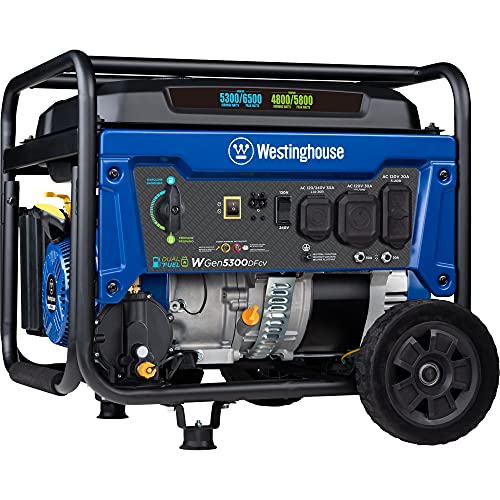
Best for the fridge, the freezer, lights, the furnace fan and a few outlets
- 6,500 peak / 5,000 running watts, dual fuel
- Transfer switch ready 30A outlet plus an RV TT-30R
- Recoil start with a low-oil shutdown
- Light enough for one person to move on flat ground
Why buy it: the size most households actually need — enough to keep a home habitable without the weight, fuel burn and noise of a 12,000-watt machine.

Best for a first generator, a job site, or backing up the essentials only
- 4,750 surge / 3,800 running watts on gasoline
- Dual fuel with a 120V/240V transfer-switch-ready outlet
- Electric start with a wheel kit included
- Roughly 11 hours at half load on a full tank
Why buy it: the honest entry point — 240V capable and transfer switch ready at a price where most competitors give you 120V only.
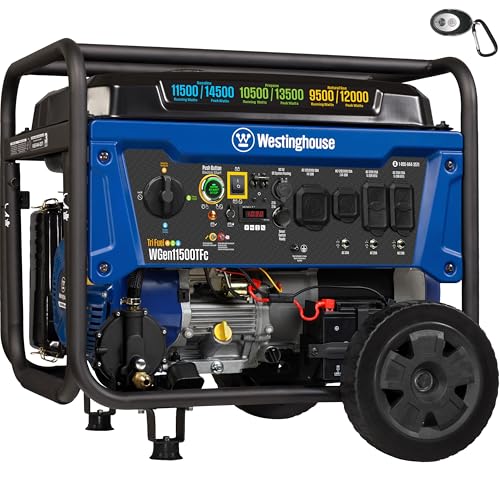
Best for larger homes, well pumps and central air, with natural gas as an option
- 14,500 peak / 11,500 running watts on gasoline
- Tri-fuel: gasoline, propane, or a natural gas hookup
- CO sensor with automatic shutdown
- 50A and 30A transfer-switch outlets, remote electric start
Why buy it: the natural gas capability is the real argument — a tri-fuel unit plumbed to a house gas line never runs out of fuel and never needs a trip to the gas station in a storm.
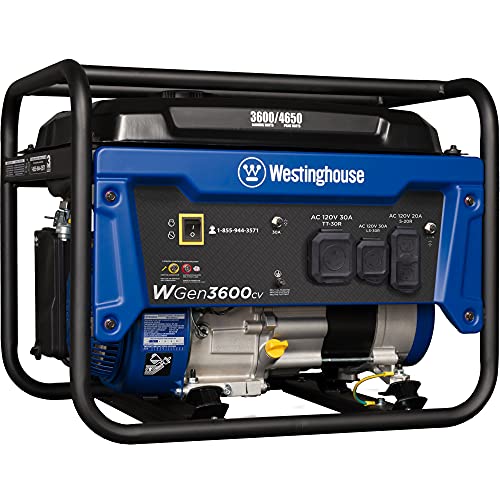
Best for a fridge, a sump pump and lights, or a small job site
- 4,650 peak / 3,600 running watts, gasoline
- Built-in CO sensor that shuts the engine down automatically
- RV Ready 30A TT-30R outlet
- Compact enough to lift into a truck bed with two people
Why buy it: the CO sensor is the reason it is here — an automatic shutdown when carbon monoxide accumulates is the single most valuable feature a generator can carry, and it is still not universal.

Best for hard use — contractors, farms, and homes with big motor loads
- 13,000 peak / 10,500 running watts, dual fuel
- All-metal frame and a 500cc engine built for sustained load
- Full panel: 120V, 120/240V, 50A and a 30A twist-lock
- Copper windings rather than aluminum
Why buy it: built like site equipment rather than a homeowner appliance, and the owner record on long-term durability is the reason contractors keep buying it.
Quick Comparison
| Product | Best for | Rating | Price | Buy |
|---|---|---|---|---|
| Westinghouse WGen9500DF 12500 Peak Watt Dual Fuel Portable Generator, Remote Electric Start | Best Overall | — | Check (paid link) | |
| Westinghouse WGen3600DF 6500 Peak Watt Dual Fuel Portable Generator, RV Ready | Best Mid-Size | — | Check (paid link) | |
| WEN DF475T 4750 Watt 120V/240V Dual Fuel Portable Generator with Electric Start | Best Value | — | Check (paid link) | |
| Westinghouse WGen11500TFc 14500 Peak Watt Tri-Fuel Home Backup Generator, Remote Electric Start | Best Large | — | Check (paid link) | |
| Westinghouse WGen3600cv 4650 Peak Watt Portable Generator with CO Sensor, RV Ready | Best Small | — | Check (paid link) | |
| DuroMax XP13000EH 13000 Watt Dual Fuel Portable Generator with Electric Start | Best Heavy Duty | — | Check (paid link) |
Getting Power Into the House — The Only Correct Way
A generator on the patio with extension cords running through a window works, and for a lot of households it is genuinely enough: heavy-gauge outdoor-rated cords to the fridge, the freezer and a lamp will get you through. It is unglamorous and completely safe, provided the cords are rated for the load and the window is not closed on them.
To power circuits that are wired in — the furnace, the well pump, lighting circuits — you need a transfer switch or an interlock kit, installed by a licensed electrician. Both do the same essential job: they make it physically impossible for the generator and the utility supply to be connected to your wiring at the same time. That interlock is the entire point. Without it, your generator feeds power back through the meter and onto the utility line, where a line worker who has tested the circuit dead can be electrocuted by it, and where returning grid power can arrive out of phase and destroy the generator or start a fire.
Expect a transfer switch installation to run roughly $500 to $1,500 for a typical 6 to 10 circuit setup in 2026, plus the switch itself, and expect a permit and an inspection — this is wiring at the service panel and it is jurisdiction-specific. Our standby generator guide covers the switch options in detail. Do not improvise, and do not use a cord with a male plug on both ends. There is no version of that which is safe.
Fuel, Storage and Why Generators Refuse to Start
Look at any generator's low reviews and the same story dominates: it worked when new, sat for a year, and would not start when it was needed. That is almost always fuel, not the machine. Modern gasoline containing ethanol begins to deteriorate within about 30 days and can gum a carburetor's pilot jet within a few months, and that jet is a passage narrower than a pin.
- Treat every tank with fuel stabilizer if the machine will sit. It is the cheapest insurance in the category.
- Or run it dry. Close the fuel valve and let the engine consume what is in the carburetor bowl before storing. Units with a fuel shut-off valve make this easy and it is the reason that feature keeps appearing in spec lists.
- Or store it on propane. The real advantage of dual fuel, and why it dominates the home backup segment.
- Exercise it. Start and run under load for 20 to 30 minutes every three months. This finds the problem in your driveway on a Saturday instead of in a blackout.
- Change the oil early. New engines want their first oil change at 20 to 25 hours. See how often to change generator oil.
If yours will not start now, work through the generator troubleshooting sequence — the fix is usually free.

How We Rank
We do not buy, run or test these machines. Rankings come from aggregated owner ratings across the most-owned portable generators, weighted toward reviews written after a season or more where starting reliability and carburetor problems surface, and cross-checked against published specifications for running wattage, fuel capacity and outlet configuration. Four things carry the weight: honest running watts rather than the peak figure on the carton; starting reliability after storage, which is the failure mode that matters most in a backup machine; safety equipment, specifically CO shutdown sensors and low-oil protection; and serviceability, because a generator you can put a new carburetor on is a generator you keep. Prices were checked at the time of writing. Full method: how we rank.
What Owners Actually Complain About
Hard starting after storage. The dominant complaint across every brand, and almost always stale fuel rather than a defective engine. Dual fuel units stored on propane largely escape it.
Noise. Open-frame generators run 70 to 80 dB at 23 feet. Buyers who expected a conversational sound level are consistently unhappy, and no amount of enclosure fixes it safely — never box in a running generator.
Weight and wheels. The wheel kits fitted to large units handle pavement well and grass badly. Owners moving a 200lb machine across a wet lawn find out quickly.
Confusing outlet configurations. Buyers frequently discover the 30A outlet on their generator does not match the inlet the electrician fitted. Check for L14-30 versus TT-30 before you buy, not after.
Fuel consumption. A 9,500-watt unit at half load burns roughly half a gallon an hour. A three-day outage is 25 to 35 gallons, which is a genuine planning problem when gas stations have no power either.
The Verdict
For real home backup the Westinghouse 12500 Peak Watt Dual Fuel is the sensible buy — enough headroom for pumps and motors, and propane storage that solves the starting problem that defeats most generators. Step down to the Westinghouse 6500 Peak Watt if you only need the essentials and would rather not own something that heavy, and take the Westinghouse 14500 Tri-Fuel if you can plumb it to natural gas, because a machine that never runs out of fuel is a different proposition entirely. Whatever you buy, size on running watts, put a CO alarm on every floor, and run it 20 feet from the house with the exhaust pointed away. Check price on Amazon → (paid link)
Sources: US Consumer Product Safety Commission Carbon Monoxide Information Center; Electrical Safety Foundation International, portable generator safety; Ready.gov power outages.
More from this hub: power tools & workshop · best quiet generators · best whole house generators · best portable power stations · how we rank.