 Garden

Affiliate Disclosure
Some links on this page are affiliate links. As an Amazon Associate, we earn from qualifying purchases — at no extra cost to you. We do not buy, test, or physically handle the products we cover; our rankings come from aggregated owner reviews, ratings and expert consensus. Commissions never change our verdicts. How we rank · full disclosure.
The verdict in 90 seconds
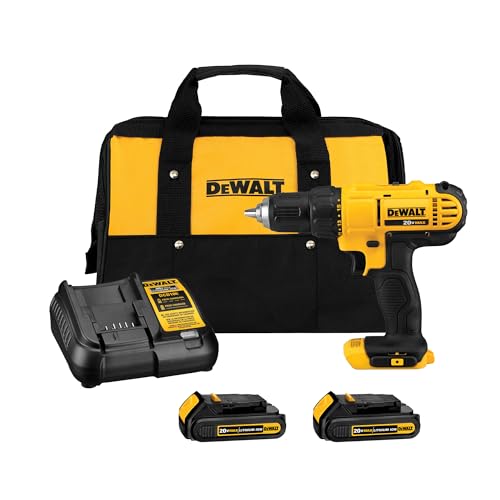
The DCD771C2 is the drill to buy if you want one drill, want it to work, and do not want to think about it again. It has one of the deepest and most consistently positive review bases of any power tool sold, because 300 unit watts out, a two-speed gearbox and a proper ratcheting chuck cover almost every household job for around a hundred dollars. It is also a brushed, older-generation tool shipped with the smallest batteries DEWALT makes, and it has no hammer mode. Know those three things and it is close to unbeatable value.
Best for a first serious cordless drill, and the cheapest sensible way onto the 20V MAX platform
- Two-speed transmission at 0 to 450 and 0 to 1,500 rpm
- 300 unit watts out with a 1/2 in. ratcheting keyless chuck
- Compact 7.52 in. front to back, around 3.6 lb bare
- Kit includes two 1.3 Ah batteries, charger and contractor bag
Why buy it: it is the drill that has quietly outsold everything else because it does 95 percent of household jobs for around a hundred dollars.

What owners consistently praise
It simply works, for years. The dominant theme in long-term reviews is uneventfulness. Owners report five and six years of shelves, furniture, fencing and repairs with no failures. For a tool that spends most of its life in a drawer and then gets asked to do something hard, that reliability is the product.
The chuck. A 1/2 inch ratcheting keyless chuck grips round-shank bits properly, which matters the moment you use a spade bit or a hole saw. Owners upgrading from a cheaper drill with a friction chuck describe bits slipping as the problem this solved.
Two real speeds. Low gear at 0 to 450 rpm gives torque for driving and large-diameter boring; high gear at 0 to 1,500 rpm gives speed for small twist bits. Cheap single-speed drills force a compromise, and owners notice the difference immediately.
The platform. Every DEWALT 20V MAX battery fits, and the range spans hundreds of tools. Owners consistently describe buying this kit first and then adding an impact driver, a saw or a light on the same packs.
Size and balance. At about 7.5 inches front to back and 3.6 pounds bare it fits into cabinets and joist bays without being top-heavy, and the belt hook is genuinely useful on a ladder.
What owners actually complain about
The 1.3 Ah batteries. The single most common criticism. Two of the smallest packs DEWALT sells is fine for a shelf and inadequate for a deck. Owners describe running both flat inside an afternoon of real work. It is the deliberate cost-saving in the kit, and almost every experienced reviewer recommends adding a larger pack.
No hammer mode. Buyers who assumed any drill handles masonry report grinding away at concrete without progress. It is clearly stated in the specification and still catches people out.
Brushed motor heat and runtime. Compared with the brushless models, owners report the tool getting warm during sustained boring and pulling more from the battery for the same work.
The LED position. The light sits below the trigger rather than at the front of the foot, so in tight spaces the chuck casts a shadow exactly where you are drilling. A steady, specific and legitimate complaint.
Chuck runout on some units. A minority report visible bit wobble, particularly with long twist bits. It is within tolerance for a drill at this price but it frustrates owners doing precise work, and it is one of the reasons the step-up models exist.
The bag, not a case. The kit comes in a contractor bag. Owners who wanted a hard case say so, and some report the zip failing.
Clutch settings that feel coarse. Fifteen positions sounds like fine control and in practice the useful range for small screws is narrow. Owners driving into softwood report going from not-quite-seated to countersunk between adjacent clicks.

Getting the best out of it
Use the gearbox properly, because most owners never do. Low gear at 0 to 450 rpm is for driving screws, large spade bits, hole saws and anything where torque matters more than speed. High gear at 0 to 1,500 rpm is for twist bits under about 3/8 in. Running a hole saw in high gear is the fastest way to stall the drill, overheat the motor and burn the workpiece, and it is exactly what a new owner does by default.
Set the clutch rather than trusting your wrist. Start two or three clicks below where you think you need it and work up until the screw seats flush — that is how you avoid stripping heads in softwood and snapping small fasteners. Keep the chuck tight by hand-ratcheting it firmly with a bit inserted, since most reported bit slippage is under-tightening rather than a defective chuck. And store lithium packs at partial charge in a cool place over winter; heat and long storage at full charge are what shorten battery life far more than cycle count.
Who it suits, and who should buy something else
Buy it if you want a dependable general-purpose drill, an entry into the 20V MAX platform, and the lowest sensible price for both.
Buy a brushless DCD791 or DCD800 instead if you bore large holes regularly or work a full day on batteries — more power, more runtime, shorter body.
Buy a hammer drill instead if concrete or brick is in your plans. Start with how to drill into concrete and how to drill into brick to see why the tool matters more than the bit.
Buy an impact driver alongside it if you drive long screws — our DEWALT impact driver review and impact driver vs drill driver explain the split. The full ranked field is in our best cordless drill guide, or the homeowner-focused best cordless drill for home use.

Specifications
| Spec | DEWALT DCD771C2 |
|---|---|
| Motor | Brushed, 20V MAX |
| Power | 300 unit watts out (UWO) |
| Speeds | 0 to 450 rpm and 0 to 1,500 rpm |
| Chuck | 1/2 in. single-sleeve ratcheting keyless |
| Clutch | 15 positions plus drill mode |
| Hammer mode | None |
| Length | Approximately 7.52 in. front to back |
| Weight | About 3.6 lb. bare |
| Included | Two 1.3 Ah batteries, charger, double-ended bit tip, contractor bag |
| Warranty | 3 year limited, 1 year free service, 90 day money back |
The bottom line
There is a reason this specific kit turns up in more American garages than almost any other power tool. It is not the most powerful drill, the newest, or the one with the best battery — it is the one that does the whole range of ordinary jobs competently for a price that makes the decision easy. Add a bigger battery when you outgrow the pair in the box, and buy a hammer drill separately if masonry is coming.
Check price on Amazon → (paid link)
Next: understand the motor question in brushless vs brushed cordless drills, plan the battery in how long cordless drill batteries last, check the buying criteria in what to look for in a cordless drill, or start from the power tools and workshop hub.