 Garden
Affiliate Disclosure
Some links on this page are affiliate links. As an Amazon Associate, we earn from qualifying purchases — at no extra cost to you. We do not buy, test, or physically handle the products we cover; our rankings come from aggregated owner reviews, ratings and expert consensus. Commissions never change our verdicts. How we rank · full disclosure.
The short version: after weighing six popular elevated planters on owner star ratings, review volume, published dimensions and the complaints that show up after a season outdoors, our #1 pick is the Best Choice Products 48 x 24 x 30 inch planter. It offers the largest useful planting area at genuine waist height, ships with a liner, and includes a lower shelf that keeps pots and tools off the ground. If you would rather not maintain wood at all, the FOYUEE galvanized bed does the same job in steel and assembles in minutes.
An elevated planter is a different tool from a ground-level bed, not a smaller version of one. It exists to put soil at standing height and to work where there is no soil at all — a deck, a balcony, a paved side return. If you have open ground and a bad back is not the constraint, read best raised garden bed first, because a bottomless bed on soil will grow more for less. Everything else about the format is at the raised beds and planters hub.
Top Picks at a Glance
Our #1 Pick: Best Choice Products 48 x 24 x 30 in.
Two numbers explain why this remains the benchmark. Forty-eight by twenty-four inches is eight square feet of planting surface — enough for a real salad and herb garden, or a row of bush beans plus a couple of determinate tomatoes, rather than the token strip most elevated planters offer. And thirty inches of stand height is true waist height for most adults, which is the entire point of buying one.
Consensus Score ████████░░ 8.4
The lower shelf is more useful than it looks in photos. Pots, gloves, twine, a trowel and a watering can all stop living on the ground, which matters enormously if the reason you bought a waist-height bed was that bending is difficult. Owners consistently report that assembly takes under an hour with a screwdriver, and that the finished frame feels solid once the soil is in and settled.
The honest limits are depth and wood care. The trough holds roughly eight inches of soil, so plan your planting around that, and the fir will last much longer if you seal the outside faces before the first season and replace the supplied liner when it tears. Do both and this is a bed you will use for years.
Check price on Amazon → (paid link)
Best Elevated Planter Boxes 2026: The Ranked Field
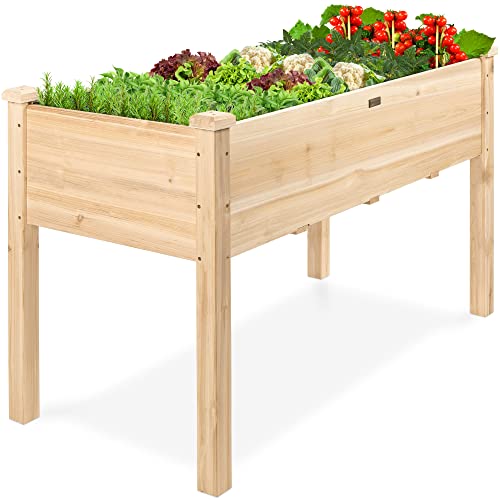
Best for a full waist-height vegetable bed on a deck or patio
- 30 in. working height — no kneeling at all
- Fir frame with a fitted bed liner
- 200 lb capacity, roughly 8 in. of soil
- Lower shelf for pots, tools and a watering can
Why buy it: the largest planting area at true waist height for under $100, which is why it stays the category benchmark.

Best for the same footprint for a little less money
- Unpainted natural fir, double-layer structure
- 220 lb rated capacity on the box
- Fabric liner and drainage holes included
- Single-piece side panels for rigidity
Why buy it: a rigid, untreated fir bed at the biggest useful size, with the liner already in the box.

Best for anyone who does not want to reseal wood every few years
- 40 x 16 x 31 in., 8.3 in. planting depth
- Galvanized steel — no rot, no annual sealing
- Drainage holes and drainage line built in
- Assembles in roughly five minutes
Why buy it: the only material here that will look the same in ten years, and it goes together in one coffee break.
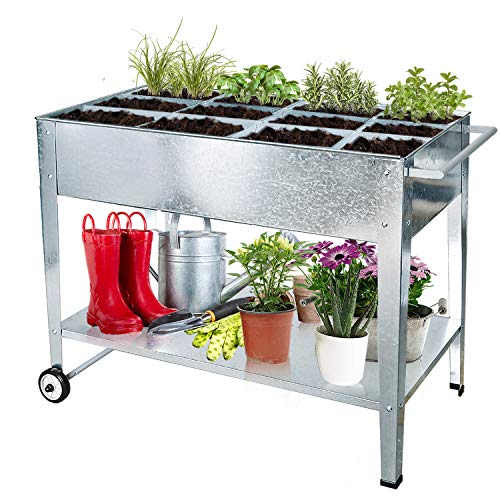
Best for chasing sun around a balcony or rolling inside before a frost
- 40 x 20 x 31.5 in. with locking wheels
- Handle for steering on a deck or patio
- Lower storage shelf for pots and tools
- Galvanized steel body with drainage line
Why buy it: movable soil is a genuinely different tool — you can follow the sun, or roll a crop indoors overnight.

Best for balconies and anyone who cannot water every single day
- Built-in reservoir with a water level gauge
- Drainage plug for heavy rain
- Weather-resistant resin — no rot, no rust
- Assembles in under 30 minutes
Why buy it: the reservoir buys three to five days between waterings, which is what keeps a shallow bed alive in July.

Best for small balconies, side returns and narrow patios
- 34 in. wide — fits where a 4 ft bed cannot
- Natural fir with a fitted liner
- Built-in lower storage shelf
- Waist-height 30 in. stand
Why buy it: full standing height in a footprint that fits a genuinely small balcony, at the lowest price here.
Quick Comparison
| Product | Best for | Rating | Price | Buy |
|---|---|---|---|---|
| Best Choice Products 48 x 24 x 30 in. Elevated Wood Planter | Best Overall | — | Check (paid link) | |
| Yaheetech 48 x 24 x 30 in. Elevated Wooden Planter Box | Best Value Wood | — | Check (paid link) | |
| FOYUEE Galvanized Elevated Raised Garden Bed with Legs | Best Metal | — | Check (paid link) | |
| FOYUEE Elevated Planter Box with Wheels and Shelf | Best on Wheels | — | Check (paid link) | |
| Keter Easy Grow 31.7 Gallon Elevated Resin Garden Bed | Best Self-Watering | — | Check (paid link) | |
| Yaheetech 34 x 18 x 30 in. Elevated Planter with Storage Shelf | Best Compact | — | Check (paid link) |
How We Rank
We do not buy, build or physically handle any of these planters. We aggregate star ratings and review volume across thousands of verified owner reviews, weight recent reviews above launch-window ones, check published dimensions, soil depth, load rating and material against manufacturer specifications rather than listing photos, and read the one- and two-star reviews closely for the failures that appear after a winter outdoors.
Four factors set the order. Usable soil depth, because it decides what you can actually grow and it is the source of most disappointment in this category. Working height and access, since a planter that still requires bending has failed at its one job. Material durability, drawn from multi-season owner reports about rot, liner tearing and leg failure under a full soil load. And value per square foot of planting surface rather than lowest sticker price. Prices were checked at the time of writing and move with the season. Full method: how we rank.
The Planters, Reviewed
1. Best Choice Products 48 x 24 x 30 in. — Best Overall
Covered above. Consensus Score ████████░░ 8.4. Strengths: the largest planting area here at genuine waist height, a useful lower shelf, a fitted liner in the box, and a 200 pound load rating that survives wet soil. Recurring complaints: the roughly eight-inch trough disappoints anyone who planted full-size tomatoes; the fir needs sealing on the outside faces to last; the supplied liner tears easily and is worth replacing early; and it dries out fast in summer heat.
2. Yaheetech 48 x 24 x 30 in. — Best Value Wood
Effectively the same bed for slightly less, with a rigidity advantage worth knowing about: the side panels are single pieces rather than slats, which is why the box carries a higher rated load than most wooden competitors. The fir is unpainted and untreated, which matters if you are growing food and would rather not think about what is leaching out of the frame.
Consensus Score ████████░░ 8.3
Recurring complaints: the same eight-inch depth ceiling, and the same need to seal the wood if you want it to last past four or five seasons. Reviewers report that board thickness and finish vary between production runs, and that a few pilot holes make assembly much easier because the fir splits if you drive screws straight in. The liner is thin.
3. FOYUEE Galvanized Elevated Bed — Best Metal
The low-maintenance answer. Galvanized steel does not rot, does not need sealing and does not need a liner, so the whole annual ritual of wood care disappears. Owners consistently report assembly taking around five minutes, and the built-in drainage holes and drainage line are properly engineered rather than an afterthought — which matters, because a blocked elevated planter drowns plants faster than any bed in the ground.
Consensus Score ████████░░ 8.2
Recurring complaints: at 40 by 16 inches it offers less planting area than the wooden benchmarks, and 8.3 inches of depth is the usual ceiling. Metal in full sun heats the soil at the edges faster than wood, which some owners in hot southern climates notice in July. A minority report the legs flexing slightly under a completely saturated soil load.
4. FOYUEE Elevated Planter with Wheels — Best on Wheels
Mobility turns out to be a real feature rather than a gimmick. A planter on locking casters can follow the sun across a deck through the season, roll into shelter before a hard frost, and be pushed aside when you need the space for guests. The handle makes steering a fully loaded bed genuinely possible, and the lower shelf carries the usual pots and tools.
Consensus Score ████████░░ 8.0
Recurring complaints: wheels on rough surfaces are the weak point — reviewers with paving slabs or gravel find them much harder to move than the listing suggests. A full bed of wet soil is heavy regardless of casters. Depth is again the standard 8 inches, and a few owners report the locking mechanism on the casters wearing over a season or two.
5. Keter Easy Grow — Best Self-Watering
A resin elevated bed with a reservoir in the base and a level gauge on the side. Fill the reservoir and the soil wicks moisture upward as it needs it, which owners consistently report buys three to five days between waterings in high summer. That is the difference between a balcony garden that survives a week away and one that does not. It will not rot, will not rust, and assembles in under half an hour.
Consensus Score ████████░░ 8.4
Recurring complaints: capacity — 31.7 gallons is a container garden, not a vegetable plot, and expectations have to match. Several reviewers describe the legs as the weak point under a full soil load, the resin can fade or grow brittle after several seasons in intense sun, and a few report the reservoir gauge sticking. Compared in full against other reservoir designs in best self-watering planters.
6. Yaheetech 34 x 18 x 30 in. — Best Compact
The one that fits where nothing else does. At 34 inches wide it slots onto a small balcony, a narrow side return or beside a back door without blocking the path, and it still gives you full standing height and a storage shelf underneath. For herbs, salad and a couple of strawberry plants it is entirely sufficient, and it is the cheapest bed in this roundup.
Consensus Score ███████░░░ 7.9
Recurring complaints: the small footprint means the small soil volume dries out fastest of anything here, so daily summer watering is the norm without mulch or a drip line. Wood care applies as it does to the larger Yaheetech. Owners also note that the narrower box limits you to one row of most crops, which is fine for herbs and frustrating for anything else.
How to Choose an Elevated Planter Box
Start with the crops, because depth is the hard constraint and it cannot be fixed later. Salad, herbs, radishes, strawberries, bush beans and patio tomatoes? Eight inches is genuinely fine, and any planter here works. Full-size tomatoes, peppers, squash? You want a deeper box or a ground-level bed. Carrots, parsnips, potatoes? An elevated planter is the wrong tool — Iowa State Extension puts ordinary raised beds at 6 to 12 inches and builds permanent framed beds higher for deeper-rooted crops — see how deep should a raised bed be.
Then measure the space honestly, including the swing of a door and the path you walk past it. A 48-inch bed on a small balcony is a mistake people make once. And check the working height against the person using it: 30 inches suits most adults standing, but if the goal is gardening from a seated position you want to confirm there is clear knee space under the box.
Finally, plan the watering before you fill it. A shallow, raised, wind-exposed soil volume is the fastest-drying growing situation in the garden, and the two fixes that actually work are a reservoir design or a drip line on a timer. EPA WaterSense puts typical landscape demand at about one inch of water a week including rainfall and advises against watering in the middle of the day, when evaporation is highest. Adding two inches of mulch to the surface helps more than most people expect. The watering and irrigation hub has the parts list.
What Owners Actually Complain About
Five themes repeat across every brand in this category. Soil depth disappointment is by far the largest, and it is an expectation problem rather than a product fault — the listing photos show tomatoes, the trough holds eight inches, and the buyer plants an indeterminate variety. Drying out is second and is inherent to the format.
Liner failure is third: the fabric liners supplied with wooden planters are thin, they tear during filling, and once soil is in contact with the boards the wood starts its clock. Buying a heavier landscape fabric and stapling it in before you fill is a ten-dollar fix. Wood rot at the base follows from that, and sealing the outside faces before first use delays it by years. And leg flex under load appears in reviews of nearly every design once the soil is fully saturated — the ones that hold up are those with cross-bracing or a shelf that ties the legs together, which is a useful thing to look for in photos.
The Verdict
For most people, the Best Choice Products 48 x 24 x 30 inch planter is the one to buy — the biggest useful planting area at true waist height, with the shelf and liner included. Want the same thing slightly cheaper? The Yaheetech 48-inch. Never want to maintain wood? The FOYUEE galvanized bed. Cannot water daily in July? The Keter Easy Grow and its reservoir.
Check price on Amazon → (paid link)
Next: get the soil right in what to fill a raised bed with, compare reservoir designs in best self-watering planters, or step up to a full ground-level bed in best metal raised beds.