 Garden

Affiliate Disclosure
Some links on this page are affiliate links. As an Amazon Associate, we earn from qualifying purchases — at no extra cost to you. We do not buy, test, or physically handle the products we cover; our rankings come from aggregated owner reviews, ratings and expert consensus. Commissions never change our verdicts. How we rank · full disclosure.
The short answer: 12 inches of soil depth suits the great majority of home vegetables. Leafy crops and herbs are fine in 6 to 8 inches; tomatoes, peppers, beans, squash and beets want 12; carrots, parsnips, potatoes and daikon want 16 to 18. What sits underneath changes the answer as much as the crop does — on open soil a 10 to 12 inch frame behaves much deeper because roots keep going, but over hardpan, a patio or a deck, every inch a root will ever occupy has to be inside the box.
Depth by Crop
Root depth in the table below is the working zone where most feeder roots sit, not the theoretical maximum a plant can reach in ideal ground. The recommended bed depth adds working headroom for settling and mulch.
| Crop | Type | Working root depth | Bed depth over open soil | Bed depth over a hard surface |
|---|---|---|---|---|
| Lettuce, arugula, mesclun | Leafy | 4–6 in | 6 in | 8–10 in |
| Spinach, chard | Leafy | 6–8 in | 6–8 in | 10–12 in |
| Most culinary herbs | Leafy | 6–8 in | 6–8 in | 10 in |
| Radish, green onion | Root, shallow | 4–6 in | 6 in | 8 in |
| Kale, cabbage, broccoli | Leafy, heavy feeder | 10–12 in | 10–12 in | 14–16 in |
| Bush beans, peas | Fruiting, shallow | 8–12 in | 10 in | 12–14 in |
| Beets, turnips | Root, medium | 10–12 in | 12 in | 14–16 in |
| Carrots, standard varieties | Root | 10–12 in | 12 in | 14–16 in |
| Onions, garlic, leeks | Root, shallow | 8–10 in | 10 in | 12 in |
| Peppers, eggplant | Fruiting | 12–18 in | 12 in | 16–18 in |
| Cucumbers, summer squash | Fruiting | 12–18 in | 12 in | 18 in |
| Tomatoes | Fruiting, deep | 12–24 in | 12 in (18 preferred) | 18–24 in |
| Winter squash, pumpkin, melon | Fruiting, sprawling | 18–24 in | 12–18 in | 24 in |
| Potatoes | Tuber | 12–18 in plus hilling | 16–18 in | 18–24 in |
| Carrots, long varieties; parsnip; daikon | Root, deep | 16–18 in | 16–18 in | 18–24 in |
| Asparagus, rhubarb (perennial) | Perennial, deep | 18–24 in | 18 in | 24 in |
| Blueberries and shrubs | Woody perennial | 18–24 in | 18–24 in | 24 in and a wide footprint |
Two patterns are worth pulling out of that table. First, the jump from leafy to fruiting crops is bigger than the jump from fruiting to root crops — greens genuinely are content in a shallow bed and everything with fruit on it is not. Second, the right-hand column is consistently 4 to 6 inches deeper than the middle one, and that gap is the entire reason patio beds behave differently from garden beds.
What Is Underneath Changes Everything
Over open soil or lawn
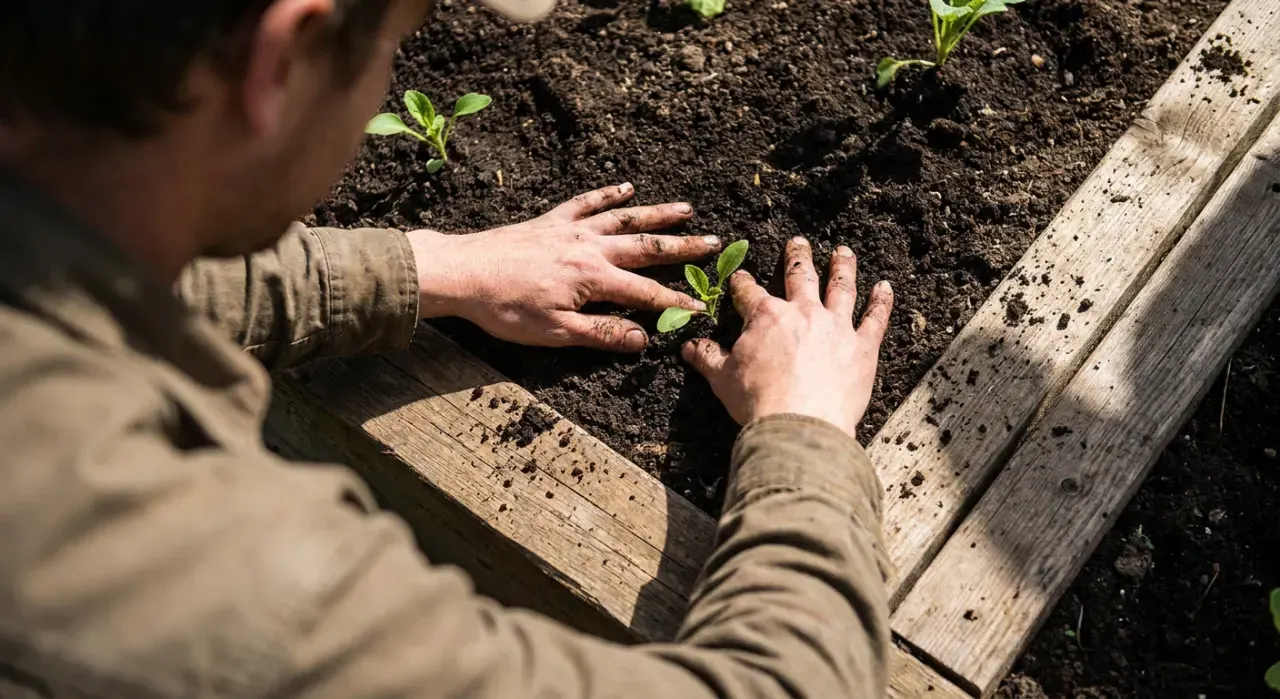
This is the easy case and the one most people are in. Roots that reach the bottom of the frame do not stop; they carry on into the ground below, drawing water and nutrients from it and giving the plant a much larger effective root volume than the frame suggests. A 10 or 12 inch bed on decent ground behaves like an 18 to 24 inch bed for most crops.
Two things make that work. Do not put a solid bottom or plastic sheeting in the bed — it converts an open bed into a container and throws away the advantage. And loosen the ground beneath before filling: strip or smother the grass with plain cardboard, then push a garden fork or broadfork in and rock it to fracture the top 8 to 12 inches without turning it over. That single step, which takes twenty minutes on a 4 by 8 bed, is the difference between roots continuing downward and roots hitting a compacted interface and turning sideways.
Over hardpan, compacted clay or fill
Common on newer construction lots, where topsoil was scraped and heavy equipment compacted what remained. Here the ground below is not usable root space and it also drains badly, so a shallow bed sits on top of what is effectively a bathtub.
Two viable approaches. Break the pan mechanically with a broadfork before building — if you can get 10 to 12 inches of fracture and the subsoil drains at all, treat it as open soil and build 12 inches. If the pan is genuinely impenetrable or the site puddles for hours after rain, treat it like a hard surface and build 16 to 18 inches, and consider raising the whole bed slightly on a base of coarse material so water has somewhere to go sideways. Do not put a gravel layer inside the bed for drainage — a coarse layer under finer soil creates a perched water table and makes drainage worse, not better.
Over a patio, deck, driveway or rooftop
Now the bed is a container in every sense. Every inch of root volume is inside the box, there is no reservoir of moisture below, and the sides and base are exposed to air and heat on all faces, so the whole thing dries faster and swings hotter than a bed on soil.
Plan on 12 inches minimum for greens and shallow crops, 18 for tomatoes, peppers, squash and root vegetables, and 24 for anything perennial. Give drainage explicit attention: raise the bed on feet, cleats or paver blocks so water can leave the base rather than sitting against the slab, and check that whatever weep holes exist are not blocked by fabric or settled fines. Weight is the other constraint — moist soil runs roughly 75 to 100 pounds per cubic foot, so a 4 by 8 bed at 18 inches is on the order of two tons once watered. That is a real question on a deck or a balcony and worth checking before building rather than after.
Over tree roots
Building a bed over the root zone of an established tree looks like a solution and rarely is. The tree roots grow up into the new soil within a season or two, take the water first, and the bed becomes progressively drier and less productive. If it is the only spot, use 18 inches and hardware cloth or a heavy geotextile at the base to slow root entry — and accept that you will be watering more than a bed elsewhere would need.
Bed Height Is Not Soil Depth
These get conflated constantly, and separating them saves a lot of money. Height is where the rim sits relative to your back. Depth is how much growing medium is inside. A tall bed does not have to be full of purchased soil.
| Rim height | How you work it | Growing mix needed |
|---|---|---|
| 6–12 in | Kneeling or squatting | The full depth |
| 16–20 in | Kneeling comfortably; sitting on the edge is a stretch | Top 12 in, coarse fill below |
| 24 in | Sit on the rim to work — a real comfort gain | Top 12–18 in, coarse fill below |
| 30–36 in | Stand and work without bending | Top 12–18 in, coarse fill below |
| Elevated planter on legs | Stand, or roll a chair underneath | Whatever the trough holds, usually 8–12 in |
The standard approach in a tall bed is to fill the bottom third to half with logs, branches, leaves and untreated cardboard, then put the real mix in the top 12 to 18 inches. It saves substantially on soil, holds water like a sponge and feeds the bed for years as it breaks down. The costed comparison is in cheapest way to fill a raised bed.
Elevated planters on legs are the exception, and the constraint is worth stating plainly: most hold only 8 to 12 inches of soil in a shallow trough, which is genuinely enough for salad, herbs, bush beans and determinate tomatoes but not for carrots, potatoes or a full-size indeterminate tomato. They also dry out fast, because there is air on every face. That trade is covered in best elevated planter box, where drainage design and trough depth matter more than the footprint.
What Each Depth Costs You in Volume
Depth is the expensive dimension, because cost scales linearly with it while growing area does not change at all.
| 4 × 8 ft bed | Cubic feet of mix | Cubic yards | 1.5 cu ft bags |
|---|---|---|---|
| 6 in deep | 16 | 0.6 | 11 |
| 10 in deep | 27 | 1.0 | 18 |
| 12 in deep | 32 | 1.2 | 21 |
| 18 in deep | 48 | 1.8 | 32 |
| 24 in deep | 64 | 2.4 | 43 |
Going from 12 to 18 inches on one bed adds 16 cubic feet — more than half a cubic yard of material for a change that benefits only carrots, parsnips and potatoes. That is exactly the case for building 12 inches for the main beds and reserving one deeper bed for root crops, rather than building everything deep.
Plan for Settling
A newly filled bed drops. Compost continues to decompose, air pockets close as water works through, and any organic material in the base shrinks as it breaks down. Expect 3 to 4 inches of settling in the first season in a straightforward bed, and 5 to 6 inches or more where there is a deep hugelkultur core.
Two habits handle it. Overfill slightly at build time, mounding an inch or two above the rim, and water the bed thoroughly before planting so the settling happens before your seedlings are in it rather than after. Then top up with an inch or two of compost each spring, which the bed needs for fertility regardless — raised beds mineralize organic matter faster than ground soil because they are warmer and better aerated, so annual replenishment is not optional.
The Depth Mistakes That Cost a Season
- A solid bottom on a ground-level bed. Turns an open bed into a container and throws away all the depth beneath. Hardware cloth against voles is fine; plywood and plastic are not.
- Gravel in the base "for drainage." Creates a perched water table, wastes 3 or 4 inches of depth, and makes the bed wetter at the root zone rather than drier.
- Not loosening the ground first. A compacted interface at the bottom of the frame stops roots as effectively as concrete does.
- Growing carrots in an 8-inch bed on a patio. They fork, stub and split against the base. Long roots need 16 to 18 inches or a short round variety.
- Building 24 inches everywhere. Nearly double the fill cost for a benefit only a few crops use. Build one deep bed, not four.
- Ignoring width while obsessing over depth. A bed wider than 4 feet cannot be reached from both sides and gets compacted by people stepping into it — which undoes the depth you paid for. Layout rules are in raised bed spacing and layout.
The Practical Recommendation
For a first bed on open ground, build 12 inches. It handles nearly everything, the ground below extends it for the crops that want more, and it costs a third less to fill than 18. Loosen the soil underneath, leave the bottom open, and put the money you saved into better soil rather than more of it — what goes in matters more than how much, and the mix ratios are in what to fill a raised bed with.
Build 18 inches when you are on a patio, deck or hardpan, when you specifically want long carrots, parsnips or potatoes, or when a taller rim would make the bed easier on your back. Build 6 to 8 inches only for a dedicated salad and herb bed on open soil, where it is a genuinely sensible and cheap choice rather than a compromise.
Whichever depth you choose, the frame material matters less than people expect — metal, cedar and composite all hold soil equally well, and the choice is about lifespan, looks and price. The field is ranked in best raised garden bed.
We never buy, test or physically handle the products we rank. Recommendations come from aggregated owner reviews, star ratings, review volume and expert consensus — see how we rank.
More from this hub: Raised Beds & Planters · What to fill a raised bed with · Cheapest way to fill a bed · Raised bed vs in-ground · Raised bed on concrete · How we rank