 Garden

Affiliate Disclosure
Some links on this page are affiliate links. As an Amazon Associate, we earn from qualifying purchases — at no extra cost to you. We do not buy, test, or physically handle the products we cover; our rankings come from aggregated owner reviews, ratings and expert consensus. Commissions never change our verdicts. How we rank · full disclosure.
The short answer: raised beds win where native soil is poor, compacted, rocky, contaminated or badly drained, where the plot is small enough to justify the fill cost, and where bending is a problem. In-ground wins where you already have workable soil, where you want a lot of area cheaply, where water is scarce or expensive, and for sprawling crops. Beds cost more up front and give you a longer season and total soil control; ground costs almost nothing and holds moisture far better.
Side by Side
| Raised bed | In-ground | |
|---|---|---|
| Soil control | Total — you build the soil from scratch | You improve what is there, over years |
| Drainage | Excellent; raised soil sheds water | Depends entirely on your site |
| Spring warm-up | 2–3 weeks earlier | Follows the ground |
| Summer root-zone heat | Runs hotter, especially metal beds | Cooler and steadier |
| Watering demand | Roughly a third more often | Lower; the ground is a reservoir |
| Compaction | None — nobody walks on it | Real, unless you use permanent paths |
| Up-front cost | Frame plus fill; the fill usually dominates | Seed, compost and a fork |
| Cost to scale up | Linear and steep | Nearly flat |
| Back strain | Much less, more so at 24–30 in rim height | Bending and kneeling throughout |
| Weed pressure | Low at first; you started with clean fill | Higher; the existing seed bank is in there |
| Perennial weeds | Bindweed and quack grass can still come up through | A long-term project |
| Voles and gophers | Solvable with hardware cloth under the bed | Harder to exclude |
| Sprawling crops | Wasteful — one squash plant eats a bed | Ideal |
| Season extension | Easy — hoops, covers and frames fit a fixed frame | Possible but more improvised |
| Looks and structure | Tidy, defined, year-round | Depends on your maintenance |
| Longevity | 7–12 years cedar, 20+ metal; then rebuild | Indefinite; the soil improves |
Where Raised Beds Clearly Win
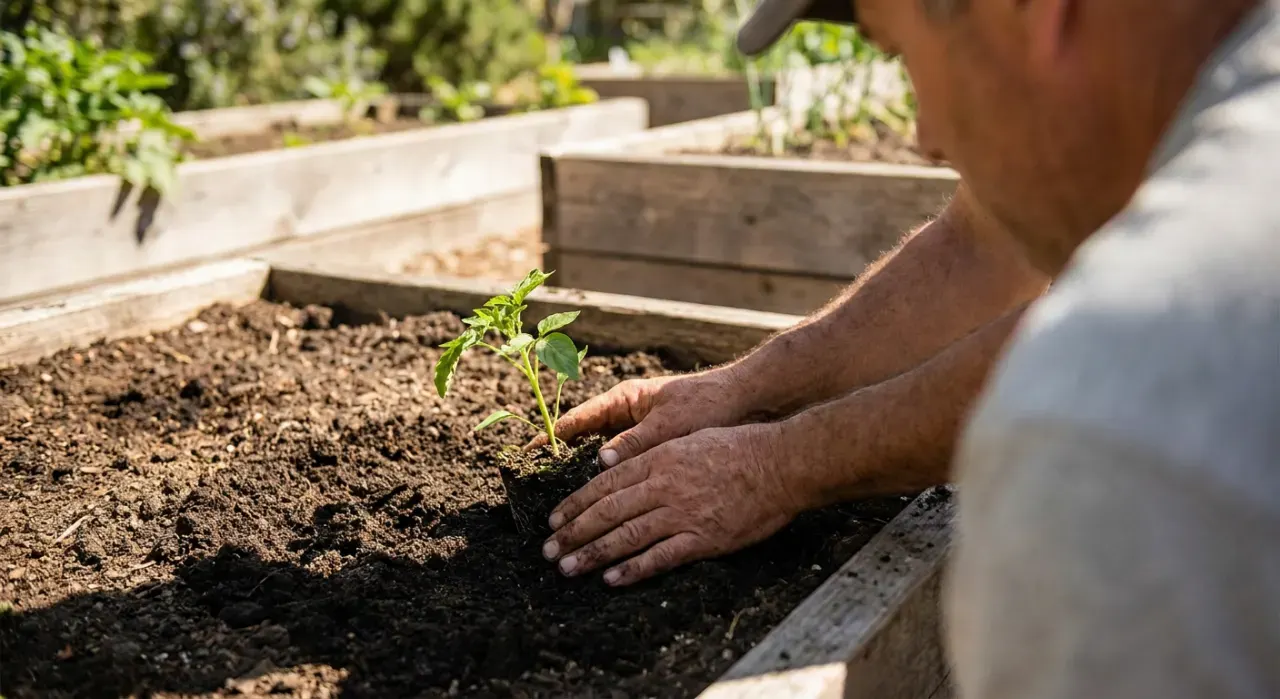
Bad soil. This is the strongest argument and it is the reason the category exists. Heavy clay that sets like concrete, sand that will not hold a nutrient, rocky glacial till, scraped construction fill, or an urban lot with a contamination history — in every one of those cases, improving the native soil is a multi-year project and building a bed on top of it is a weekend. You are not buying a frame; you are buying soil.
Poor drainage. Raised soil sheds excess water rather than sitting in it, and root rot in a wet spring is the failure mode that kills more vegetable plantings than drought does. If your yard puddles for hours after rain, or if a spring bed is still too wet to work in mid-May, a raised bed converts that site from marginal to good.
A longer season at both ends. Raised soil warms two to three weeks earlier, which means earlier sowing and earlier transplanting, and it drains and warms again faster after a wet spell. A fixed frame also makes season extension trivial: hoops slot into the sides, a row cover clips to the rim, a cold frame lid sits on top. That structural advantage is easy to underrate and adds up to real weeks of growing.
No compaction, ever. Because the growing area is defined and nobody walks on it, bed soil stays loose indefinitely. That is what allows the dense in-bed spacing that makes a small garden productive.
Your back. A 12-inch bed is a modest improvement. A 24-inch bed you can sit on the edge of, or a 30-inch bed you can work standing, is a transformation — and it is the difference between gardening into your seventies and giving it up.
Small spaces. On a patio, a deck, a rooftop or a gravel yard there is no in-ground option at all. The bed is the garden.
Where In-Ground Still Wins
Cost per square foot. This is the honest counterweight. A 4 by 8 foot bed at 12 inches deep needs about 32 cubic feet of growing medium, plus a frame. An equivalent 32 square feet of open ground needs a fork, some compost and an afternoon. Multiply by six beds and the difference is the price of a lot of gardening.
Water. Ground soil is a reservoir. Roots reach down into moisture that raised soil simply does not have below it, and in a dry climate or under watering restrictions that is decisive. In-ground plantings survive a missed week in July in a way beds often do not, and this is the single most underrated advantage of gardening in the ground.
Sprawling crops. One winter squash plant will run 10 feet. Sweet corn needs a block, not a row, for pollination. Potatoes want space and hilling. Putting any of those in a 4 by 8 bed spends a whole bed on one crop, when the same plants are perfectly happy in rough open ground with minimal soil preparation.
Scale. If you want 500 square feet of vegetables, beds become a construction project and ground becomes a garden. Above roughly 200 square feet the economics tip hard.
Genuinely good soil. Some people have deep loam and do not know how lucky they are. If a spade goes in easily, the soil crumbles rather than smearing, and there are earthworms, building a raised bed on top of it is solving a problem you do not have.
Permanence. Ground soil that you feed and stop walking on gets better every year, indefinitely. A cedar bed needs rebuilding in a decade.
The Middle Options People Forget
The choice is not binary, and two intermediate approaches capture most of the benefit for a fraction of the cost.
Mounded or hilled rows. Mark permanent beds 3 to 4 feet wide with permanent paths between them, then simply mound the soil from the paths onto the beds so the growing surface sits 4 to 8 inches above the path. No frame, no purchased fill. You get most of the drainage benefit, most of the early warm-up, and complete freedom from compaction — because the paths are permanent and nobody walks on the beds. This is how a great many productive market gardens are run, and it costs nothing but labor.
Framed but shallow, on improved ground. A 6 to 8 inch frame on ground you have broadforked and amended. The frame defines the bed, holds mulch in, gives you something to clip hoops to, and needs only a third of the fill of a 12-inch bed — while roots run straight down into the improved ground below and behave as if the bed were much deeper. For most gardeners with workable native soil this is the best value in the whole category.
Grow bags and fabric beds. The cheapest entry to contained growing. A large fabric bed holds real volume, air-prunes roots into a denser root system, and can be moved or stored. It dries out faster than a framed bed and lasts three to five seasons, which is an honest trade rather than a hidden flaw. The field is covered in best grow bags, and it is a reasonable way to garden for a season while you work out where the permanent beds should go.
Choosing by Crop
| Crop | Better in | Why |
|---|---|---|
| Salad greens, spinach, arugula | Raised bed | Early sowing, dense spacing, easy cover for shade or frost |
| Herbs | Raised bed | Drainage matters more than fertility for most of them |
| Carrots, beets, parsnips | Raised bed | Stone-free, loose soil is the whole battle |
| Tomatoes, peppers, eggplant | Either; bed for an earlier start | Beds warm sooner, which matters in short seasons |
| Bush beans, peas | Either | Undemanding; use whichever you have |
| Garlic and onions | Raised bed | Hate wet feet over winter; drainage decides the crop |
| Strawberries | Raised bed | Drainage, cleanliness, easier netting against birds |
| Potatoes | In-ground, or a deep dedicated bed | Space, hilling, and a large volume of soil per plant |
| Winter squash, pumpkin, melon | In-ground | They sprawl; a bed is a waste of built volume |
| Sweet corn | In-ground | Needs a block for pollination, and lots of it |
| Asparagus, rhubarb | Either, but dedicated | Permanent, deep-rooted, cannot be rotated |
| Blueberries | Container or wood bed | Need acidic soil, which is easier to hold in a container |
The Cost Comparison, Framed Honestly
For a first-year garden of about 100 square feet of growing area:
| Approach | What you buy | Relative first-year cost | Ongoing |
|---|---|---|---|
| In-ground rows on decent soil | Compost, seed, a fork | Lowest | Compost annually |
| Mounded permanent beds, no frame | Compost, seed, mulch for paths | Low | Compost and path top-up |
| Shallow frames on improved ground | 3 frames plus about 1 cu yd of mix | Moderate | Compost annually; rebuild frames eventually |
| Three 4 × 8 beds at 12 in, filled | 3 beds plus about 3.5 cu yd of mix | High | Compost annually |
| Three 4 × 8 beds at 18 in, filled | 3 beds plus about 5.3 cu yd of mix | Highest | Compost annually; more settling to top up |
The fill is usually the surprise, not the frame. Ways to bring it down substantially — hugelkultur cores, bulk delivery instead of bags, and the cubic-foot math to work out what you actually need — are in cheapest way to fill a raised bed. And building shallower is the other lever, since depth scales cost linearly while growing area does not change at all; the depth-by-crop breakdown is in how deep should a raised bed be.
The Raised Bed Downsides Nobody Mentions at Purchase
Watering. The most consistent theme in owner reports after a first season. Beds dry from the sides as well as the top, and a metal bed in full sun dries fastest of all. Drip line laid along each bed at build time, plus 2 to 3 inches of mulch, solves it permanently and costs far less than the frustration of hand-watering in August. Install it before you plant, not after.
Summer heat at the root zone. The early-spring advantage inverts in July. Lettuce bolts sooner in a bed than in the ground, and shallow-rooted crops suffer in a heatwave. Mulch, and consider shade cloth over beds during the worst weeks.
Settling. Expect 3 to 4 inches of drop in the first season, more with an organic core, and plan on topping up with compost each spring.
Fertility runs down faster. Warmer, better-aerated soil mineralizes organic matter more quickly, so beds need feeding more regularly than ground soil does. An inch or two of compost annually is the baseline, not an extra.
Perennial weeds still come through. Bindweed, quack grass and horsetail will find their way up through cardboard and into a bed. Beds reduce weed pressure; they do not end it.
They are permanent-ish. Once filled, a bed is not being moved without a lot of shoveling. Mark the layout with string and live with it for a few days before building — the layout rules are in raised bed spacing and layout.
How to Decide, in Three Questions
- Dig a hole a foot deep where you want to grow. If the spade goes in without a fight, the soil crumbles rather than smearing, and there are worms in it — you have good ground and in-ground or shallow frames will serve you well. If you hit rock, a compacted pan or heavy gray clay, build a bed.
- Fill the hole with water and watch it. If it drains within a few hours, drainage is fine. If it is still holding water the next day, you have a wet site and a raised bed is the direct answer.
- Ask what you want to grow and how much. Intensive salad, herbs, tomatoes and roots in a modest area suit beds. Squash, corn and potatoes at scale suit open ground. Wanting both is normal and building both is normal.
If the answer comes out in favor of beds, material choice is the next decision and it is mostly about lifespan, looks and price rather than performance — metal, cedar and composite all hold soil equally well. The field is ranked in best raised garden bed.
We never buy, test or physically handle the products we rank. Recommendations come from aggregated owner reviews, star ratings, review volume and expert consensus — see how we rank.
More from this hub: Raised Beds & Planters · How deep should a raised bed be · What to fill a raised bed with · Are galvanized beds safe · How we rank