 Garden

Affiliate Disclosure
Some links on this page are affiliate links. As an Amazon Associate, we earn from qualifying purchases — at no extra cost to you. We do not buy, test, or physically handle the products we cover; our rankings come from aggregated owner reviews, ratings and expert consensus. Commissions never change our verdicts. How we rank · full disclosure.
The short version: after weighing six popular home security systems on sensor coverage, what happens during a power or internet outage, the real three-year cost of monitoring and what reviews written a year or more after purchase say, our #1 pick is the Ring Alarm 8-Piece Kit (2nd Gen). It has the cheapest professional monitoring of the mainstream systems, sensors that stay off your Wi-Fi, and it still works — siren, app alerts, sensor log — if you never pay a cent beyond the box.
This page covers whole systems: hubs, door and window sensors, motion detectors, keypads, sirens and the monitoring plans behind them, both professionally monitored and self-monitored. If you specifically want the DIY-installation angle, our best DIY home security systems guide goes deeper on kit sizing and expansion. If what you actually want is one camera watching a driveway, go to best home security cameras instead — a camera tells you what happened, a system tells you the moment a door opened and makes noise about it.
Top Picks at a Glance
Read This First: the Monthly Fee Is the Real Price
The single most common regret in this category is buying on the sticker price. The hardware is the headline number and the monitoring plan is the actual cost. Over three years a mid-tier plan almost always exceeds what you paid for the kit, and over five years it can be several times the kit price.
Here is the arithmetic laid out. Plan pricing moves — these are ranges as of mid-2026 and you should confirm on the vendor page before buying — but the shape of the table does not change.
| System | Typical kit price | Monitoring, per month | 3-year plan cost | 3-year total |
|---|---|---|---|---|
| Ring Alarm 8-Piece, self-monitored | ~$250 | $0 | $0 | ~$250 |
| Ring Alarm 8-Piece, monitored | ~$250 | ~$10–$20 | ~$360–$720 | ~$610–$970 |
| SimpliSafe 8-Piece, monitored | ~$260 | ~$22–$32 | ~$790–$1,150 | ~$1,050–$1,410 |
| eufy 5-Piece, self-monitored | ~$180 | $0 | $0 | ~$180 |
| Ring Alarm Pro, monitored with internet backup | ~$300 | ~$20 | ~$720 | ~$1,020 |
| Traditional installed system on contract | often financed | ~$30–$60 | ~$1,080–$2,160 | ~$1,100–$2,300+ |
Two things follow from that table. First, if you are choosing between brands, compare the plans, not the boxes — the hardware differences are small next to a $700 gap in three-year cost. Second, decide early whether you want professional monitoring at all, because that decision moves the total more than any other choice you will make. Our side-by-side comparison tool lets you line these systems up on verified owner ratings if you want to see them next to each other.
Self-Monitored vs Professionally Monitored: the Distinction That Matters
These two words get used as though they are tiers of the same thing. They are different products.
Professional monitoring means a staffed center receives the alarm signal, attempts to contact you, asks for your safe word, and dispatches police or the fire department if you do not answer or answer wrongly. That chain runs whether you are asleep, in a meeting, on a flight or in a dead zone. It is the only version of home security that summons help without you.
Self-monitoring means the siren sounds and your phone gets a push notification. If you see it, you decide what to do. If your phone is face-down on silent, or you are somewhere with no signal, or you are asleep, the notification sits there. Nothing else in the chain fires.
That is not an argument against self-monitoring. For a lot of households it is genuinely the right call: the siren does most of the deterrent work, the app log is useful, and the money saved is real. It is an argument for knowing which one you bought. The most bitter reviews in this whole category come from people who assumed a dispatch was included and found out during an actual break-in that it was not.
One practical note if you do choose professional monitoring: many American cities require an alarm permit for a system that can dispatch police, registered with the local police department for a small annual fee, with escalating fines for repeated false alarms. This is entirely jurisdiction-specific — your city or county website is the only reliable source.
Our #1 Pick: Ring Alarm 8-Piece Kit (2nd Gen)
The eight-piece kit suits a one- or two-bedroom home: a base station, a keypad, four contact sensors, a motion detector and a range extender. The base station carries the siren, the battery backup and — on a monitored plan — the cellular radio, so it keeps working through a power cut and a broadband outage. Sensors talk to it over Z-Wave rather than Wi-Fi, so adding a dozen sensors does not add a dozen devices to your router. That single design decision is why this system draws far fewer connectivity complaints than Wi-Fi-per-sensor alternatives.
What owners consistently praise is cost with no strings. The monitoring plan is the cheapest of the mainstream options, it includes cellular backup, and there is no contract. Decline it entirely and the system still works — siren, app alerts, full sensor history. Reviewers moving off a legacy contract alarm return to that combination over and over as the reason they switched.
Consensus Score █████████░ 9.0
The complaints are worth taking seriously. It is an Amazon ecosystem product — the app, the cameras and the voice control all assume Alexa, and reviewers who mind say so plainly. Key features are plan-gated: without a subscription you lose cellular backup and camera recording, which changes the math for some buyers. The contact sensors are bulky next to newer designs. And the range extender is closer to required than optional in a house with plaster or masonry walls, so budget a second one above roughly 2,000 square feet.
Check price on Amazon → (paid link)
Best Home Security Systems 2026: The Ranked Field

Best for most homes — the lowest total cost over three years with real monitoring
- Base station, keypad, 4 door/window sensors, motion detector, range extender
- Z-Wave sensor mesh — sensors do not sit on your Wi-Fi
- Professional monitoring with cellular backup on a paid plan, no contract
- Works fully self-monitored for $0 if you skip the plan
Why buy it: the cheapest professional monitoring of any mainstream system, cheap add-on sensors, and it still functions with no plan at all.

Best for people who want a monitoring center on the line, not a phone buzz
- Base station with 95 dB siren, keypad, entry and motion sensors
- Cellular radio and battery backup built into the base station
- Encrypted proprietary sensor radio, not Wi-Fi
- Month-to-month monitoring, no contract, cancel any time
Why buy it: the monitoring experience owners rate highest — fast operator pickup, easy false-alarm cancellation, and no contract to escape.
Best for self-monitoring with genuinely zero recurring cost
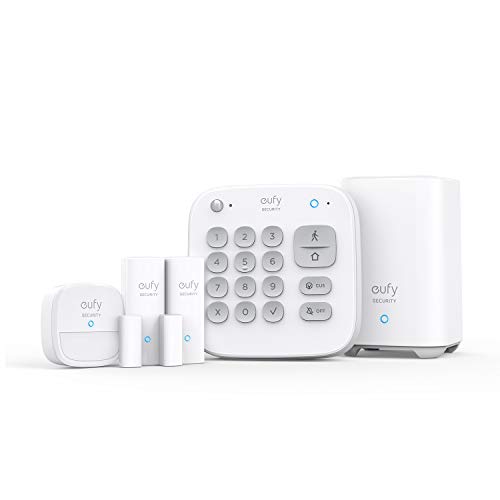
- HomeBase hub, keypad, motion sensor, 2 entry sensors
- Every core alarm function works without a subscription
- Links to eufyCam cameras with local storage on the HomeBase
- Optional professional monitoring if you want it later
Why buy it: nothing is paywalled, which over three years is the difference between a $180 purchase and a $900 one.

Best for homes where a cut line or a dead router is the realistic failure
- Base station doubles as an eero Wi-Fi 6 mesh router
- Cellular internet backup keeps the whole home online on a paid plan
- Local video storage on a microSD card in the base
- 24-hour battery backup in the base station
Why buy it: it is the only kit here that keeps the house online — not just the alarm — when the broadband drops.

Best for wanting an operator to see what tripped the alarm
- The 8-piece kit plus an indoor HD camera
- Physical privacy shutter closes when the system is disarmed
- Video verification can speed police dispatch on a monitored plan
- Same no-contract monitoring terms
Why buy it: sensors say something happened; a verified clip says what — and that difference is what turns an alert into a dispatch.

Best for covering the outside of the house instead of the doors inside it
- Four 4K solar-charging cameras plus a HomeBase 3
- 16 GB local storage built in, expandable, no subscription
- On-device AI face and person recognition
- HomeBase 3 acts as the hub for eufy sensors and locks
Why buy it: a no-fee outdoor system that records in 4K to a hard drive you own, with cameras that charge themselves.
Quick Comparison
| Product | Best for | Rating | Price | Buy |
|---|---|---|---|---|
| Ring Alarm 8-Piece Kit (2nd Gen) Home Security System | Best Overall | — | Check (paid link) | |
| SimpliSafe 8-Piece Wireless Home Security System | Best Professional Monitoring | — | Check (paid link) | |
| eufy Security 5-Piece Home Alarm Kit with HomeBase | Best With No Monthly Fee | — | Check (paid link) | |
| Ring Alarm Pro 8-Piece Kit with Built-in eero Wi-Fi 6 Router | Best for Internet Outages | — | Check (paid link) | |
| SimpliSafe 9-Piece Wireless Home Security System with HD Camera | Best With Camera Verification | — | Check (paid link) | |
| eufy Security eufyCam S330 (eufyCam 3) 4-Camera Kit | Best Camera-First System | — | Check (paid link) |
What Happens When Things Go Wrong
This table is the one to read twice. A security system is judged on the day the power is out, the internet is down, or someone has deliberately cut both.
| System | Sensor radio | Works with no plan? | Cellular backup | Local video storage |
|---|---|---|---|---|
| Ring Alarm 8-Piece (2nd Gen) | Z-Wave | Yes — siren, app, log | On paid plan | No |
| SimpliSafe 8-Piece | Encrypted proprietary | Yes — siren and app | On paid plan | No |
| eufy 5-Piece Alarm Kit | Proprietary to HomeBase | Yes — fully | Optional service | Yes, with eufy cameras |
| Ring Alarm Pro | Z-Wave | Yes — siren, app, log | On paid plan, plus internet backup | Yes — microSD in base |
| SimpliSafe 9-Piece + camera | Encrypted proprietary | Yes — siren and app | On paid plan | No |
| eufyCam S330 4-Cam Kit | Proprietary to HomeBase 3 | Yes — fully | No | Yes — 16 GB built in |
Note what the second column does not say. Every one of these keeps making noise locally without a plan. What the plan buys is the part that reaches outside your house.
How We Rank
We never buy, install or physically handle the products on this site, and we say so on every ranking page. These rankings come from aggregated owner reviews, star ratings, review volume, manufacturer specifications and expert consensus from established security and smart home publications. For whole systems we weight four things: reliability of the hub-to-sensor link, since dropped sensors and false alarms dominate the negative reviews; resilience — what the system does during a power cut, a broadband outage or a cut line; three-year total cost including the plan rather than the box price; and expandability, because almost every household buys more sensors than the starter kit contains. Full method on how we rank.
The Systems, Reviewed
1. Ring Alarm 8-Piece Kit (2nd Gen) — Best Overall
Covered above. What owners like: the cheapest monitoring of the majors, Z-Wave sensors that stay off the Wi-Fi, inexpensive add-on sensors, a genuinely quick setup, and a system that still works free. What they complain about: deep Alexa dependence, plan-gated cellular backup, bulky sensors, and extenders needed in larger homes. Check price (paid link).
2. SimpliSafe 8-Piece — Best Professional Monitoring
SimpliSafe built its name on the monitoring experience rather than the hardware, and the review record reflects that: what owners praise most is how quickly an operator comes on the line and how easy it is to cancel a false alarm before anyone is dispatched. The base station carries a loud siren, battery backup and cellular, and the sensors use an encrypted proprietary radio rather than Wi-Fi — strong encryption on connected devices being one of the baseline practices the FTC recommends.
Consensus Score ████████░░ 8.8
Recurring complaints: it is weakest without a plan, and reviewers who expected full functionality for free are the unhappiest group in its reviews. Monitoring costs meaningfully more than Ring’s. The keypad and sensors are plastic and feel it. Camera integration is thinner than Ring’s.
3. eufy Security 5-Piece Home Alarm Kit — Best With No Monthly Fee
The eufy proposition is simple and, over three years, financially significant: every core function works with no subscription. The HomeBase stores footage locally when you add eufy cameras, the app alerts you, the siren sounds, and nothing core sits behind a paywall. Professional monitoring exists as an option rather than an assumption. More on that trade-off in no-monthly-fee security systems.
Consensus Score ████████░░ 8.5
Recurring complaints: five pieces is a small kit and most homes need more sensors, which raises the real price. The monitoring option is newer and less proven than Ring or SimpliSafe. Integration outside eufy’s ecosystem is limited. And the HomeBase must stay near the router on power, which constrains placement.
4. Ring Alarm Pro — Best for Internet Outages
The Alarm Pro base station is also an eero Wi-Fi 6 mesh router, which sounds like a gimmick until you think about the failure mode. On a paid plan its cellular radio provides internet backup for the whole house, not just the alarm — so when the line is cut or the ISP goes down, the alarm reports, the cameras upload, and the rest of your smart home stays online. It also takes a microSD card for local video, one of very few Ring products that does.
Consensus Score ████████░░ 8.4
Recurring complaints: it costs more than the standard Alarm and the internet backup sits on the top-tier plan, so the three-year number is high. As a router it is competent rather than exceptional, and owners with an existing mesh network end up running two systems or replacing one. Setup is more involved than the plain Alarm because you are also commissioning a router.
5. SimpliSafe 9-Piece with HD Camera — Best With Camera Verification
The eight-piece system with an indoor HD camera added. The camera has a physical privacy shutter that closes when the system is disarmed, which is the detail owners mention most often — it answers the obvious objection to a camera in a living room. On a monitored plan, video verification lets an operator confirm an actual intrusion, which is what separates a priority dispatch from a routine one in many jurisdictions.
Consensus Score ████████░░ 8.6
Recurring complaints: the camera is indoor-only and needs an outlet, limiting placement. Recording and verification both require a plan. And buying the camera separately later often costs little more, so the bundle saving is smaller than it looks.
6. eufyCam S330 (eufyCam 3) 4-Camera Kit — Best Camera-First System
Some households do not want door sensors at all; they want to see the outside of the house. This kit is the strongest no-fee answer to that: four 4K cameras with integrated solar panels that keep themselves charged, recording to 16 GB of local storage in a HomeBase 3 that you can expand with your own drive. On-device recognition handles person and face detection without sending anything to a cloud service.
Consensus Score ████████░░ 8.2
Recurring complaints: the up-front price is the highest here. Solar charging underperforms in winter at northern latitudes and in shaded mounting spots, and owners in those situations end up recharging by hand. The app has drawn criticism over past changes to eufy’s cloud and privacy handling. And cameras are not sensors — this kit will not tell you a door opened.
What Owners Actually Complain About
Read enough security system reviews and five themes account for most of the one- and two-star ratings. False alarms come first, and the cause is nearly always placement — a motion detector aimed at a heating vent, a sunlit window or a pet. Subscription surprise is second, and it is the angriest category: buyers who did not realize cellular backup, camera recording or dispatch required a plan. Sensor dropouts are third, clustering heavily around Wi-Fi-per-sensor designs and around hub systems pushed past their range without an extender. Battery life is fourth — sensor batteries typically last one to three years and always seem to fail at 3 a.m. And adhesive failure is fifth: the supplied tape struggles on textured, dusty or cold surfaces, and experienced owners screw the sensors down instead.
How to Choose a Home Security System
Answer the monitoring question first, because it drives everything else. Do you want an operator who calls the police, or do you want your phone to buzz? If the answer is an operator, price the plan over three years and let that pick the brand. If the answer is your phone, eufy is the honest choice because nothing core is paywalled.
Then count openings: every exterior door, every reachable ground-floor window that opens, plus one motion detector per main living space. A typical 1–2 bedroom home lands at four to six contact sensors; a three-bedroom with a basement door and a slider is usually eight to twelve. Buy the kit nearest that number and add sensors individually — they are cheap on every system here.
Then check three practicalities. Does it survive an outage — hub with cellular and battery, or nothing? Where can the hub physically live, since most need power and proximity to the router? And does your city require an alarm permit? On the security of the devices themselves, NIST IR 8425 sets out a recommended baseline for consumer IoT products — a useful yardstick when a vendor makes vague claims about app security.
On deterrence, be skeptical of big numbers. The most-quoted evidence is a 2012 University of North Carolina at Charlotte study of 422 incarcerated burglars, in which about 60 percent said an alarm would push them to another target. That study was funded by the Alarm Industry Research and Educational Foundation, which is worth knowing before treating the figure as independent. What is not in dispute is that a siren and a phone alert shorten the time an intruder will stay.
Once the alarm is in, the natural additions are a video doorbell at the front door, outdoor cameras on the approaches, and a smart lock so the spare key stops living under the mat. If you are weighing two specific brands, we compare them directly in SimpliSafe vs Ring and Ring vs ADT.
The Verdict
For most homes the Ring Alarm 8-Piece Kit is the system to buy: cheap sensors, the cheapest monitoring of the majors, Z-Wave rather than Wi-Fi, and full function without a plan. Choose SimpliSafe if the monitoring center is the whole point, eufy if you refuse to pay monthly, Ring Alarm Pro if internet reliability is your real problem, and the eufyCam S330 kit if you want eyes outside rather than sensors inside. Check price on Amazon → (paid link)
More from this hub: Smart Home & Security · Best DIY security systems · Best systems for renters · Best security cameras · How many cameras do I need? · How we rank