 Garden

Affiliate Disclosure
Some links on this page are affiliate links. As an Amazon Associate, we earn from qualifying purchases — at no extra cost to you. We do not buy, test, or physically handle the products we cover; our rankings come from aggregated owner reviews, ratings and expert consensus. Commissions never change our verdicts. How we rank · full disclosure.
Label the end panel, not the lid; use one bin size across the whole space so everything stacks; write the category rather than an inventory; and add color for zone or owner so a stray bin can be re-homed from across the room. Those four rules cover the vast majority of what makes a labeling system survive. The reason organized garages and closets unravel after six months is almost never that the storage was wrong — it is that finding something took longer than dumping it somewhere, and inconsistent labeling is what makes finding slow.
Why labeling is the load-bearing habit
A storage system has to beat the alternative, and the alternative is putting things down wherever you are standing. That is a competition on effort. If retrieving the holiday lights means opening four unmarked bins on a ladder, the system loses, and after a few losses people stop putting things back at all.
Good labeling does three things. It makes retrieval fast, which is what keeps the system in use. It makes return obvious, so anyone in the household — not just the person who built the system — knows where something goes. And it makes gaps visible: an empty labeled slot tells you something is missing, which is how you notice the drill has been in the car for three weeks.
That second point is the one people underestimate. A system only one person can navigate is a system that person maintains alone, and it collapses the first time they are busy for a month.
The rules that hold up
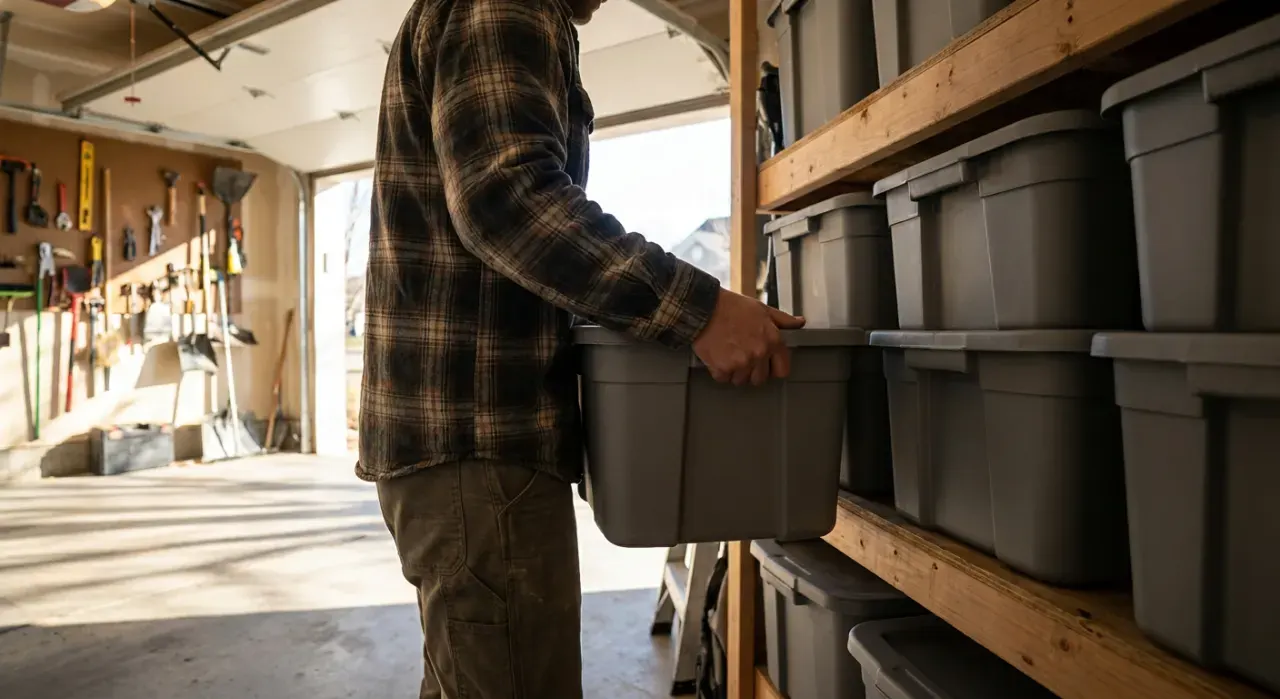
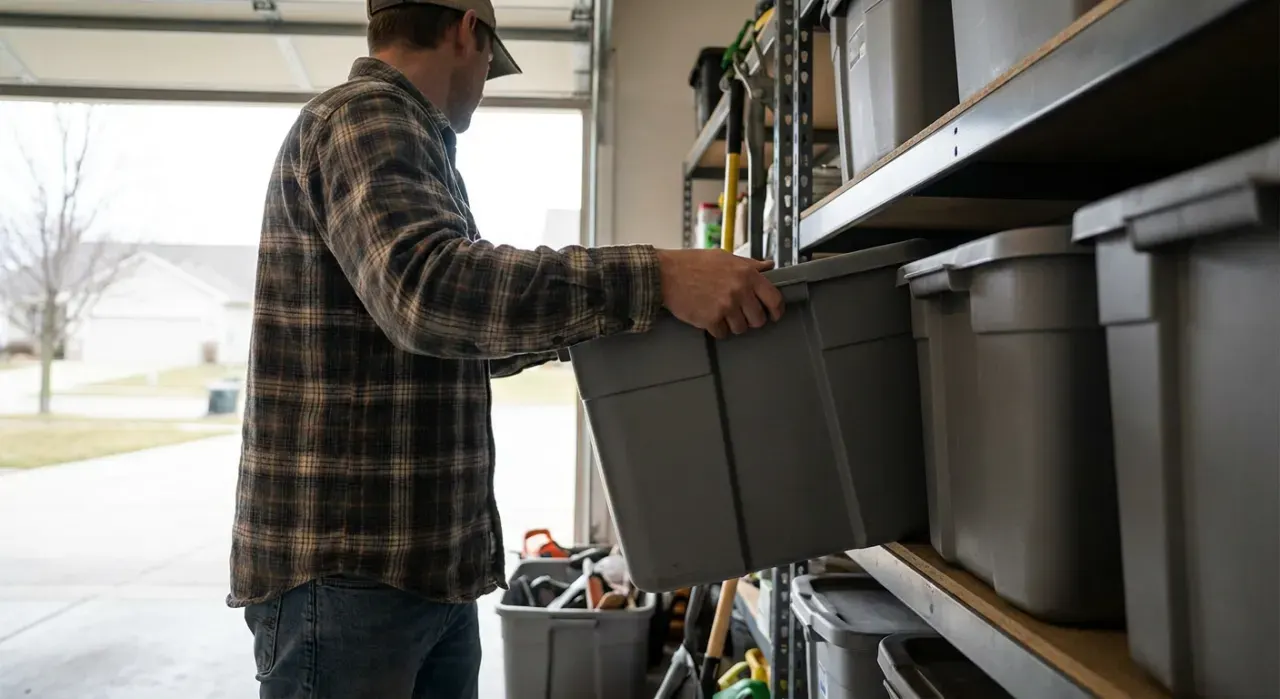
1. End panel, always. On a shelf you see the end and nothing else. Lids are invisible and long sides are against the next bin. The one exception is floor stacks, where lids are visible — and labeling both costs a few extra seconds.
2. One bin size. This is a labeling rule as much as a storage one. Uniform bins stack squarely, sit at consistent heights, and put every label in the same place on every shelf, so your eye learns where to look. Mixed sizes scatter the labels and waste vertical space.
3. Category, not inventory. “Camping — cooking and lighting” stays accurate for a decade. A contents list is wrong the first time someone borrows something. Three to six words is the target: enough to decide whether to open this bin, not enough to require maintenance.
4. Big enough to read at distance. If you have to climb the ladder to read the label, the label has failed at its main job. Aim for legible from six to eight feet.
5. Color for zone or owner. A colored lid or colored label tells you a bin belongs in the seasonal zone, or belongs to a particular person, without anyone reading a word. This is what makes a family able to re-home a stray bin.
6. Clear beats labeled where you can. The best label is the one you do not need — for anything opened more than twice a year, a clear bin plus a category label beats an opaque bin plus a detailed one.

Best for anything you open more than twice a year, where seeing the contents beats reading about them
- Clear body, so the label only has to name the category, not the contents
- Latching lids keep dust out and stay shut when carried
- Uniform size means everything stacks and interchanges
- Flat end panel gives a clean surface for a label
Why buy it: the best label is the one you do not need — a clear bin answers most questions before anyone reads anything.
What to label with, and what fails
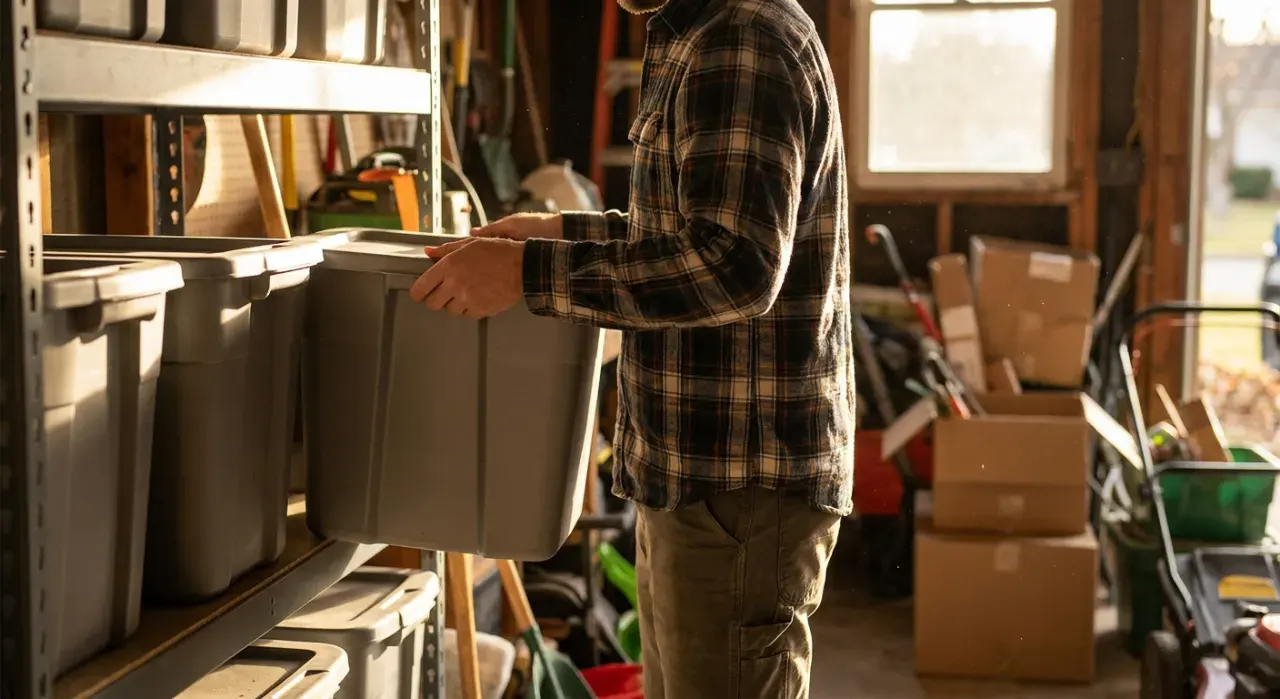
Garages and attics are hostile to adhesives. Temperature cycling from below freezing to above 120°F dries out cheap glue, and UV through a window fades ink. Choose accordingly.
| Method | Lasts | Good for | Weakness |
|---|---|---|---|
| Printed label-maker tape | Years | Permanent categories | Hard to remove cleanly |
| Adhesive labels + permanent marker | 2–5 years | Most household use | Handwriting legibility |
| Painter’s tape + marker | Months to a year | Temporary or changing contents | Dries out and falls off in heat |
| Clip-on label holders | Indefinite | Bins whose contents rotate | Requires a compatible bin rim |
| Chalkboard adhesive panel | Years | Frequently changing contents | Chalk smudges when handled |
| Number + external index | Indefinite | Deep storage, archives, spare parts | The index must actually be kept |
Two failure modes account for most dead labels: masking tape in an unconditioned space, where the adhesive gives up within a year or two, and ballpoint or non-permanent marker, which fades to nothing. Neither is obvious until you need the bin.
The numbered index, for deep storage
Category labels stop being enough when the contents are genuinely miscellaneous — spare parts, archived paperwork, outgrown clothing by size, hobby components. The fix is to stop trying to describe the bin on the bin.
- Number every bin permanently and largely on the end panel: 1, 2, 3.
- Keep the detail in a phone note, a shared document or a spreadsheet, one row per bin.
- Search the note, not the shelf. “Where are the extra deck screws?” becomes a text search that returns “bin 14.”
- Update the note when contents change — which is a thirty-second edit rather than replacing a label.
This is the one system that scales past about twenty bins, and it is the only one that copes with contents that shift. It has a single point of failure: if nobody maintains the index, it becomes worse than a written label. Keep it somewhere shared rather than in one person’s head.
Adapting it room by room
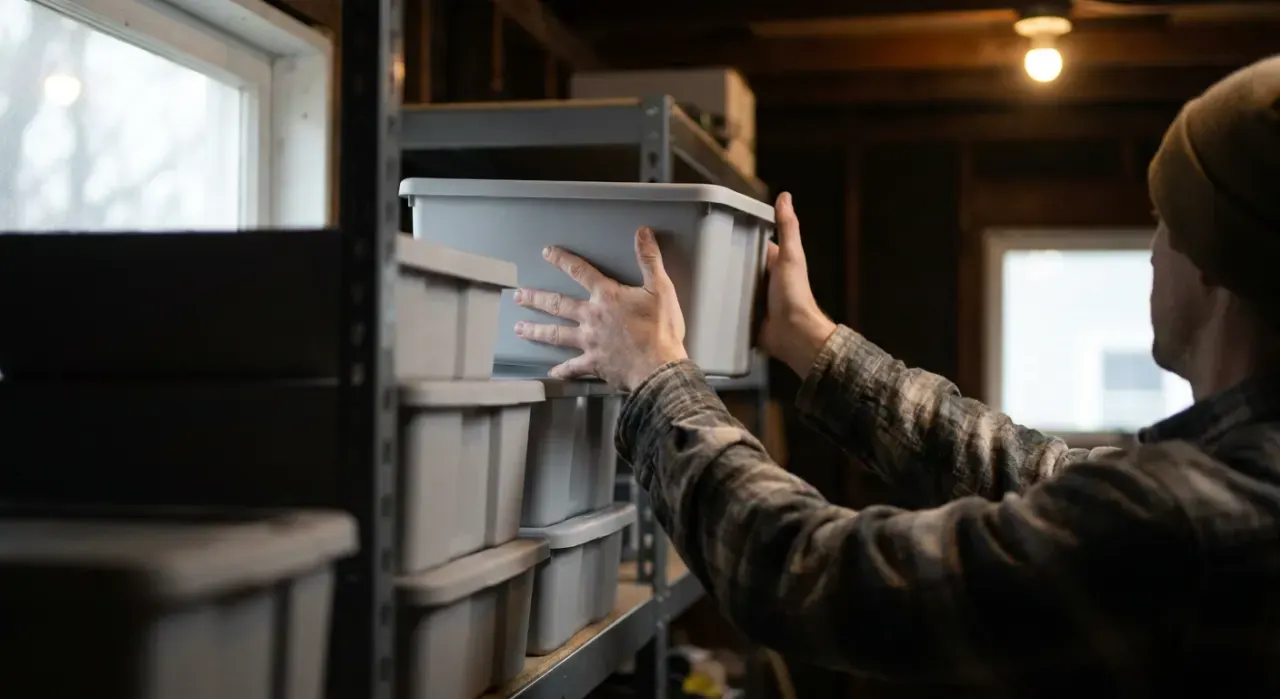
Garage. Uniform totes, end labels, color by zone. Match the labeling to the zones described in how to organize a garage so the label tells you not just what it is but where it lives.
Attic. Everything gets a label because nothing is convenient to open on a ladder in the heat, and add the year the bin was last opened. Anything untouched for two summers is a candidate for disposal. See storing things in a hot attic.
Pantry. Labels face out on decanted containers, and include the item plus the use-by if you decant. This is where clear containers do the most work — see how to organize a pantry and best pantry organizers.
Closets. Shelf-edge labels rather than bin labels, because closet storage is usually open. Season and size are the two useful categories — see small closet layout.
Under-bed. Label the end that faces out from under the bed, which is the only one you will ever see. See best under-bed storage.
Starting without redoing everything
Do not label the whole house in a weekend. Label the bins you actually opened in the last three months, because those are the ones where retrieval speed pays off, and leave the rest until you next touch them. A system built incrementally around real use ends up matching how the household actually behaves, which is the only version that lasts.
Then set one rule for new items: nothing goes into storage unlabeled. That single habit is what stops the drift back, and it is a fifteen-second task at the moment when you already know what is in the box. A practical walkthrough of the mechanics is in how to label storage bins, and the container field is ranked in best storage bins.
We never buy, test or physically handle the products we rank. Every recommendation is drawn from aggregated owner reviews, star ratings, review volume and published expert consensus — see how we rank.
More from this hub: Storage & Organization · How to organize a garage · Storing things in a hot attic · Best storage bins · How we rank