 Garden

Affiliate Disclosure
Some links on this page are affiliate links. As an Amazon Associate, we earn from qualifying purchases — at no extra cost to you. We do not buy, test, or physically handle the products we cover; our rankings come from aggregated owner reviews, ratings and expert consensus. Commissions never change our verdicts. How we rank · full disclosure.
The short version: after weighing six popular seed starting kits on aggregated owner ratings, review volume and the complaints that come up again and again, our #1 pick is the HomeBuddy 10-Pack Seed Starter Tray. It rates 4.5 across more than thousands of owner ratings, delivers 120 cells with genuinely adjustable dome vents, and — the detail owners keep returning to — its trays survive a season of watering and washing without splitting. Below is the ranked field, the real recurring gripes, and a comparison table.
This is the start step of a vegetable garden. Timing matters more than gear, so check your sowing dates in when to start seeds by zone before you buy anything, and read how to start seeds indoors for the method itself.
Top Picks at a Glance

Our #1 Pick: HomeBuddy 10-Pack Seed Starter Tray
If you buy one kit this spring, this is the one the consensus supports most strongly. Across more than 418 owner ratings it holds 4.5 stars, and the praise clusters around one thing that cheap trays get wrong: the plastic is thick enough to survive. Reviewers who have run it for two and three seasons report cells that still hold their shape after repeated washing, which is exactly where flimsier ten-dollar sets fail.
The rest of the design is sensible rather than clever. You get ten trays of twelve cells — 120 cells total, enough for a full spring of sowing plus succession batches — each with a solid, watertight base tray so you can bottom water. The domes have sliding vents, which matters more than it sounds: fixed domes trap stagnant, saturated air and invite damping off — the seedling disease Penn State Extension attributes to soil-borne fungi in wet, poorly drained conditions, while a vent you can crack open lets you wean seedlings off humidity gradually. Labels and a small hand tool set are included, and the footprint is the industry-standard 10 in × 20 in, so it drops straight onto any heat mat or shop-light shelf.
Consensus Score ██████████░░ 8.7 — from 418 owner ratings.
What is it not? It is not self-watering, and it does not include a light or a heat mat. If you need either of those in the box, jump to picks 3 and 4.
Check price on Amazon → (paid link)
Best Seed Starting Kits 2026: The Ranked Field
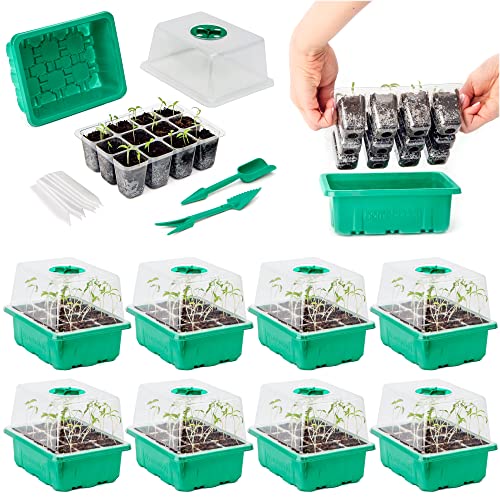
Best for the gardener who wants one kit that covers a whole spring
- 10 trays, 120 cells total
- Adjustable-vent humidity domes
- Plant labels and hand tools included
- Fits a standard 10 in × 20 in heat mat
Why buy it: the best balance of capacity, sturdiness and price — enough cells for a full season of sowing without the flimsy plastic owners complain about in cheaper sets.

Best for a first spring or a small balcony sowing plan
- 5 trays, 12 cells each (60 total)
- Adjustable dome vents
- Solid base trays for bottom watering
- Cheapest per cell here
Why buy it: the least money you can spend and still get vented domes and a watertight base tray — the two things that actually matter.

Best for people with no south-facing window
- 2 trays, 80 cells total
- Integrated full-spectrum LED bar
- Built-in 4/8/12-hour timer
- Height-adjustable light arms
Why buy it: it solves the leggy-seedling problem in the box — no separate shop light, stand or timer to buy.
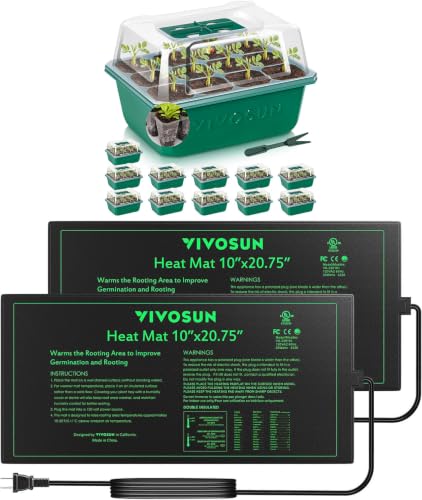
Best for tomatoes, peppers, eggplant and other heat-lovers
- 2 UL-listed waterproof heat mats
- 12 trays, 144 cells
- Raises soil roughly 10°F–20°F above room temp
- Humidity domes included
Why buy it: warm-season seed that sulks for two weeks at room temperature is usually up in five or six days on a mat.

Best for absolute beginners who do not want to handle soil
- 72 compressed peat pellets
- Just add water — pellets expand in minutes
- Clear vented greenhouse dome
- Transplant pellet and all, no root shock
Why buy it: the simplest possible entry point — no mixing, no measuring, and transplanting is a single lift with almost no root disturbance.
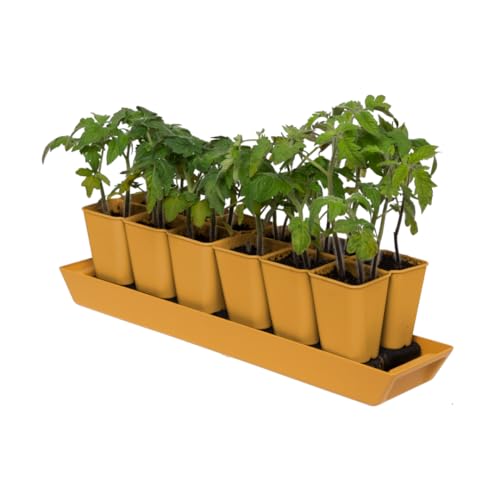
Best for gardeners who forget to water
- Self-watering capillary reservoir
- Extra-deep cells for stronger root runs
- Reusable, heavy-gauge construction
- Includes watering mat and covers
Why buy it: the reservoir keeps moisture even for days at a time — the one design that forgives an erratic watering habit.
Quick Comparison
| Product | Best for | Rating | Price | Buy |
|---|---|---|---|---|
| HomeBuddy Seed Starter Tray, 10-Pack (120 Cells) | Best Overall | — | Check (paid link) | |
| Bonviee 5-Pack Seed Starter Trays with Humidity Domes | Best Value | — | Check (paid link) | |
| SZSJA Seed Starter Kit with Grow Light (80 Cells) | Best All-in-One With Light | — | Check (paid link) | |
| VIVOSUN Seedling Heat Mat + 12-Pack Tray Kit (144 Cells) | Fastest Germination | — | Check (paid link) | |
| Jiffy 72-Cell Seed Starter Greenhouse with Peat Pellets | Best Beginner Pellet Kit | — | Check (paid link) | |
| Gardener’s Supply Company Gardener’s Best XL Seed Starting Kit | Best Premium | — | Check (paid link) |

The Numbers Side by Side
| Kit | Cells | Dome | Light | Heat | Reusable |
|---|---|---|---|---|---|
| HomeBuddy 10-Pack | 120 | Adjustable vents | No | No (mat-compatible) | Yes, multi-season |
| Bonviee 5-Pack | 60 | Adjustable vents | No | No (mat-compatible) | 1–2 seasons |
| SZSJA with Grow Light | 80 | Yes | Full-spectrum LED + timer | No | Yes |
| VIVOSUN Heat Mat Kit | 144 | Yes | No | 2 UL-listed mats | Mats yes, trays 1–2 seasons |
| Jiffy 72-Cell Greenhouse | 72 | Vented dome | No | No | Tray yes, pellets no |
| Gardener’s Best XL | Deep XL cells | Covers included | No | No | Yes, heavy-gauge |
How We Rank
We do not buy, test or physically handle any of these kits — and we say so plainly because it is the honest description of what we do. Instead we read the field the way a careful shopper would if they had a week to spare: we aggregate star ratings and review volume across each listing, then read through the negative reviews specifically, because that is where durability problems live. A kit rated 4.5 across 418 owner ratings is a far stronger signal than a 4.8 across 60.
We weight four things. Durability — do cells crack, do base trays leak, do domes warp? Cell design — depth, drainage and whether seedlings pop out cleanly at transplant time. Germination support — vented domes, heat, light, and whether the kit fits standard 10 in × 20 in accessories. And value per cell, adjusted for how many seasons the thing realistically survives. Prices were checked at the time of writing and move constantly. Full method: how we rank.
What Owners Actually Complain About
Every kit here has recurring gripes, and pretending otherwise would be useless to you. Four come up across nearly every listing in this category.
Thin, brittle plastic. By far the most common complaint across budget trays, including the Bonviee set. Cells split at the corners when you squeeze a seedling out, and base trays flex enough to spill water. Reviewers who lift trays from the middle rather than the ends report far fewer failures.
Domes that do not vent enough. Owners of several kits describe waking up to condensation, mold on the mix surface, and seedlings flattened by damping off. The fix is behavioral — crack the vents as soon as the first seedlings emerge, and remove the dome entirely a few days later — but kits with fixed, unvented domes make it harder.
Uneven heat on mats. On the VIVOSUN bundle, a recurring theme is warm spots and cool corners, plus warnings not to run a mat without a thermostat on hot days. Several reviewers report cooking seedlings by leaving a mat on after germination. Turn it off once the seeds are up.
Peat pellets drying hard. With the Jiffy kit, the repeated complaint is pellets that dry out into a crust and then repel water. They also shrink noticeably, so owners who let them dry once often struggle to rehydrate them evenly. Bottom watering solves most of it.
How to Choose a Seed Starting Kit
Work backward from your constraints. No bright window? Buy a kit with an integrated light, or budget separately for a shop light — this is the one thing you cannot improvise, and it is the direct cause of the stretched, floppy seedlings covered in why seedlings get leggy. Growing tomatoes and peppers? Prioritize a heat mat; the germination difference is dramatic. First time and slightly intimidated? A pellet kit removes half the decisions. Erratic watering habits? A self-watering reservoir kit is genuinely worth the premium.
Two things nearly everyone underestimates. First, buy sterile seed-starting mix rather than potting soil or garden dirt — Clemson Extension asks for a well-drained, well-aerated, sterile soilless medium precisely because it reduces soil-borne diseases such as damping-off. Second, count cells honestly: two cells per plant you intend to grow, because germination is never perfect and you will thin to the strongest seedling. If you are unsure which crops belong in trays at all, direct sow vs transplant settles it crop by crop.
What Separates a Good Kit From a Cheap One
Strip away the marketing and four things genuinely distinguish seed starting kits, and none of them is cell count.
Plastic thickness. This is the whole durability story. Thin thermoformed trays flex when you lift them, split at the cell corners when you squeeze a seedling out, and crack after one dishwasher cycle. Thicker rigid trays cost a few dollars more and last years. The tell in reviews is simple: search the critical reviews for the word "flimsy" and see how often it appears — on the budget sets it dominates, on the HomeBuddy trays it barely registers.
Vent control on the dome. A humidity dome is essential for germination and actively harmful afterward, because the same warm saturated air that helps a seed break dormancy is what damping off needs to flatten a whole tray. A dome with sliding vents lets you wean seedlings gradually; a sealed dome forces an all-or-nothing decision. It is a two-cent feature that changes outcomes.
Cell depth and taper. Deeper cells hold more moisture, so they dry out less violently between waterings, and they give roots a longer run before the plant becomes root-bound. Tapered cells with a firm base also release the root plug cleanly at transplant time — the difference between lifting a seedling out intact and tearing half its roots off. This is where the deeper premium kits earn their price.
Standard sizing. The 10 in × 20 in tray footprint is the industry standard for a reason: every heat mat, light stand, dome and shelf in the hobby is built around it. A kit with an unusual footprint may work fine on its own but locks you out of accessories later, and owners who bought one frequently mention it as their main regret.
Notice what is not on that list. Cell count is easy to inflate and rarely the constraint. Bundled seeds are usually generic and often old. Decorative labels are pleasant and irrelevant. Buy for the plastic, the vents and the depth, and the rest sorts itself out.
Mistakes That Waste a Whole Tray
The gear rarely fails on its own. Five habits account for most lost trays. Sowing too early — a plant that outgrows its cell in March has nowhere to go until May, and it never fully recovers. Leaving the dome on too long — humidity helps germination and then becomes the enemy; once seedlings emerge, vent it, then remove it. Watering from above — it compacts the surface, dislodges tiny seeds and keeps the crown wet; fill the base tray instead and let the mix wick it up. Leaving the heat mat running — heat is for germination, not for growing on; seedlings kept warm and under-lit stretch badly. And skipping the hardening-off week — a tray raised perfectly indoors can still be destroyed in one afternoon of unfiltered sun and wind. The routine is in hardening off seedlings.
The Verdict
For most gardeners, the HomeBuddy 10-Pack Seed Starter Tray is the one we would point at first: enough capacity for a real season, vented domes, standard sizing, and the durability record that owner reviews back up. Spend less and the Bonviee 5-pack gets the job done for a small sowing plan. Add the VIVOSUN heat mat if you are growing tomatoes and peppers, or buy the SZSJA light kit if your windowsill is the problem. Whatever you choose, sow on the right date and put a light over the tray — those two decisions matter more than the plastic.
Next: read how to start seeds indoors, plan the bed they will move into with best raised garden beds, or head back to the seeds and vegetable growing hub for the full map.
Check the current price of our top pick on Amazon → (paid link)