 Garden
Affiliate Disclosure
Some links on this page are affiliate links. As an Amazon Associate, we earn from qualifying purchases — at no extra cost to you. We do not buy, test, or physically handle the products we cover; our rankings come from aggregated owner reviews, ratings and expert consensus. Commissions never change our verdicts. How we rank · full disclosure.
The short version: strawberries are near-perfect container plants — shallow roots, small footprint, fruit that stays clean when it hangs over an edge — but nearly every strawberry planter fails in the same way. Water poured into the top of a stacked tower runs straight down the middle and out the bottom, so the top plants die of drought while the bottom ones sit wet. Our pick is the GreenStalk 5-Tier, because its internal watering system is the only design here that actually solves that. On a budget, the Mr. Stacky tower does the same job for a quarter of the price if you are prepared to water carefully.
Whatever you plant into, strawberries want a minimum of six hours of direct sun, a medium that drains freely, and six to eight inches of usable depth; Wisconsin Extension's container-growing guide covers why a loose, free-draining potting mix matters more in a pot than in a bed. If you are growing them in a bed instead, pine straw is the traditional mulch and it is covered in the best mulch for a vegetable garden. The rest of the hub is at vegetable growing.
Top Picks at a Glance
Our #1 Pick: GreenStalk Large 5-Tier Vertical Planter
Vertical strawberry planters have an obvious appeal and one structural problem. Thirty plants in a single square foot of patio is a genuinely good trade, and strawberries — with their shallow fibrous roots and their preference for fruit that hangs clear of the soil — are the crop the format suits best. The problem is that water goes down, not sideways.
Consensus Score █████████░ 9.1 — the highest-regarded vertical planter in the category among gardeners who have used several
In a simple stacking planter, water poured into the top pot runs through the middle and out the drain hole. The plants in the upper pockets get whatever ran past them, which is not much, and they are simultaneously the most exposed to sun and drying wind. The bottom tier gets everything, and sits in it. Anyone who has run a cheap tower for a season recognizes the pattern: dead plants at the top, waterlogged crowns at the bottom, and a middle band that does fine.
GreenStalk's patented internal watering system is a genuine engineering answer rather than a marketing line. Water goes into a distribution reservoir at the top and is metered out sideways to each pocket on each tier before descending, so every plant on the tower receives roughly the same amount. Owners consistently report the practical result: they can water the whole thing in one operation and every tier stays alive, which is not true of any simple stacking design.
The rest is well judged. It is made in the USA from UV-stabilized, BPA-free food-grade plastic, which matters when the container holds something you eat. The tiers rotate on the stack, so plants that spent a week on the shaded side can be turned into the sun — a small feature that makes a visible difference to ripening evenness.
The complaints are mostly about money and mass. It is expensive — several times what a basic tower costs. Filled with damp medium and thirty plants it is heavy and awkward to move, so it wants siting once and leaving. Some owners report the tiers being tight to separate for cleaning. And it needs water added at a rate the system can distribute — dumping a full watering can into the top overwhelms it and defeats the design.
Check price on Amazon → (paid link)
Best Strawberry Planters: The Ranked Field

Best for a serious strawberry patch in about one square foot of floor space
- Five tiers with 30 planting pockets in a 1 sq ft footprint
- Patented internal watering system distributes water evenly to every tier
- UV-stabilized, BPA-free food-grade plastic made in the USA
- Tiers rotate so every plant gets its turn in the sun
Why buy it: the internal watering system is the whole difference — every other tower dries out at the top and drowns at the bottom, and this one does not.
Best for a first vertical strawberry setup without a large outlay
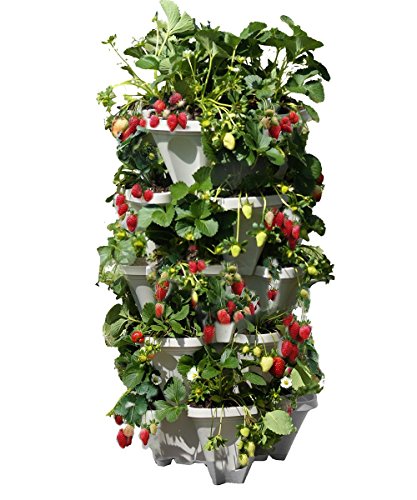
- Five stacking pots, each with four planting pockets — 20 plants total
- Water poured into the top cascades down through each tier
- Stacks and unstacks freely, so height is adjustable
- Works with any growing medium including coir and clay pebbles
Why buy it: a quarter the price of a premium tower for the same basic idea, and the stacking design means you can start small and add tiers.

Best for a patio or balcony where a rigid tower would look and feel too heavy
- 10 gallons of root volume per bag with six side pockets plus the top
- Thickened nonwoven fabric that air-prunes roots instead of letting them circle
- Reinforced handles for moving the bag before it is filled
- Folds flat for winter storage
Why buy it: fabric drains and breathes on every side, which suits strawberries — the crop most reliably killed by sitting in wet potting mix.

Best for one well-made bag that will still be usable in five years
- Eight side pockets sized for shallow strawberry roots
- Mesh grommets in the base prevent waterlogging
- Made from recycled plastic, UV resistant
- Rigid enough to hold its shape when filled
Why buy it: holds its shape and drains properly, which is where the very cheap felt bags fall down after one wet winter.

Best for people who travel in summer and cannot water daily
- 12.7 gallon capacity with a built-in water reservoir and level gauge
- Elevated on legs — no bending, and no slugs climbing straight in
- Drainage plug so the reservoir can be emptied for winter
- Resin construction that does not rot or need treating
Why buy it: strawberries in containers fail from drought more than anything else, and a reservoir with a gauge removes the daily decision entirely.

Best for balconies and deck railings with no floor space at all
- Fits securely over flat railings 3.75 in. or 5.75 in. wide
- Roughly four gallon soil capacity in a 24 in. box
- Fruit hangs over the edge, away from soil and slugs
- UV-stabilized resin, several colorways
Why buy it: a rail planter uses space that was doing nothing at all, and hanging fruit stays clean and out of reach of slugs.
Quick Comparison
| Product | Best for | Rating | Price | Buy |
|---|---|---|---|---|
| GreenStalk Large 5-Tier Vertical Garden Planter with Internal Watering System | Best Overall | — | Check (paid link) | |
| Mr. Stacky 5-Tier Vertical Gardening Planter, Indoor & Outdoor | Best Value Tower | — | Check (paid link) | |
| Strawberry Grow Bags, 2 Pack 10 Gallon with 6 Side Planting Pockets | Best Grow Bag | — | Check (paid link) | |
| Bloem BloemBagz Strawberry Planter Grow Bag, 9 Gallon | Best Single Bag | — | Check (paid link) | |
| Keter Urban Bloomer 12.7 Gallon Raised Garden Bed with Self Watering Gauge | Best Self-Watering | — | Check (paid link) | |
| Bloem Deck Balcony Rail Planter, 24 in. | Best for Railings | — | Check (paid link) |
How We Rank
We do not buy, plant or overwinter these planters. We rank them by aggregating star ratings and review volume across owner reviews, weighting reports from a full season and a winter above assembly-day impressions, checking stated capacity, material and drainage design against manufacturer specifications, and reading negative reviews for the failures that show up in a July heatwave or a wet January.
Four criteria set the order, all specific to strawberries. Water distribution, because uneven watering is the failure mode that kills more container strawberries than anything else. Soil volume per plant, since volume determines how fast a container dries and how often you are tied to a watering can. Drainage and material — strawberry crowns rot readily in medium that stays wet. And owner satisfaction weighted by review count, read for UV degradation, winter survival and honest capacity. Full method: how we rank.
The Planters, Reviewed
1. GreenStalk Large 5-Tier — Best Overall
Covered above. Consensus Score █████████░ 9.1. Strengths: an internal watering system that genuinely distributes to every pocket, thirty plants in one square foot, food-grade UV-stable plastic made in the USA, and rotating tiers for even ripening. Recurring complaints: price is several times that of a basic tower, it is very heavy once filled and effectively immovable, tiers can be tight to separate for cleaning, and the watering system needs water added at a moderate rate rather than dumped.
2. Mr. Stacky 5-Tier — Best Value Tower
The original stacking pot tower and still the most sensible cheap entry into vertical growing: five pots, four pockets each, twenty plants, at roughly a quarter of the price of a premium system. It has no distribution mechanism — water goes in the top and cascades — which means the upper-tier drying problem is real and you have to manage it by watering slowly in several passes. Handled that way it works perfectly well, and the stacking design lets you run three tiers instead of five if you would rather have fewer, healthier plants.
Consensus Score ████████░░ 8.5 — good ratings with a very well-understood set of limitations
Recurring complaints: uneven watering leads the complaints, exactly as the design predicts — top tier dry, bottom tier soggy. The plastic is thinner than premium towers and owners report cracking after two or three seasons of UV exposure and freeze-thaw. A filled stack is top heavy and blows over in wind unless a stake is run down the center. And pocket volume is small, so plants dry out fast in a heatwave.
3. Strawberry Grow Bags, 2 Pack 10 Gallon — Best Grow Bag
Fabric is a genuinely good match for strawberries. Ten gallons of root volume per bag gives each plant far more medium than a tower pocket does, the nonwoven fabric drains and breathes on every surface so crowns are much less likely to sit wet, and the fabric air-prunes roots — they stop at the wall rather than circling — which produces a denser, more fibrous root system. Six side pockets plus the top surface gives around seven plants per bag.
Consensus Score ████████░░ 8.5 — well rated for value, with lifespan the honest trade-off
Recurring complaints: because fabric breathes on all sides it dries out much faster than a solid pot, and owners in hot climates report daily watering in midsummer. The fabric degrades in UV within two to four seasons. The side pockets are small and medium tends to spill out of them when watering from above until plants root in. And the handles will tear if the bag is lifted while full, which it should never be.
4. Bloem BloemBagz Strawberry Planter — Best Single Bag
A step up in build from the generic felt bags. Made from recycled plastic rather than thin nonwoven fabric, it holds its shape when filled instead of slumping, the eight side pockets are properly sized for shallow strawberry roots, and mesh grommets in the base give real drainage rather than relying on the fabric alone. Nine gallons is a sensible volume for a single-bag planting, and the material handles UV noticeably better than felt.
Consensus Score ████████░░ 8.6 — solid ratings with a long track record
Recurring complaints: the pockets are shallower than they look and owners report plants working loose before they root in — most people pin them or plant into a slightly damp mix to hold. It is less breathable than a felt bag, so overwatering is easier. Several reviewers report the material stiffening and cracking in very cold winters if left out filled. And nine gallons across eight pockets plus the top is a modest volume per plant.
5. Keter Urban Bloomer — Best Self-Watering
The answer for anyone whose container strawberries die while they are away for a week in August, which is a much larger group than admits to it. A 12.7 gallon bed with a built-in reservoir and a water level gauge removes the daily judgement call entirely — you fill the reservoir, check the gauge every few days, and the medium wicks moisture up as the plants use it. Being elevated on legs also means no bending to pick and a meaningfully harder climb for slugs.
Consensus Score ████████░░ 8.7 — very large review base with consistently good ratings
Recurring complaints: assembly draws the most criticism — many parts, and owners report panels that need force to click together. The reservoir must be drained before a hard freeze or it cracks the housing, and people forget. It is a flat bed rather than a pocket planter, so fruit rests on the medium unless you mulch or let it hang over the rim. And 12.7 gallons is a modest volume for the physical size of the unit.
6. Bloem Deck Balcony Rail Planter — Best for Railings
The best use of space that was previously doing nothing. It saddles a flat railing 3.75 or 5.75 inches wide, holds roughly four gallons in a 24 inch box, and puts strawberries at eye height with the fruit hanging over the outer edge — clean, easy to pick, and considerably harder for slugs to reach than anything at ground level. For a small balcony where floor space is the entire constraint, this frees up more growing area per dollar than any other option here.
Consensus Score ████████░░ 8.8 — well rated, with railing fit the thing to check before buying
Recurring complaints: the fit is specific, and owners with round, wide or non-standard railings consistently report it not seating properly — measure first. Four gallons is a small volume that dries out fast in sun and wind. There is no drainage tray, so water runs straight through onto whatever is below, which matters on an apartment balcony. And in strong wind an unsecured rail planter can shift, so most owners strap or bolt it.
How to Choose a Strawberry Planter
Start with how you will water, because that decides more than any other factor. If you are home daily and happy to water carefully, a cheap stacking tower is fine and you will simply learn to water in three slow passes. If you travel, work long days, or garden on a hot exposed balcony, buy a system with genuine water distribution or a reservoir — the premium is far cheaper than replacing plants every year.
Then work out volume per plant rather than pocket count. Thirty pockets sounds better than seven, but thirty plants sharing the medium of a five-tier tower have far less root run each than seven plants in a ten gallon bag, and less volume means faster drying and more frequent feeding. One to two gallons per plant is a comfortable target. Anything below about half a gallon per plant will need watering every day in high summer.
Match the variety to the container. June-bearing varieties crop heavily over two to three weeks and throw a lot of runners — good in a bed, awkward in a tower where runners dangle everywhere. Everbearing and day-neutral types produce smaller flushes across the season and make fewer runners, which is why they are the standard container recommendation — University of Wisconsin Extension calls day-neutral varieties the easiest for container growing, because they fruit in the first season and stay more productive than older everbearers. Alpine strawberries suit small pocket planters best of all: tiny, intensely flavored, almost no runners.
Finally, plan for winter before you buy, especially in zone 6 and colder. Roots in a container experience air temperature on all sides and are damaged below roughly 15°F, whereas the same plant in the ground is buffered. A planter you can carry into an unheated garage is worth a lot in a cold zone; a filled five-tier tower is not going anywhere. And expect to replace plants every two to three years — pin a few runners into small pots each summer and you never have to buy them again.
What Owners Actually Complain About
Uneven watering in vertical planters is the number one complaint in this entire category, and it is a physics problem rather than a manufacturing defect. Water descends; it does not spread sideways. Top-tier plants die of drought while bottom-tier crowns rot. Either buy a design with real internal distribution, or water in several slow passes and accept that you are the distribution system.
Drying out far faster than expected is the second theme and it affects fabric bags and small pockets worst. A ten gallon fabric bag in full sun in July can need water every single day, which surprises people who bought it expecting container gardening to be less work than a bed.
UV degradation and winter cracking come up across every plastic and fabric product here. Thin plastic towers become brittle after two or three seasons outdoors; felt bags fray and thin; reservoirs left full through a freeze split their housings. Emptying reservoirs and storing lighter planters under cover through winter meaningfully extends their lives.
And two strawberry-specific ones: slugs and birds, which find ripening fruit before you do — hanging fruit over an edge helps enormously with slugs, and netting is the only real answer to birds; and plants working loose from side pockets before they have rooted in, which is solved by planting into slightly damp medium and pinning each crown for the first fortnight.
The Verdict
If you want a vertical strawberry patch that survives a hot July without daily attention, buy the GreenStalk 5-Tier — the internal watering system is genuinely the thing that separates it from every other tower. On a budget, the Mr. Stacky does the same job for far less if you water carefully. For a patio or balcony, fabric strawberry grow bags give each plant far more root volume than a tower pocket, with the BloemBagz as the better-built single-bag option. If you travel in summer, the Keter Urban Bloomer and its reservoir will save the crop. And where there is no floor space at all, a Bloem rail planter turns a railing into a garden.
Check price on Amazon → (paid link)
Next: mulch beds and containers properly with the best mulch for a vegetable garden, get the feeding right using the best vegetable garden fertilizer, work out watering frequency in how often to water a vegetable garden, and see the wider container options in the best vertical garden planters.