 Garden

Affiliate Disclosure
Some links on this page are affiliate links. As an Amazon Associate, we earn from qualifying purchases — at no extra cost to you. We do not buy, test, or physically handle the products we cover; our rankings come from aggregated owner reviews, ratings and expert consensus. Commissions never change our verdicts. How we rank · full disclosure.
The short answer: one inch of water per week, including rainfall — the typical landscape requirement EPA WaterSense publishes — delivered in one or two deep soakings rather than daily sprinkles. One inch over 100 square feet is about 62 gallons. A 4 by 8 foot raised bed therefore needs roughly 20 gallons a week. In heat above 90°F, on sandy soil, or for fruiting vegetables at peak production, expect to need 1.5 to 2 inches. Containers are outside the rule entirely and often need water every day.
The inch-a-week figure is the most useful number in gardening because it converts cleanly into gallons, into sprinkler minutes and into emitter run times. But the delivery matters as much as the volume: the same inch applied as one long soak builds deep roots, while the same inch applied in seven daily sips keeps roots at the surface where they are most vulnerable.
We never buy or physically handle the products we mention; recommendations elsewhere on the site come from aggregated owner reviews and expert consensus, described in how we rank. The full system view is at the watering and irrigation hub.
The Inch, in Gallons
An inch of water over one square foot is 0.623 gallons. Everything else follows from that:
| Area | 1 inch of water | Typical weekly need |
|---|---|---|
| 1 sq ft | 0.62 gal | 0.62 gal |
| 4 x 4 ft raised bed, 16 sq ft | 10 gal | 10 gal |
| 4 x 8 ft raised bed, 32 sq ft | 20 gal | 20 gal |
| 100 sq ft border | 62 gal | 62 gal |
| 500 sq ft vegetable garden | 312 gal | 312 gal |
| 1,000 sq ft lawn | 623 gal | 623 gal |
Those numbers are the whole week, not per session. Split into two soakings, a 4 by 8 bed gets about 10 gallons on Monday and 10 on Thursday. Subtract rainfall — half an inch of rain on Tuesday means you skip Thursday.
Three Ways to Measure What You Are Actually Delivering
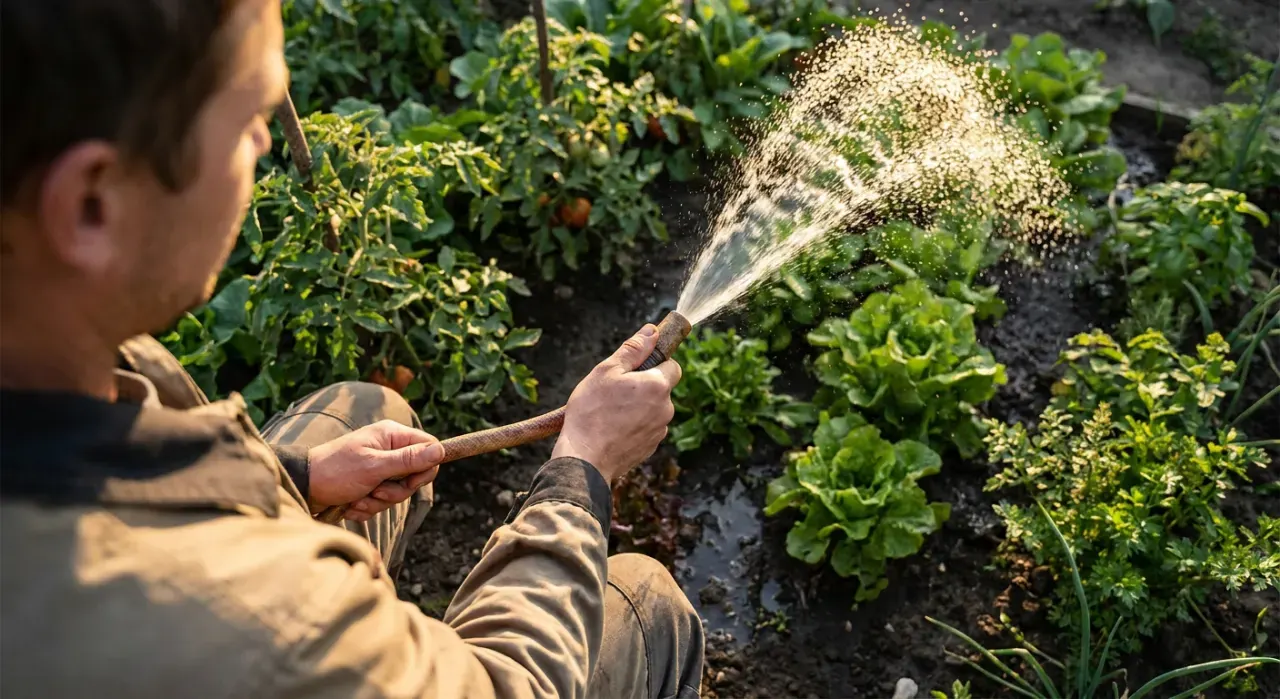
The can test, for sprinklers. Put three or four straight-sided cans — tuna or cat food cans are the classic choice because their sides are vertical — around the sprinkler pattern. Run it for 15 minutes and measure the water depth in each with a ruler. If you average a quarter inch in 15 minutes, an hour delivers an inch. The variation between cans is usually the more valuable finding: most patchy lawns turn out to be coverage problems rather than duration problems, and the fix is repositioning the sprinkler so patterns overlap by about 30 percent.
The screwdriver test, for everything. An hour after watering, push a long screwdriver or a wooden dowel into the soil. It slides easily through moist soil and stops at dry soil. If it reaches 6 inches, the root zone is wet. If it stops at 2, you delivered a quarter of what you thought. This is the single most useful watering diagnostic there is and it costs nothing.
Arithmetic, for drip and soaker. Drip emitters are rated in gallons per hour. A 4 by 8 bed needing 20 gallons a week, running on twelve 1 GPH emitters, needs about 100 minutes a week — say two 50-minute cycles. Soaker hose typically puts out somewhere in the range of half a gallon to a gallon per foot per hour depending on pressure, so a 25-foot run in a bed delivers roughly 12 to 25 gallons an hour; measure yours by running it into a bucket for five minutes. The comparison between the two systems is in drip vs soaker hose.
And put a rain gauge in the yard. Guessing at rainfall is notoriously unreliable — a shower that sounds heavy on a roof frequently delivers less than a quarter inch.
Soil Type Changes Everything
| Soil | Water held per foot of depth | Watering pattern |
|---|---|---|
| Sandy | About 0.5 to 1 in | Half an inch twice a week; drains fast |
| Loam | About 1.5 to 2 in | One inch once a week; the ideal case |
| Clay | About 2 to 2.5 in | One inch slowly, once; easy to overwater |
Sandy soil cannot hold a full inch in the root zone — apply it all at once and much of it drains past the roots. Split the week into two half-inch applications instead.
Clay holds a great deal of water but accepts it slowly. Apply an inch quickly to clay and most of it runs off the surface. The fix is cycle-and-soak: run for 15 minutes, wait 30, run again, repeat. Clay also punishes overwatering hard, because saturated clay excludes air and roots suffocate. On clay, always check with the screwdriver before adding water.
Organic matter improves both cases. Compost worked into sandy soil increases its water holding capacity substantially, and in clay it improves structure and infiltration. It is the one amendment that helps both problems.
Heat, Wind and Zone
The inch-a-week rule is a temperate-season baseline. Adjust it:
- Above 85°F: add roughly 25 percent.
- Above 95°F with wind: demand can double, particularly for fruiting vegetables and anything in a container.
- Cool spring and fall, under 70°F: often half an inch a week is plenty, and overwatering is the more common error.
- Arid western zones with low humidity: evaporative demand is far higher than the same temperature in a humid region; expect to be at the top of every range.
- Humid southeastern summers: rainfall often covers the requirement, and the risk shifts from drought to fungal disease in constantly wet foliage.
- Winter in zones 7 and warmer: evergreens and containers still need occasional water during dry, windy spells when frozen or dry ground cannot resupply roots.
Mulch is the cheapest way to reduce all of these numbers. Two to three inches of shredded bark, leaves or straw cuts evaporation from the soil surface substantially and moderates soil temperature. For many gardens, mulching is a bigger water saving than any equipment upgrade.
What Different Plants Need
| Plant group | Weekly water | Notes |
|---|---|---|
| Established lawn | 1 to 1.5 in | Cool-season grasses go dormant in drought and recover |
| New seed or sod | Light, 2 to 3 times daily | Keep the surface damp until rooted, then switch to deep |
| Vegetables, establishing | 1 in | Consistency matters more than volume |
| Vegetables, fruiting in heat | 1.5 to 2 in | Erratic moisture causes blossom end rot and splitting |
| Perennial borders | 1 in year one, less after | Established natives often need none |
| New trees and shrubs | 5 to 15 gal per week | For the first two growing seasons, at the root ball |
| Containers | Daily, sometimes twice | Water until it runs from the drainage holes |
| Established drought-tolerant plantings | Little to none | Overwatering is the main killer |
New trees deserve a specific note because they are the most expensive thing in most yards and the most commonly lost to underwatering. A newly planted tree needs water delivered slowly at the root ball, not spread over the lawn around it, for two full growing seasons. A 5-gallon bucket with a small hole drilled near the bottom, refilled twice a week, is a genuinely effective low-tech solution.
Reading the Plant
Underwatering: wilting that persists into the evening and the next morning, leaf edges browning and crisping, older leaves yellowing and dropping first, soil pulling away from the sides of a container.
Overwatering: wilting despite wet soil — a classic and much-missed sign, because the roots are suffocating and cannot take water up — yellowing across the whole plant, soft brown roots, algae or fungus gnats on the surface, and a sour smell in the soil.
Midday wilting in intense heat is often not a water problem at all. Large-leaved plants like squash, hydrangeas and hostas droop at 2pm as a heat response and recover by evening. Check the soil before responding to wilt, or you will steadily overwater plants that were never thirsty.
Why Deep and Infrequent Wins
Roots grow toward available water. Water lightly every day and the top 2 inches stay reliably moist, so that is where roots live — a shallow mat that dries out within hours in a heat wave and cannot survive a missed day. Water deeply once or twice a week and the moisture front reaches 6 to 8 inches down, roots follow it, and the plant gains access to a soil reservoir that buffers it against your schedule and the weather.
That is the reasoning behind almost every piece of watering advice, and it is why the volume matters less than whether it actually reaches root depth. It is also why timing matters, and why Illinois Extension recommends watering the soil rather than the foliage and doing any overhead watering early in the day — an early morning soak loses far less to evaporation than the same water applied at 2pm, covered in best time of day to water.
The practical route to consistency is automation. EPA WaterSense labels weather-based and soil moisture-based irrigation controllers that do the same job across a whole yard, watering only when plants need it. A faucet timer running a drip zone at 6am delivers the same measured volume every week whether or not you are home, which removes the largest variable in the whole equation — see best hose timer, or build the zone itself with how to set up drip irrigation.