 Garden

Affiliate Disclosure
Some links on this page are affiliate links. As an Amazon Associate, we earn from qualifying purchases — at no extra cost to you. We do not buy, test, or physically handle the products we cover; our rankings come from aggregated owner reviews, ratings and expert consensus. Commissions never change our verdicts. How we rank · full disclosure.
Yes, as a supplement, not as protection on its own. Portable HEPA air cleaners remove the airborne particles that carry respiratory viruses, and both the EPA and CDC list them as a way to add clean air where ventilation falls short. CDC guidance for buildings targets at least 5 air changes per hour of clean air in occupied spaces. What a purifier cannot do is address close-range exposure, surfaces, or anyone in the room with you a few feet away. The EPA states plainly that by itself, air cleaning is not enough to protect people from COVID-19.
We do not buy or physically handle the units we rank; our picks come from aggregated owner reviews and expert consensus, explained in how we rank. Model shortlists are in best air purifier, inside the air quality hub. Nothing here is medical advice.
How does a filter catch something that small?
Two ways, and the smaller the particle the better the second one works. HEPA media captures larger particles by interception and impaction, where the particle physically strikes or brushes a fiber. Below roughly 0.1 micron, particles no longer travel in straight lines; they jitter through the air by Brownian motion and collide with fibers far more often than their size suggests, which is capture by diffusion. Between those two regimes sits a worst case around 0.3 micron, which is precisely why the HEPA standard is defined there, at 99.97 percent efficiency. Efficiency is higher on both sides of that point.
The other half of the answer is that a virus does not travel bare. Exhaled particles carrying SARS-CoV-2 are respiratory aerosols made of water, salts, protein and mucin, and published measurements put the relevant range broadly between about 1 and 10 microns. That is comfortably in the range where mechanical filtration is most effective. The filtration terminology that decides whether your unit actually meets the standard is covered in true HEPA vs HEPA-type, and it matters here more than anywhere, because a HEPA-type filter carries no efficiency guarantee at all.
How much purifier do I need for 5 air changes an hour?
Compute the room volume, multiply by 5, divide by 60. That gives the cubic feet per minute of clean air you need, which is what a smoke CADR rating expresses. Use the smoke figure rather than dust or pollen, because AHAM measures it with the finest particles of the three and it is the closest proxy for respiratory aerosols. The room-size claim printed on the carton is usually calculated at 2 to 3 air changes per hour, so it will understate what you need by roughly half.
| Room | Volume at 8 ft ceiling | Smoke CADR for 5 ACH | Smoke CADR for 6 ACH |
|---|---|---|---|
| Bedroom, 150 sq ft | 1,200 cu ft | 100 CFM | 120 CFM |
| Bedroom, 250 sq ft | 2,000 cu ft | 167 CFM | 200 CFM |
| Living room, 400 sq ft | 3,200 cu ft | 267 CFM | 320 CFM |
| Open plan, 700 sq ft | 5,600 cu ft | 467 CFM | 560 CFM |
| Classroom, 900 sq ft | 7,200 cu ft | 600 CFM | 720 CFM |
Two practical adjustments. Buy for the CADR you can achieve at a fan speed you will actually leave running, because noise is the reason most units end up on low or off. And remember that the room only counts as a room if the door is shut; an open bedroom door means the machine is trying to serve the hallway and everything connected to it. If cost is the constraint, a taped filter-and-box-fan build delivers real CADR for a fraction of the price, covered in how to build a DIY box fan air purifier.
What will a purifier not do?
It will not protect you from the person sitting next to you. A room air cleaner works on the mixed, room-average concentration, and the air in the few feet between two people talking has not been through the filter. It will not do anything about contact transmission. And it will not fix a room while it is switched off, which is the most common real-world failure, since a unit bought during an illness and run for two hours a day contributes far less than one on a moderate speed continuously. The EPA notes that air cleaning should be used alongside, not instead of, source control and ventilation.
Opening a window remains the cheapest large intervention when outdoor air is clean and the weather permits, because outdoor air exchange dilutes everything rather than only what passes through a filter. During a wildfire event the calculation flips entirely, and sealing up with filtration is correct; see best air purifier for wildfire smoke. If you want visibility into whether anything is changing, a monitor with a laser particle sensor shows a room clearing in real time, though it measures particulate and not pathogens; see best air quality monitor.
Does filter condition change how well it works?
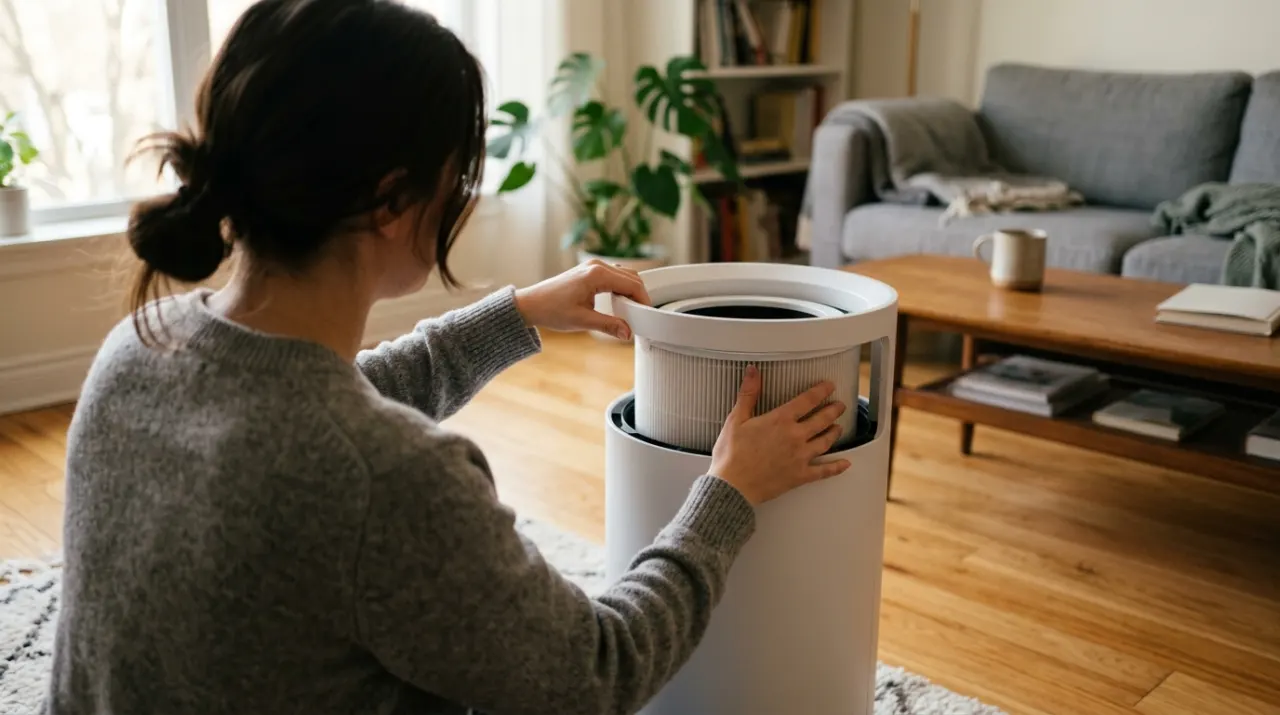
It changes the delivery, not the capture. A loaded HEPA element keeps catching what reaches it, but airflow through the machine falls as resistance rises, so the effective CADR drops and with it the achieved air changes per hour. A unit running an overdue filter can be delivering half the clean air it did when new while looking and sounding identical. Rinse the washable pre-filter monthly, which is the single biggest thing you can do for airflow and HEPA life, and replace the HEPA element on the manufacturer schedule, generally every 6 to 12 months. Practical steps are in how to replace an air purifier filter, and the upstream question of what the whole house is filtering is in how often should you change a furnace filter. For the allergen side of the same machine, see do air purifiers help with allergies.