 Garden

Affiliate Disclosure
Some links on this page are affiliate links. As an Amazon Associate, we earn from qualifying purchases — at no extra cost to you. We do not buy, test, or physically handle the products we cover; our rankings come from aggregated owner reviews, ratings and expert consensus. Commissions never change our verdicts. How we rank · full disclosure.
The feature that matters in a toilet auger costs about a dollar to manufacture: a vinyl sleeve over the end of the tube. Vitreous china is glazed, hard and unforgiving, and a bare steel cable dragged around a bowl leaves black scoring that never comes out. That is why a closet auger is a completely different tool from the drum auger you use on a sink, and why putting the wrong one in a toilet is a mistake you look at every day afterward.
Everything else in this category is reach and cable construction. Three feet clears the trapway and the closet bend, which handles most clogs. Six feet gets into the branch line, which is where the clog is when a three-foot auger keeps coming back clean.
Top Picks at a Glance
Why a toilet needs its own auger
A toilet's trapway is a fixed S-bend cast into the china, typically around two inches at its narrowest and roughly 18 to 24 inches long from the bowl outlet to the closet flange. It is not a pipe you can open, and it is not a shape a general-purpose cable negotiates well.
A closet auger solves three problems at once:
- The protective sleeve. The rigid down tube keeps the cable off the glaze, and the vinyl or rubber tip sits in the bowl so nothing steel ever touches china.
- The curve. The tube is bent to match the trapway, so pushing the handle down feeds the cable along the path rather than into the wall of the bend.
- The head. Bulb heads bore through compacted paper. Drop heads hook and retrieve. Both are shaped to fit a two-inch trapway, unlike the open corkscrew tip on a sink auger.
| Tool | Cable | Reach | Use it on | Never use it on |
|---|---|---|---|---|
| Closet (toilet) auger | 1/2 in in a sleeved tube | 3–6 ft | Toilets only | Sinks — the tube will not fit |
| Drum auger | 1/4 in bare | 15–25 ft | Sinks, tubs, showers | Toilets — it scores the china |
| Flange plunger | None | — | Toilets, first | Flat sink basins |
| Barbed hair tool | Flat plastic strip | 18–24 in | Bathroom sinks, showers | Toilets — it cannot reach |
Our #1 Pick: RIDGID K-3
The K-3 is the closet auger you find in the back of most plumbing vans, and its reputation comes from the two things that decide whether an auger survives: the cable and the sleeve.
The compression-wrapped cable resists the failure mode that ends cheap augers — birdcaging, where the outer wrap unwinds under torque and the cable balloons into a useless tangle. That happens when a light cable is twisted hard against a stubborn clog, which is exactly the situation you bought it for. The vinyl-coated tube handles the other half: the cable never touches the glaze.
Three feet is the right default length. It puts the head through the trapway and around the closet bend, which is where the overwhelming majority of toilet clogs sit. Owners consistently report the same experience — a clog that survived repeated plunging gives up in under a minute once a cable reaches it.
Honest limitations: at three feet it cannot reach a clog in the branch line past the closet bend, and if you find yourself augering the same toilet every few weeks, the problem is further out and you want a six-foot model. It is also a genuinely unpleasant tool to store — everyone keeps it in the garage, and everyone regrets that at 11pm.
Check price on Amazon → (paid link)
The Ranked Field

Best for the toilet auger to own if you only ever own one
- 3-foot cable in a vinyl-coated protective tube that will not score porcelain
- Bulb head designed to bore through paper masses rather than hook them
- Compression wrap cable that resists kinking under load
- Standard-length reach that clears the trapway and the closet bend
Why buy it: the auger plumbers actually carry, and the protective sleeve is the whole point — a bare cable in a toilet leaves permanent black scoring on the china.

Best for stubborn clogs beyond the trapway, and repeat offenders
- 6-foot tri-wrap cable — double the reach of a standard closet auger
- Drop head design that hooks and retrieves obstructions rather than boring past them
- Runs manually or on a cordless drill for extra torque
- Telescoping tube that collapses for storage
Why buy it: six feet gets you past the closet bend and into the branch line, which is where a clog lives when a three-foot auger keeps coming back empty.
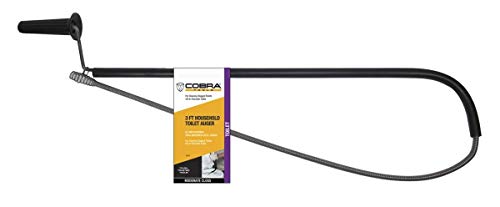
Best for a household that wants the right tool without spending much on it
- 3-foot, 3/8-inch cable with a protective vinyl guard on the down tube
- Standard bulb head for paper and soft obstructions
- Light enough to store in a bathroom vanity
- The most-owned budget closet auger in the category
Why buy it: half the price of the RIDGID and still the correct type of tool — a lighter cable that flexes more, which for two or three uses a year is a trade most households will take.

Best for landlords, property managers and anyone using one weekly
- 6-foot Flexicore cable — wire rope core wrapped in spring steel
- Down head that follows the trapway rather than fighting it
- Built for repeated professional use rather than occasional homeowner duty
- Replaceable cable rather than a disposable tool
Why buy it: the Flexicore construction is the difference — a wire rope core lets the cable take repeated hard twisting without birdcaging, which is exactly how cheap augers die.

Best for anyone who would rather let a cordless drill do the cranking
- 3-foot cable with a drill adapter as well as a hand crank
- Angled down tube shaped to the geometry of a toilet trapway
- Rubber guard at the tube tip to protect the bowl
- Storage bag included
Why buy it: a drill applies steadier rotation than a wrist does, which helps on a compacted paper clog — just keep the speed low, because a fast cable is how a trapway gets damaged.

Best for a spare for a second bathroom or a rental property
- 3-foot high-carbon spring steel cable
- Protective sleeve on the down tube
- Rubber grip handle and a compact stored length
- Priced as a keep-one-in-each-bathroom tool
Why buy it: cheap enough to leave in a rental or a guest bathroom, which matters because the auger that is in the house beats the better one that is in the garage.
Quick Comparison
| Product | Best for | Rating | Price | Buy |
|---|---|---|---|---|
| RIDGID K-3 Toilet Auger with 3-Foot Snake and Bulb Head | Best Overall | — | Check (paid link) | |
| RIDGID K-6DH Hybrid Toilet Auger with 6-Foot Heavy-Duty Drop Head Tri-Wrap Cable, Manual or Drill | Best Long Reach | — | Check (paid link) | |
| Cobra Products 40030 Home Toilet Auger, 3/8-inch by 3 Feet | Best Value | — | Check (paid link) | |
| General Pipe Cleaners I-T6FL-DH Closet Auger, 6-Foot Flexicore Snake with Down Head | Best Professional | — | Check (paid link) | |
| DrainX Toilet Auger Drain Plumbing Snake, Use With Drill or Manually, Angled for Toilet Clogs | Best Drill-Powered | — | Check (paid link) | |
| HimaPro Professional Toilet Auger and Closet Auger, 3-Foot Pipe Snake, Rust-Resistant Spring Steel | Best Budget | — | Check (paid link) |
How to use one without damaging anything
- Plunge first. A flange plunger with a proper seal clears most toilet clogs and takes two minutes. The auger is step two, not step one — the technique is in how to unclog a toilet fast.
- Retract the cable fully into the tube before you put anything in the bowl. Cable hanging out is cable rubbing china.
- Seat the curved tip in the bottom of the bowl, aimed into the trapway opening, and keep it seated for the whole job.
- Push the handle down slowly while cranking clockwise. Always clockwise — the cable is wound so that clockwise rotation tightens the coil and drives the head forward. Counter-clockwise under load unwinds it.
- Work the clog rather than ramming it. Steady moderate pressure with continuous rotation. If you hit an absolutely hard stop that will not give, stop: that is usually a solid object, and pushing drives it further into the trapway.
- Retract while still turning clockwise, so anything hooked stays hooked instead of dropping back into the bend.
- Flush twice to confirm, watching that the bowl clears fully rather than draining slowly.
If you are using a drill-capable model, keep the speed low. Torque clears clogs; speed chips porcelain and birdcages cable.
When the toilet clogs again and again
A toilet that clogs every couple of weeks is telling you something, and it is rarely about what is being flushed.
- Scale in the trapway. On hard water, mineral deposits narrow the trapway over years. The bowl looks fine; the passage behind it is not. See how to test water hardness.
- A partial obstruction you pushed past. An auger that bores through a solid object leaves it in place, slightly further along. Every subsequent flush catches on it.
- A first-generation low-flow toilet. Early 1.6 gallon models from the 1990s were widely criticized for inadequate bowl evacuation. Modern 1.28 gallon WaterSense-labeled toilets are tested for waste removal performance and clear better on less water.
- Weak flush from the tank. A worn flapper that closes early, or a fill valve set too low, delivers a partial flush that will not carry solids. Check the flapper and the water level before blaming the trapway.
- A vent or main-line problem. If the tub gurgles when the toilet flushes, or other fixtures back up, the issue is downstream and a plumber with a camera is the right call.
How We Rank
We never buy or use these tools. For closet augers the ranking priorities are: whether the china is protected, which is non-negotiable and rules out any bare-cable tool; cable construction, since birdcaging under torque is the failure that ends these tools; reach matched to where clogs actually sit; and aggregated owner reports after repeated use, because a tool used three times a year reveals its quality slowly. Ratings come from verified Amazon listing data and refresh automatically. Prices were checked at the time of writing. Full method: how we rank.
The Field, Reviewed
1. RIDGID K-3 — Best Overall
Covered above. Owners praise: that it works immediately on clogs that defeated a plunger, the sleeve that protects the bowl, and cable that survives hard use. Owners gripe about: three feet not being enough for a recurring clog, and the price against a supermarket auger. Check price (paid link).
2. RIDGID K-6DH — Best Long Reach
Double the reach, a heavier tri-wrap cable, and a drop head that retrieves obstructions rather than boring past them. The telescoping tube collapses for storage, which matters more than it sounds when the alternative is a six-foot tool in a hall closet.
Owners praise: reaching clogs a three-foot auger never found, the drill option for compacted masses, and build quality. Owners gripe about: the price, the bulk, and a learning curve on feeding six feet of cable without letting it kink. Check price (paid link).
3. Cobra 40030 — Best Value
The budget closet auger most Americans own, and importantly it is the correct type of tool rather than a compromise. Three feet, a protective guard, a standard bulb head.
Owners praise: the price, that it does the job, and light weight. Owners gripe about: a lighter cable that flexes and can kink under real load, and a handle that is less comfortable to crank hard. For two or three uses a year, most owners consider that a fair trade. Check price (paid link).
4. General Pipe Cleaners I-T6FL-DH — Best Professional
Flexicore cable is the distinguishing feature: a wire rope core wrapped in spring steel, which takes repeated hard twisting without unwinding. For a landlord or a property manager clearing toilets weekly, that is the difference between a tool that lasts years and one that lasts a season.
Owners praise: cable durability, the down head following the trapway cleanly, and replaceable rather than disposable construction. Owners gripe about: a price that is hard to justify for two uses a year, and weight. Check price (paid link).
5. DrainX Toilet Auger — Best Drill-Powered
A three-foot auger with a drill adapter as well as a hand crank, which helps on a compacted paper clog where steady rotation beats wrist strength. The angled down tube is shaped for a trapway and the tip is rubber-guarded.
Owners praise: the drill option, the storage bag, and the price for what it does. Owners gripe about: the temptation to run the drill too fast, and a cable that is lighter than the RIDGID equivalent. Check price (paid link).
6. HimaPro 3-Foot — Best Budget
Cheap enough to buy two and leave one in each bathroom, which is a genuinely sensible strategy — the auger in the house beats the better one in the garage at 11pm.
Owners praise: the price, that it clears ordinary clogs, and the compact stored size. Owners gripe about: a lighter cable, and a sleeve that some owners report needing care to keep seated. Check price (paid link).
What Owners Actually Complain About
Kinked and birdcaged cable. The single recurring failure, and it happens when a light cable is cranked hard against a clog that will not move. Heavier compression-wrapped or Flexicore cables resist it; budget cables do not.
Buying three feet and needing six. A frequent second purchase. If a clog recurs at the same toilet, it is past the closet bend and a three-foot auger will never touch it.
Marks on the bowl. Almost always from letting bare cable out of the tube, or from a drill run at speed. The tool prevents this if you keep the tube seated.
Storage. Nobody wants this in the house, and everyone needs it in the house. A sealed bag or bucket in the utility closet is the usual compromise.
The Verdict
Buy the RIDGID K-3 and stop thinking about it — it is the standard for a reason, and the sleeve that protects your bowl is the entire argument for buying a proper closet auger over anything improvised. If the same toilet clogs repeatedly, the clog is past the bend and the RIDGID K-6DH is the tool that reaches it. On a budget the Cobra 40030 is the correct type of tool at half the price, and a landlord clearing toilets weekly should buy the General Pipe Cleaners Flexicore. Whatever you buy: plunge first, turn clockwise, and never put a bare drum-auger cable in a toilet. Check price on Amazon → (paid link)
More from this hub: DIY plumbing · best toilet plunger · best drain snake · best drain cleaner · how to unclog a drain · how we rank.