 Garden
Affiliate Disclosure
Some links on this page are affiliate links. As an Amazon Associate, we earn from qualifying purchases — at no extra cost to you. We do not buy, test, or physically handle the products we cover; our rankings come from aggregated owner reviews, ratings and expert consensus. Commissions never change our verdicts. How we rank · full disclosure.
Work in this order: plunge it, open the P-trap, pull the hair out with a barbed tool, then run an auger. That sequence clears the overwhelming majority of household clogs in under an hour, costs almost nothing, and does not put anything caustic in the pipe. What it deliberately leaves out is the internet's favorite answer — baking soda and vinegar — because the chemistry says plainly that it cannot clear a real blockage, and the chemistry is worth understanding before you waste an evening on it.
We never buy, test or physically handle the products we rank; recommendations come from aggregated owner reviews and published research, described in how we rank. The rest of this subject lives in the DIY plumbing hub.
The baking soda and vinegar myth, in chemistry
Pour baking soda into a drain, chase it with vinegar, and you get an impressive volcano. The reaction is genuine: sodium bicarbonate and acetic acid produce carbon dioxide, water and sodium acetate. That is the whole product list. Nothing in it is a solvent, a surfactant or a base strong enough to attack the two things that actually block domestic drains.
Run the numbers on the usual recipe. Half a cup of baking soda with a cup of ordinary 5% vinegar puts roughly 12 grams of acetic acid into the pipe, which is the limiting reagent — about 0.2 moles. That yields around 5 liters of carbon dioxide, released over a few seconds, into a pipe that is open at the top and connected to a vent stack at the other end. Gas takes the path of least resistance, which is straight back up out of the drain opening you just poured it into. It does not build meaningful pressure, and even if it did, a vented drain system is specifically designed so that pressure equalizes rather than accumulates.
Then consider what is actually in the way:
- Hair is keratin, cross-linked by disulfide bonds. It is dissolved by strong alkalis and by oxidizers — sodium hydroxide, or the bleach-based hair products. Sodium acetate in dilute solution does nothing to it whatsoever.
- Grease and soap scum need either heat above the melting point of the fat plus a surfactant to carry it away, or a strong base to saponify it into soap. A fizzing reaction that is over in ten seconds and leaves a neutral salt behind cannot do either.
There is one honest thing to say for the trick: it does deodorize. The foam lifts loose biofilm off the first few inches of the drain wall and the tailpiece, which is where most drain smells originate. If your complaint is odor rather than water, baking soda and vinegar is a reasonable, harmless answer. If water is standing in the basin, it is a distraction that costs you an evening.
Step 1: Work out what you are dealing with (2 minutes)
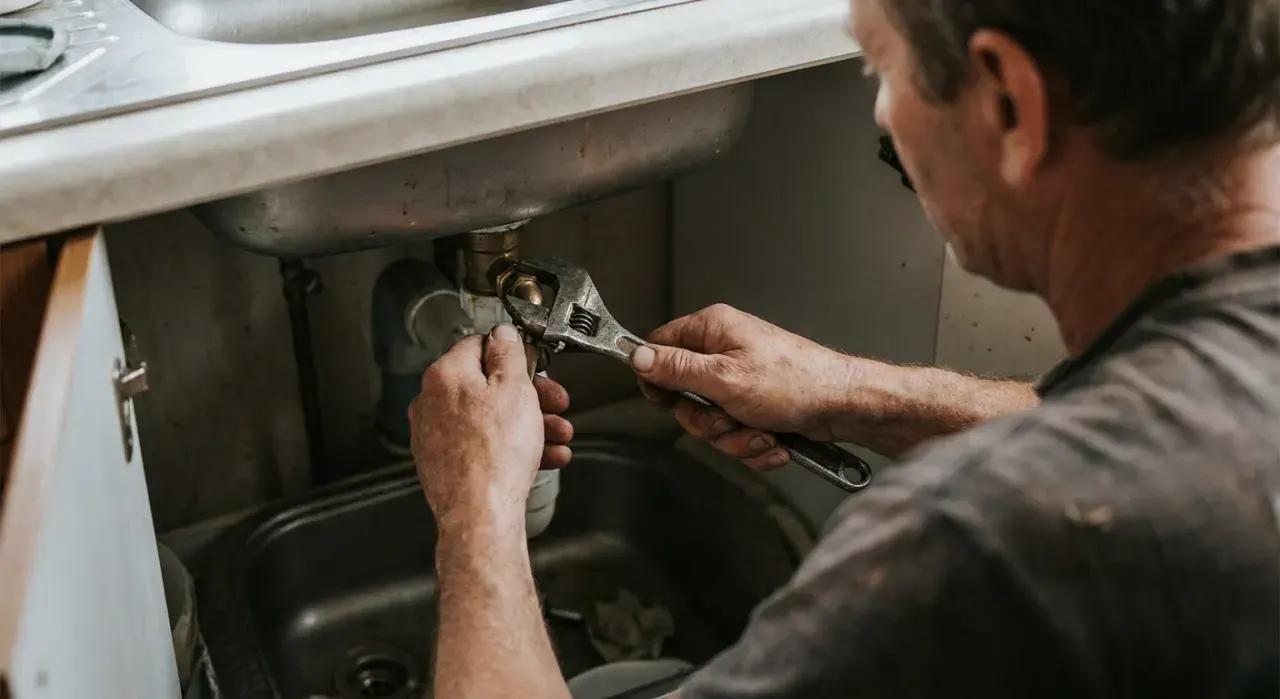
Thirty seconds of diagnosis saves an hour of the wrong effort, because the clog's location is written in how the fixtures behave.
| What you see | Where the clog is | Start with |
|---|---|---|
| One fixture slow, everything else fine | The trap or the first few feet of branch line | Plunger, then the P-trap |
| Bathroom sink slow, hair visible at the stopper | The stopper linkage, 3 to 8 inches down | A barbed hair tool |
| Kitchen sink slow after a big cooking day | Grease in the branch, 3 to 15 feet out | Hot water and detergent, then an auger |
| Two or more fixtures backing up together | The main line | Stop. Call a licensed plumber |
| Toilet flush makes the tub gurgle or fill | The main line or a blocked vent | Stop. Call a licensed plumber |
| Floor drain in the basement backing up | The main line, likely roots | Stop. Call a licensed plumber |
The bottom three rows matter more than the rest of this page. A single slow fixture is a homeowner job. Several fixtures failing at once means the shared line is blocked, and every gallon you plunge into it has to go somewhere — usually the lowest opening in the house, which is a basement floor drain. Our page on why a drain gurgles when the washing machine drains covers the venting side of this.
Step 2: Plunge it properly (5 minutes)
The plunger clears more household clogs than every other method combined, and almost everyone uses it wrong. Three details decide the outcome:
- Block the overflow. Bathroom sinks and tubs have an overflow opening that connects to the same tailpiece. Leave it open and your pressure vents out of it instead of traveling down the pipe. A wet rag jammed in, or duct tape over it, is enough.
- Use a flat cup plunger, not a toilet flange plunger. The bell-shaped one with the fold-out flange is designed for a toilet's curved trapway and seals badly on a flat sink basin. Our toilet plunger vs sink plunger page explains the difference, and the ranked field is in best toilet plunger.
- Keep two inches of water in the basin and never break the seal. Water transmits force; air compresses and does nothing. Push down slowly to seat the cup, then work it hard for 15 to 20 strokes without lifting it off the drain.
If the water suddenly drops away, run hot water for a full minute to carry off whatever you dislodged. If it is a little faster but still slow, plunge again — a second round after the first has softened the mass often finishes it. Full technique is in how to use a plunger correctly.
Step 3: Open the P-trap (15 minutes)
An unreasonable share of sink clogs — hair balls, wedding rings, bottle caps, a solid plug of toothpaste and hair — sit inside the U-bend you can reach with your hands. Put a bucket underneath, loosen the two slip nuts by hand or with channel-lock pliers, and drop the trap into the bucket.
Clean it out, check the washers for cracks while it is off, and reassemble hand-tight plus about a quarter turn. Overtightening a plastic slip nut cracks it, which turns a clog into a leak. Run water and watch the joints for a minute before you put anything back under the sink. Step-by-step detail is in how to replace a P-trap under a sink.
While the trap is off you also gain the best access point on the fixture: the wall stub. Feeding a cable straight into that stub skips two 90-degree bends and puts you in the branch line immediately.
Step 4: Pull the hair out (5 minutes)
For bathroom sinks, showers and tubs, the clog is usually a felted mat of hair and soap wrapped around the stopper linkage, three to eight inches below the grate. A flexible barbed plastic wand — the type sold as a drain weasel or zip-it — costs a few dollars, goes in past the stopper, and pulls the mat out in one motion. It is the single highest-yield tool per dollar in this whole subject, and it is why our drain cleaner roundup ranks a mechanical tool above every chemical in the category.
Two cautions. Pull slowly, or the mat tears and you leave half of it behind. And on a tub, take the two screws out of the overflow cover plate and work through there rather than through the drain grate — the bend directly under the grate is tighter than the trap.
Step 5: Run an auger (20 to 40 minutes)
If plunging, the trap and a hair tool have all failed, the blockage is genuinely down the branch line and needs a cable. Match the cable to the pipe: a 1/4-inch cable for 1.25 to 2-inch bathroom lines, a 5/16 or 3/8-inch cable for kitchen branches and laundry standpipes. Turn clockwise the entire time, feed with the drum held about a foot from the opening, and never force a cable that has hit a dead stop.
Push a foot or two past the point where the resistance falls away, then work the tip back and forth across the clog zone. A cable that bores a pencil-width hole through a grease plug leaves a drain that runs today and blocks again next month — widening the opening is the difference between a fix and a delay. Full technique is in how to use a drain snake, the picks are in best drain snake, and the failure modes are in can a drain snake damage pipes.
Where chemical drain cleaner fits — and where it does not
Chemical openers come in three families, and the differences matter for both your pipes and your safety. Sodium hydroxide gels are the supermarket standard; sulfuric acid openers are the professional-strength ones sold behind the counter; enzyme and bacterial products are maintenance treatments that do not open a blocked line at all.
The caustic types work by saponifying fat and dissolving keratin, and both reactions are strongly exothermic — NIOSH lists sodium hydroxide and sulfuric acid as corrosive to skin, eyes and respiratory tract, and the heat they generate in a pipe is real. The practical rules are short and non-negotiable:
- Never use one on a fully blocked line. The product needs contact with the clog to work; in standing water it dilutes, sits, and heats a column of caustic liquid above the blockage.
- Never plunge or snake after pouring one in. You will splash it, and the splash goes toward your face.
- Never mix products. Not with bleach, not with ammonia, not with a different brand of drain cleaner. Combining an acid opener with a caustic one is an exothermic reaction inside a sealed pipe.
- Be careful on older plumbing. Heat softens PVC and can loosen glued joints and slip washers, and acid openers attack corroded galvanized steel and old chrome-plated brass traps from the inside.
- Tell the next person. If you have poured a chemical in and later call a plumber, say so before they open anything.
The honest ranking is set out in best drain cleaner, and the maintenance products — the ones that genuinely earn a place under the sink — are in best enzyme drain cleaner.
How to stop drains clogging in the first place
Prevention here is unusually effective, because household clogs come from a very short list of causes.
- Never pour fats, oils or grease down the sink. It congeals on the pipe wall as it cools and every subsequent bit of food debris sticks to it. The EPA's work on fats, oils and grease identifies it as a leading cause of sanitary sewer blockages nationally — the same physics that blocks a city main blocks your kitchen branch. Pour cooled grease into a can and bin it.
- Fit a strainer on every drain, and a hair catcher in every shower. Three dollars a fixture, and it removes the single most common cause of bathroom clogs entirely.
- Run hot water plus a squirt of dish detergent after greasy dishes for 30 seconds. The detergent emulsifies the film the hot water melted, so it leaves the house instead of cooling in the pipe.
- Use the disposal correctly. Cold water while grinding, run it several seconds past the last of the noise, and keep coffee grounds, eggshells, pasta, rice and fibrous vegetable peel out of it. Our disposal installation guide and disposal picks cover the rest.
- Treat monthly with an enzyme product in a kitchen line that has a history. Enzymes do not open a blocked pipe, but they consume the greasy film that becomes next year's blockage, and they do it without anything corrosive.
- Flush nothing but toilet paper. Wipes labeled flushable do not break down in the time they spend in your lateral, and they are the material plumbers pull out of main lines most often.
When to stop and call a licensed plumber
Clearing a fixture drain needs no permit anywhere in the US and is squarely homeowner territory. Stop when you see any of these, because each one indicates a problem past the reach of homeowner tools:
- Two or more fixtures backing up at the same time, or water rising in the tub when the toilet flushes.
- Sewage odor or backup at a basement or garage floor drain.
- A hard, immovable stop at the same depth on every attempt — roots and collapsed sections behave exactly like that.
- Any alteration to drain, waste or vent piping. That is permitted work in most jurisdictions and the rules are set locally, so check with your city or county building department rather than assuming a national standard.
A camera inspection typically runs $200 to $500 and is worth it before anyone digs. Hourly rates are in how much a plumber charges per hour.
Related reading: how to unclog a kitchen sink, how to unclog a bathtub drain, how to unclog a toilet fast and the plumbing tools worth owning.