 Garden
Affiliate Disclosure
Some links on this page are affiliate links. As an Amazon Associate, we earn from qualifying purchases — at no extra cost to you. We do not buy, test, or physically handle the products we cover; our rankings come from aggregated owner reviews, ratings and expert consensus. Commissions never change our verdicts. How we rank · full disclosure.
The short version: a cold frame is the cheapest season extension there is, and for a great many gardeners it is the only one they need. After weighing six of the most-reviewed cold frames on the US market against owner ratings, review volume, published glazing specifications and horticultural guidance, the Juwel BioStar 1500 is the one we would buy to keep. Twin-wall polycarbonate and an aluminum frame put it in a durability class of its own here — no rot at the ground line, no repainting, no lid that goes brittle in year three. Below is the full ranked field, the consensus score behind each placement, and what owners genuinely complain about.
Read this page as the cheap alternative to a structure, not as a lesser version of one. A cold frame costs a tenth of what a walk-in greenhouse costs, sets up in an afternoon, needs no foundation and no siting survey, and delivers most of what a home gardener actually wants from season extension: seedlings hardened off in March, salad greens standing through January. University of Minnesota Extension treats frames, row covers and hoop houses as the standard ways to start earlier and finish later. If you decide you want the full structure after all, our ranked backyard greenhouses are the next step, and the trade-offs are laid out in greenhouse vs hoop house vs cold frame.
Top Picks at a Glance
Our #1 Pick: Juwel BioStar 1500
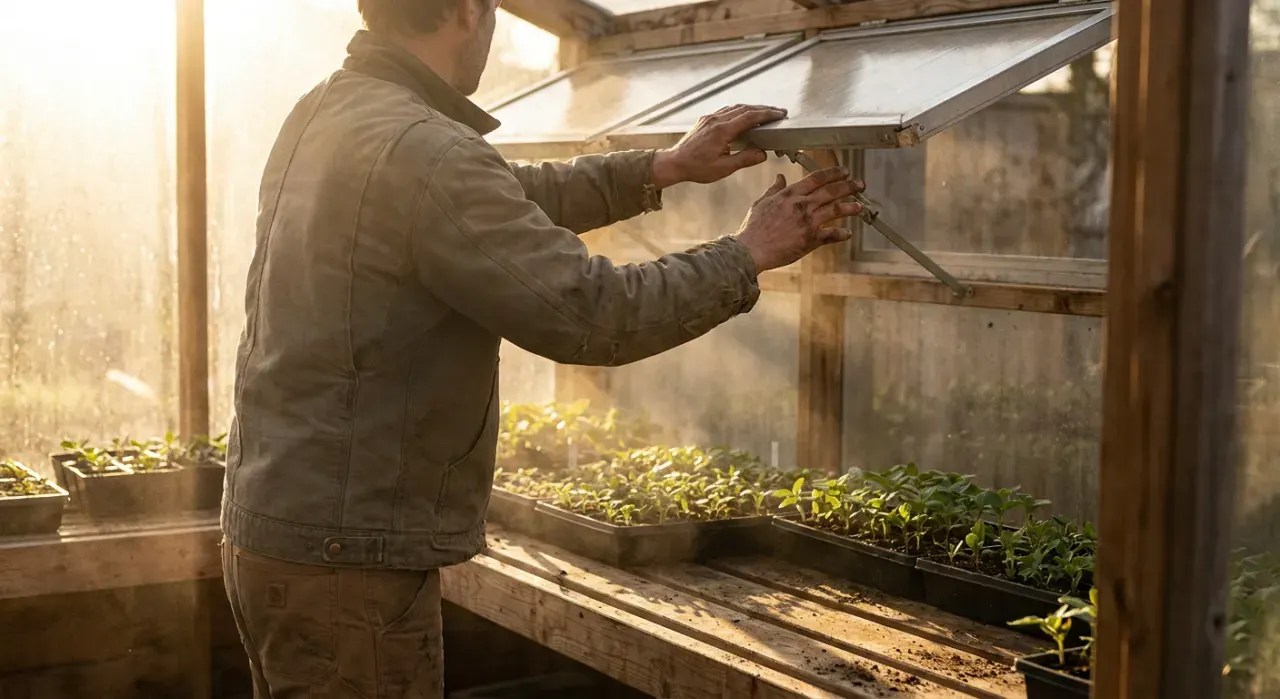
Two materials decide how long a cold frame lasts, and this one gets both right. The glazing is twin-wall polycarbonate rather than single-skin acrylic or glass: two sheets with an air gap between them, which insulates roughly twice as well as a single pane, diffuses light so plants at the edges get an even share, and does not shatter when a branch comes down on it. The frame is aluminum, so there is no rot at the ground line — the failure that eventually claims every wooden frame that sits on damp soil.
The lids are the other thing owners keep mentioning. They prop at several heights rather than open-or-shut, which is what venting a cold frame actually requires: a crack on a cool bright morning, wide open on a warm afternoon, closed by four o’clock to bank the heat. The frame also accepts a wax-piston automatic vent opener, which is the single accessory we would add to any cold frame — it does the venting for you on the March days when nobody is home and the inside hits 100°F.
Roughly five feet by three gives you real growing area: enough for a genuine winter salad supply rather than a token pot or two. Owner reports skew heavily toward long ownership, and the recurring theme is that it still looks the same after several winters, which is not something anyone writes about a fir-and-acrylic frame.
Consensus Score █████████░░░ 9.0 — from the aggregated owner-review consensus
Check price on Amazon → (paid link)
The Ranked Field

Best for a permanent cold frame that survives a decade of winters
- Twin-wall polycarbonate — insulates about twice as well as glass
- Aluminum frame, no rot, no repainting
- Lids prop open at multiple heights
- Roughly 5 ft × 3 ft growing area
Why buy it: twin-wall glazing and an aluminum frame put this in a different durability class to every wooden frame on the list.

Best for hardening off seedlings beside a back door
- Twin-wall polycarbonate panels
- Aluminum frame with adjustable lid props
- Roughly 3 ft × 2 ft footprint
- Accepts an automatic vent opener
Why buy it: the same construction as the BioStar in a footprint that fits a patio, which is where most people actually want one.

Best for a traditional-looking frame over a bed or a path edge
- Solid fir frame with polycarbonate lid
- Bottomless — sits directly over soil
- Lid opens and props at two angles
- About 39 in. × 26 in. growing area
Why buy it: bottomless construction means plant roots reach real soil, which is what separates a cold frame from a plastic box.
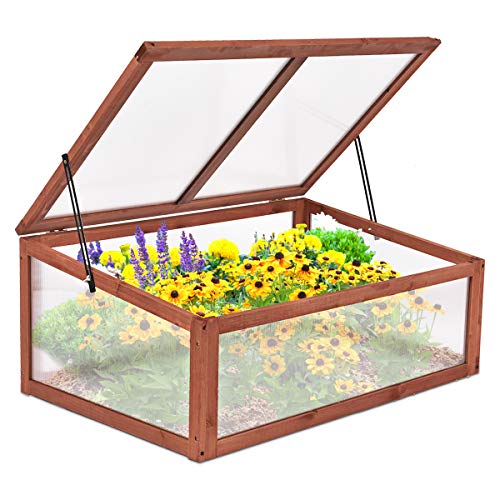
Best for trying season extension for the price of two flats of transplants
- Fir wood frame with clear polycarbonate lid
- Bottomless design, light enough to move
- Two-angle lid support rod
- Assembles in under an hour
Why buy it: the cheapest genuine cold frame here, and light enough to move to wherever the winter sun actually lands.

Best for a small yard where one structure has to do two jobs
- Raised bed with a hinged polycarbonate lid
- 48 in. × 24 in. × 32 in. overall
- Waist-height working — no kneeling
- Lid removes entirely in summer
Why buy it: a raised bed and a cold frame in one, so the same footprint grows food in July and greens in November.

Best for trays of seedlings on a balcony or against a wall
- Polycarbonate panels with an openable roof
- Three shelves, 51.5 in. × 22.75 in. × 55 in.
- Double doors for full access
- Vertical footprint against a wall
Why buy it: goes vertical instead of horizontal, which triples the tray capacity you get from a patio-sized footprint.
Quick Comparison
| Product | Best for | Rating | Price | Buy |
|---|---|---|---|---|
| Juwel BioStar 1500 Premium Cold Frame | Best Overall | — | Check (paid link) | |
| Juwel Cold Frame 1000 | Best Compact Premium | — | Check (paid link) | |
| Outsunny Wooden Cold Frame Greenhouse, 39″ × 26″ × 16″ | Best Wooden Classic | — | Check (paid link) | |
| Giantex Portable Wooden Cold Frame, 39.5″ × 25″ × 15″ | Best Budget | — | Check (paid link) | |
| Outsunny Raised Garden Bed with Polycarbonate Greenhouse, 48″ × 24″ | Best Raised-Bed Combo | — | Check (paid link) | |
| Outsunny Cold Frame Planthouse with Openable Roof, 3 Shelves | Best for Seedlings | — | Check (paid link) |
How We Rank
We never buy, test or physically handle the products we rank. Instead we aggregate what the owner base already knows: star ratings weighted by review volume, the shape of the one- and two-star distribution, published dimensions and glazing specifications, and the consensus of horticultural and university extension guidance. For cold frames we weight four things — glazing type, because twin-wall polycarbonate insulates and survives UV in a way thin acrylic does not, venting control, since overheating in spring kills more plants in cold frames than cold does, frame durability at the soil line, which is where wooden frames fail, and usable growing area against footprint, because a frame too small to hold a proper crop is an ornament. Prices move constantly and were accurate at the time of writing. The full method is on our how we rank page.
What a Cold Frame Buys You
Be precise about the physics, because it is where expectations go wrong. A cold frame does three things: it traps solar radiation during the day, it blocks wind, and it keeps foliage dry — UW-Madison Extension groups it with hot beds, cloches and row covers as the unheated end of season extension. It is not insulated in any meaningful sense, so once the sun goes down the air inside cools quickly toward outside temperature — typically holding only a few degrees above it by dawn.
Those few degrees, plus the wind block, plus the dry leaves, are nonetheless transformative for hardy crops. Spinach, mache, arugula, kale, winter lettuce, scallions and parsley all survive hard frost outdoors but stop growing and get battered; inside a frame they keep producing usable leaves through most of a northern winter. The classic American experience of clearing snow off a frame in January and cutting salad from it the same afternoon is entirely real.
Two more jobs a frame does well. It hardens off spring seedlings over a week or two, which prevents the shock that stalls transplants. And it overwinters dormant potted perennials, keeping their root balls out of the freeze-thaw cycle that kills more container plants than cold ever does.
What it cannot do, without added heat, is keep tender plants alive. Tomatoes, peppers and basil will not survive a northern January in a cold frame however sunny the day was. That is the line where added heat becomes necessary — Penn State Extension sets out two low-cost hot bed designs that supply bottom heat and keep transplants above freezing on cold nights — and the running costs are set out in how to heat a greenhouse in winter.
The Cold Frames, Reviewed
1. Juwel BioStar 1500 — Best Overall
Covered above. Consensus Score █████████░░░ 9.0. What owners like: the twin-wall glazing, the rot-proof aluminum frame, multi-position lid props, and the fact that it still looks new after several winters. What owners complain about: the price is several times what a wooden frame costs, and it is the most expensive item here by a wide margin; assembly takes longer than the instructions suggest and the hardware is fiddly; the frame is light enough that it must be pegged or weighted or a gust will move it; and the automatic vent opener is sold separately, which several owners regard as an omission at this price. Check price (paid link).
2. Juwel Cold Frame 1000 — Best Compact Premium
The same construction philosophy in a footprint of roughly three feet by two, which is what fits on a patio, beside a back door, or at the end of a small raised bed. Twin-wall polycarbonate, aluminum frame, adjustable lid props and provision for an automatic vent opener. For hardening off seedlings and running a small winter salad patch, the growing area is adequate and the durability is the same. Consensus Score ████████░░░░ 8.7. Complaints: the growing area is genuinely small — several owners describe buying a second one within a year; the price per square foot of growing space is the highest here; anchoring is again essential in wind; and, as with the BioStar, the vent opener is an extra purchase. Check price (paid link).
3. Outsunny Wooden Cold Frame, 39″ × 26″ — Best Wooden Classic
A solid fir frame with a hinged polycarbonate lid and, importantly, no floor: it sits directly on the soil so plants root into real ground rather than a container. That is what distinguishes a cold frame proper from a plastic seed box, and it is why crops in a bottomless frame keep growing through winter while the same crops in shallow trays stall. The lid props at two angles for venting. Consensus Score ████████░░░░ 8.5. Complaints: untreated fir in contact with wet soil begins to rot within two to four seasons unless it is sealed or set on a gravel base; the polycarbonate lid is single-skin and yellows with UV exposure; hinges are screwed into soft wood and several owners report them pulling out; and the lid is light enough to catch wind, so a prop that latches is worth adding. Check price (paid link).
4. Giantex Portable Wooden Cold Frame — Best Budget
Under a hundred dollars for a genuine bottomless fir cold frame of nearly forty inches by twenty-five. If the question is whether season extension is worth doing at all, this answers it for the cost of a couple of flats of transplants, and it is light enough to pick up and move to wherever the winter sun actually falls in your yard — which is often not where you first put it. Consensus Score ███████░░░░░ 8.2. Complaints: the wood is thin and the hardware basic, so assembly needs care and pre-drilling; the same rot-at-the-soil-line issue applies and arrives sooner on thinner timber; the single-skin lid provides minimal insulation, so it is a wind-and-rain shelter more than a warm box on the coldest nights; and the support rod is the part most often reported breaking or blowing loose. Check price (paid link).
5. Outsunny Raised Bed with Polycarbonate Lid, 48″ × 24″ — Best Raised-Bed Combo
This one solves a small-yard problem elegantly: it is a waist-height raised bed with a hinged polycarbonate lid, so the same four-by-two footprint is a vegetable bed in July and a cold frame in November. Working at standing height is a genuine benefit for anyone whose knees have opinions, and lifting the lid off entirely in summer turns it back into an ordinary planter. Consensus Score ████████░░░░ 8.4. Complaints: raised off the ground means the soil volume is limited and it freezes far harder than ground-level soil, so it is a poorer winter performer than a bottomless frame; the wood is again untreated fir; the soil volume dries out fast in summer and needs frequent watering; and it needs a liner and drainage layer that are not included. Check price (paid link).
6. Outsunny Polycarbonate Planthouse with Openable Roof — Best for Seedlings
Not a cold frame in the strict sense — it is a tall, narrow, three-shelf cabinet with polycarbonate panels and a roof that opens — but it solves the seedling problem better than any horizontal frame here. Stacked shelves in a footprint just under two feet deep hold several times the seed trays a patio-sized frame does, and the double doors give full access. Against a south wall it is an efficient use of a very small space. Consensus Score ███████░░░░░ 8.1. Complaints: being off the ground and mostly air, it holds far less heat overnight than a soil-based frame, so it is a spring and fall tool rather than a deep-winter one; it has a large sail area and must be anchored to a wall or it will blow over; the shelves are shallow and flex under a full flat of wet soil; and the panels scratch easily. Check price (paid link).
What Owners Actually Complain About
Across all six, four themes dominate the negative reviews.
Cooked plants in spring. The most common failure in this whole category, and it happens in March rather than January. A sealed frame on a clear spring day gets astonishingly hot, and seedlings that survived a hard winter die in an afternoon. Vent early, vent often, and fit an automatic opener if you are not home during the day.
Rot at the soil line. Untreated fir in permanent contact with wet ground has a service life measured in a few seasons. Setting the frame on a shallow gravel bed, or sealing the bottom four inches with a wood preservative rated for ground contact, roughly doubles it. Aluminum frames sidestep the problem entirely, which is most of what the extra money buys.
Lids blowing off. A propped lid is a sail. Owners across every model here report finding the lid across the yard after a gust, sometimes cracked. Peg the frame down, and use a prop that latches or a length of chain that limits how far the lid can open.
Glazing that clouds and cracks. Single-skin acrylic and thin polycarbonate yellow under UV and become brittle, typically from the second or third summer. Twin-wall polycarbonate with a UV-protected face lasts far longer, and it is the specification worth paying for if the frame is going to live outdoors permanently — the same argument made at greenhouse scale in polycarbonate vs glass vs film.
How to Choose Between Them
If you want a frame that will still be there in ten years, buy the Juwel BioStar 1500, peg it down, and add an automatic vent opener. If the space is a patio or a doorstep, the Juwel 1000 is the same build in a smaller box. If you want a traditional frame over an existing bed at a sane price, the Outsunny wooden frame — and give it a gravel base and a coat of preservative before it goes down. If you are trying the idea out, the Giantex costs less than a month of supermarket salad. If your yard is tiny and one structure has to do two jobs, the raised-bed combo. If the job is really seed trays in spring, the vertical planthouse holds far more of them.
Whatever you buy, spend the extra $40 on a wax-piston automatic vent opener. It is the accessory that prevents the single most common failure in this category, it needs no electricity, and it works every warm afternoon whether you are home or not. Then get the siting right — south-facing, against a wall if possible, on ground that drains — using the same principles set out in greenhouse sizing and siting.
The Verdict
The Juwel BioStar 1500 wins because it is built from the two materials that survive a decade outdoors — twin-wall polycarbonate and aluminum — and because its multi-position lids make the venting easy enough that you will actually do it. If the budget will not stretch, the Outsunny wooden frame and the Giantex both work; just set them on gravel and expect to replace them eventually. And keep the ambition honest: a cold frame gives you weeks at each end of the season and hardy greens through winter, not tomatoes in February. If you want more than that, the step up is our ranked backyard greenhouses, while the cheapest option of all is fabric rather than a structure — see best row covers and frost cloth. More at greenhouses and season extension. Check price on Amazon → (paid link)