 Garden


Affiliate Disclosure
Some links on this page are affiliate links. As an Amazon Associate, we earn from qualifying purchases — at no extra cost to you. We do not buy, test, or physically handle the products we cover; our rankings come from aggregated owner reviews, ratings and expert consensus. Commissions never change our verdicts. How we rank · full disclosure.
A fan does not cool air — it moves it. An air conditioner removes heat and moisture from the room and genuinely lowers the temperature. The breeze from a fan evaporates moisture off your skin, which feels like about a 4-degree drop while the thermometer does not move at all. That is enough up to roughly 85 degrees Fahrenheit at moderate humidity. Above 90, or in humid air where sweat will not evaporate, a fan stops doing useful work, and above about 95 it is blowing hot air at you. The cheapest summer setup is not one or the other: it is an air conditioner set a few degrees higher with fans running in the rooms you occupy.
Our picks come from aggregated owner reviews and expert consensus rather than first-hand handling — see how we rank.
The comparison
| Fan | Air conditioner | |
|---|---|---|
| What it does | Moves air across skin | Removes heat and moisture from the room |
| Effect on room temperature | None (adds a trace of motor heat) | Lowers it, typically 15 – 20°F below outdoor |
| Effect on humidity | None | Removes it — often the bigger comfort win |
| Typical power draw | 15 – 100 W | 500 – 1,500 W |
| Cost per 24 hours at 17¢/kWh | $0.06 – $0.41 | $2.00 – $6.10 |
| Purchase price | $25 – $250 | $180 – $700+ |
| Installation | None | Window bracket or vent hose; ceiling fan wiring |
| Works in an empty room | No — switch it off | Yes, but usually pointless |
| Upper limit | Marginal above 85°F, useless above 90°F | Works in any heat within its capacity |

When a fan is genuinely enough
Fans do more than people give them credit for, in the right conditions:
- Up to about 85 degrees with moderate humidity. The perceived 4-degree drop covers a lot of an average summer.
- Overnight, in most of the country. Outdoor temperatures fall after sunset, and a box fan or window fan set to exhaust pushes the day's accumulated heat out while pulling cooler air in. This is the highest-value fan trick there is.
- In dry-climate heat. Low humidity means evaporation works, so a fan feels far more effective at 88 degrees in Arizona than at 82 in Georgia.
- Alongside an air conditioner. The fan is what lets you raise the setpoint, which is where the money is saved.
- In a room you are actually in. Directional comfort, not room cooling. Turn it off when you leave.
Choosing between fan types is a separate question — see tower fan vs box fan, and the perceived-cooling explanation in do ceiling fans actually cool a room. Ceiling fans should run counterclockwise in summer to push air down; the seasonal switch is covered in ceiling fan direction by season.

When a fan is not enough
Three conditions defeat a fan, and it is worth recognizing them rather than persisting:
High humidity. A fan works by accelerating evaporation. When the air is already close to saturated, very little sweat evaporates no matter how hard the air moves, so the perceived cooling largely disappears. This is why 85 degrees in a humid Southeastern summer feels far worse than 90 in a dry one, and why the single biggest comfort improvement from an air conditioner in a humid climate is dehumidification rather than temperature.
Air hotter than skin. Skin sits around 92 to 95 degrees. Once room air passes that, a fan is transferring heat into you by convection, and the evaporative benefit no longer offsets it. The CDC advises against relying on fans as the primary cooling method during extreme heat for exactly this reason.
Sustained heat with no overnight relief. The reason a fan-only house copes in a normal summer is that it sheds heat overnight. During a heat wave where the overnight low stays in the 80s, the house never resets, indoor temperature ratchets up day after day, and no amount of air movement fixes it.
If any of those apply, you need actual cooling. Options and the trade-offs between them are in portable AC vs window AC and best portable air conditioners.
What each actually costs to run
The arithmetic is the same for both: watts ÷ 1,000 × hours × your rate per kWh. Using a representative 17 cents per kWh — check your own bill, since state averages span roughly 11 to over 30 cents:
- Ceiling fan, 30 W, 12 hours — 0.36 kWh, about 6 cents.
- Tower fan, 55 W, 12 hours — 0.66 kWh, about 11 cents.
- Window AC, 900 W, 12 hours at a 60 percent duty cycle — 6.5 kWh, about $1.10.
- Portable AC, 1,200 W, 12 hours at 70 percent duty cycle — 10.1 kWh, about $1.71.
Duty cycle matters more than nameplate wattage for anything with a compressor, because the unit only draws full power while the compressor runs. That is precisely why running a fan alongside the air conditioner is worth doing: raising the thermostat 3 or 4 degrees shortens the duty cycle, and the few watts the fan adds are trivial against the compressor time you avoid. Per-appliance figures are in tower fan wattage and portable AC wattage.
Getting the most from both
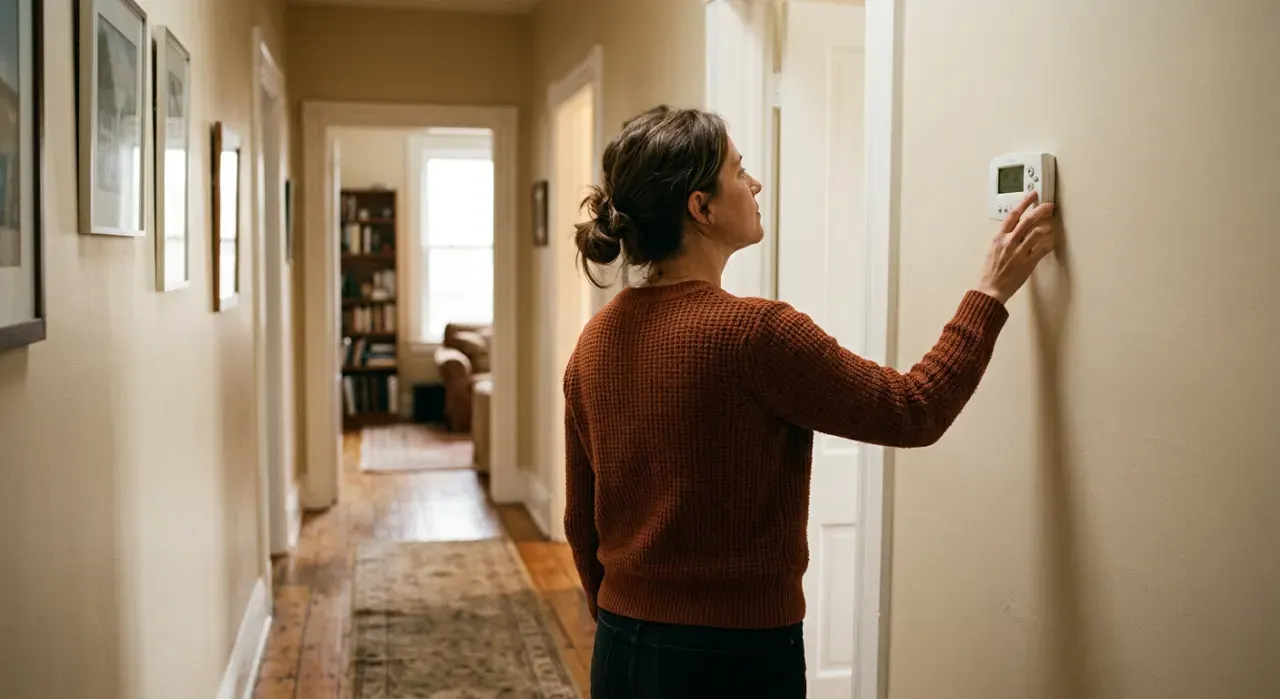
- Set the thermostat 3 to 4 degrees higher and run a fan in the room you occupy. Comfort stays level; compressor runtime falls. Setpoint guidance is in best AC temperature to save money.
- Exhaust heat at night. When the outdoor temperature drops below indoor, put a box fan in a window facing out on the warm side of the house and open a window on the cool side. You are moving heat, not just air.
- Close blinds on sun-facing windows during the day. Blocking solar gain does more than any fan.
- Switch fans off in empty rooms. No skin, no benefit.
- Keep the AC filter clean. A clogged filter cuts airflow, lengthens the duty cycle and raises the bill — see how often to change a furnace filter.
More no-compressor tactics are collected in how to cool a room without AC.
Where to go next
Fan shortlists are in best tower fans, best box fans and best ceiling fans. For real cooling, see best portable AC for a bedroom. Everything is under the heating and cooling hub.