 Garden

Affiliate Disclosure
Some links on this page are affiliate links. As an Amazon Associate, we earn from qualifying purchases — at no extra cost to you. We do not buy, test, or physically handle the products we cover; our rankings come from aggregated owner reviews, ratings and expert consensus. Commissions never change our verdicts. How we rank · full disclosure.
The short answer: a proper winterize takes about 45 minutes and comes down to six steps — deal with the fuel (stabilize a full tank or run it completely dry), change the oil while the engine is warm, replace or clean the spark plug and fog the cylinder, clean the deck and undercarriage, sharpen and balance the blade, and store the mower dry and off a cold concrete floor. Skipping the fuel step is what causes the vast majority of spring no-starts.
Do this the same weekend you take the last cut and the mower starts on the first or second pull in April. We do not physically handle the mowers we rank; our picks come from aggregated owner reviews and expert consensus, described in how we rank, with the ranked field in best lawn mowers.
Step 1: Deal with the fuel — the step that matters most
Modern pump gasoline in the US is usually E10, containing up to 10 percent ethanol. Ethanol attracts water, and after roughly 30 to 90 days the fuel begins to separate and form gum and varnish. Small-engine carburetors have a main jet with an opening measured in thousandths of an inch, so it takes very little deposit to block one. Pick one of two approaches and do it thoroughly:
- Stabilize. Add fuel stabilizer at the label rate, fill the tank to about 95 percent (a full tank leaves little air for condensation, but leave room for expansion), then run the engine for five minutes so treated fuel fully reaches the carburetor bowl. Untreated fuel sitting in the bowl defeats the whole exercise.
- Run it dry. Close the fuel shutoff valve if fitted, or siphon the tank, then start the engine and let it run until it stalls on its own. It must stall — that is what empties the bowl. Restart and let it stall a second time to be sure.
Do not leave a half-full tank of untreated fuel. That is the scenario that produces the spring ritual of pulling a starter cord thirty times. If you have the choice, ethanol-free fuel or canned pre-mixed small-engine fuel stores far longer, which is why many people keep a can of it purely for the last mow of the season.

Step 2: Change the oil, warm
Run the mower for a few minutes first. Warm oil flows out fast and carries the suspended carbon and metal with it; cold oil leaves half the contamination behind in the sump.
- Disconnect the spark plug wire before doing anything else.
- Drain via the drain plug if there is one, or tip the mower with the air filter side up and pour out through the fill neck into a pan. Tipping the other way floods the filter and carburetor with oil.
- Refill with the grade in your manual — SAE 30 is standard for warm-weather use on most small four-strokes, 10W-30 where fall temperatures swing. Walk-behind engines typically take 15 to 20 fl oz; check the dipstick rather than trusting a number.
- Do not overfill. Excess oil gets whipped by the crankshaft, blows past the rings and produces the white smoke people mistake for a blown engine.
- Take the used oil to an auto parts store or municipal recycling point. Pouring it on the ground or into a drain is illegal in every state.
While you are there, replace the air filter if it is a paper element and looks gray, or wash and lightly re-oil a foam element. The interval detail is in how often to change lawn mower oil.

Step 3: Spark plug and cylinder
Pull the plug and read it. A light tan or gray insulator is a healthy engine. Black and sooty means a rich mixture or a clogged air filter; oily means oil is getting past the rings or you tipped the mower the wrong way at some point. Most small-engine plugs are a one-season or two-season item and cost a few dollars, so fall is the sensible time to fit a new one and set the gap to the manual figure, usually around 0.030 in.
With the plug out, this is the moment to fog the cylinder if the mower will sit in a damp space: a two-second burst of fogging oil, or a tablespoon of clean engine oil, into the plug hole, then pull the starter cord slowly two or three times to spread it up the bore. Reinstall the plug but leave the wire disconnected for storage. Finish by pulling the cord gently until you feel it go firm — that is the compression stroke, with both valves closed, which seals the cylinder against moisture for the winter.
Step 4: Clean the deck and undercarriage
Packed, damp grass clippings hold moisture against the steel deck all winter and are the reason so many mower decks rust through from the underside. Scrape them off.
- Disconnect the plug wire, tip the mower with the air filter up, and scrape the underside with a putty knife or a stiff plastic scraper.
- Follow up with a wire brush on rust spots, then wipe the bare metal with a rag and a little oil, or spray a light coat of silicone or rust-inhibiting spray.
- Blow or brush clippings out of the cooling fins around the engine block. Blocked fins cause overheating next summer, and it is a genuinely common cause of a mower that dies after twenty minutes.
- Rinse and dry the grass bag fully. A bag stored damp comes out of the shed mildewed and brittle.
- Avoid blasting the whole engine with a pressure washer — water forced into bearings, the air intake and around the spindle does more harm than the dirt.
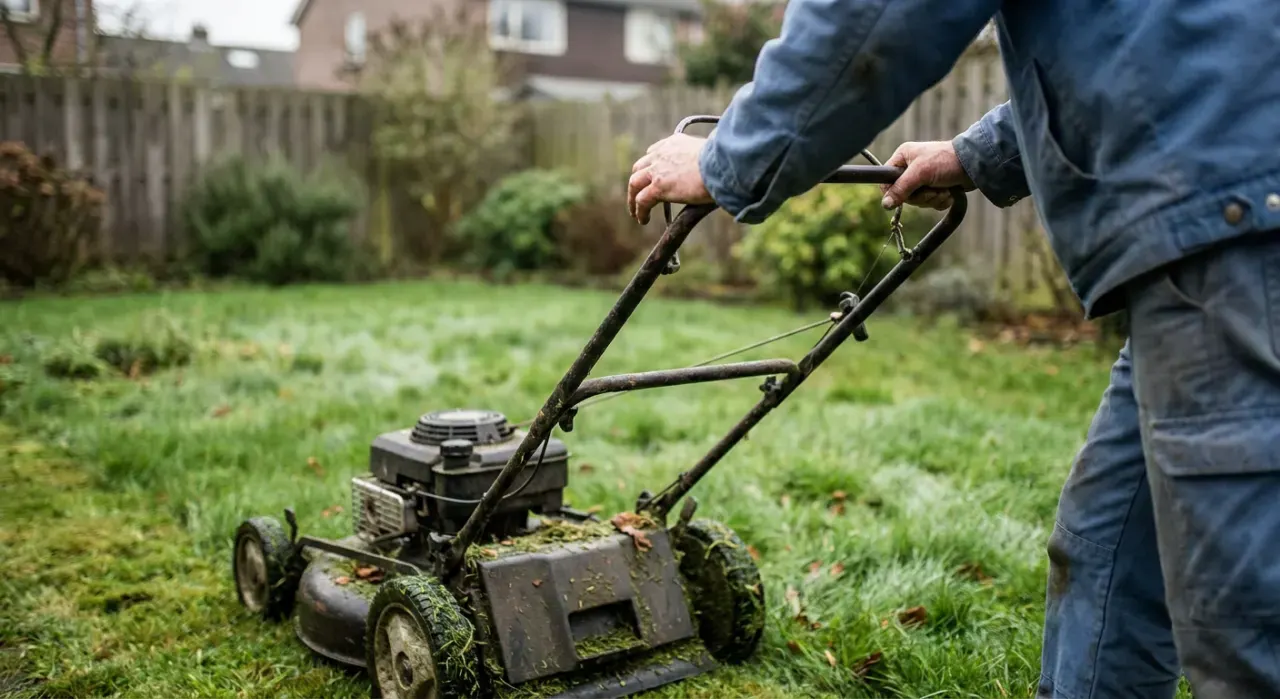
Step 5: Sharpen the blade now, not in spring
The blade is already off the mower and the deck is already clean, so the marginal effort is about fifteen minutes. Doing it in fall means the first cut of spring is a clean one and you are not chasing a shop backlog in April. Restore the existing 30 to 45 degree bevel with a mill file, balance the blade on a nail, and reinstall it torqued to spec with the sharp edges facing the direction of rotation. Full procedure in how to sharpen lawn mower blades.
Step 6: Store it properly
| Do | Why |
|---|---|
| Store indoors or under cover, dry | Condensation is what rusts cylinders, cables and decks |
| Put it on a scrap of plywood or a pallet | Cold concrete condenses moisture underneath the deck |
| Leave the spark plug wire disconnected | Prevents any accidental start while it is stored or moved |
| Battery mowers: pack at 40 to 60 percent, indoors, 50 to 77°F | Lithium cells degrade when stored full or frozen |
| Fold the handle carefully, avoiding cable kinks | Crushed control cables are a common and annoying spring repair |
| Do not cover a tightly sealed tarp over a damp mower | Traps moisture rather than excluding it |
Riding mowers add two items: put the battery on a maintenance charger or disconnect the negative terminal, and either raise the machine off its tires or inflate them to the top of the recommended range to limit flat-spotting.
Winterizing pairs naturally with knowing when the season is actually over — see when to stop mowing in fall. If your mower is already showing its age and you are weighing a service against a replacement, how long lawn mowers last has the realistic lifespans, why will my lawn mower not start covers the spring no-start, and the full seasonal routine is at the lawn care hub.