 Garden

Affiliate Disclosure
Some links on this page are affiliate links. As an Amazon Associate, we earn from qualifying purchases — at no extra cost to you. We do not buy, test, or physically handle the products we cover; our rankings come from aggregated owner reviews, ratings and expert consensus. Commissions never change our verdicts. How we rank · full disclosure.
Yes, and professional painters do it constantly — but indoors the precautions are not optional. You need full masking of every surface you are not painting, cross ventilation with a fan exhausting out a window, a NIOSH-approved respirator rather than a dust mask, and every ignition source shut off, including water heater and furnace pilots, if the coating is solvent based. Overspray in a closed room drifts several feet and settles as fine dust on everything. Airless sprayers also carry a genuine injection hazard at the tip.
When is spraying indoors actually worth it?
| Job | Spray or roll? | Why |
|---|---|---|
| Empty room or whole-house repaint before move-in | Spray | Nothing to mask; speed advantage is large |
| Kitchen cabinet doors | Spray, ideally in a garage or outdoors | Finish quality is the whole point |
| Trim, doors, built-ins, railings | Spray | Detail and profiles are slow to brush |
| Textured or popcorn ceilings | Spray | A roller drags the texture off |
| One accent wall in a furnished room | Roll | Masking costs more time than it saves |
| Small bathroom or closet | Roll | Nowhere for overspray to go; poor ventilation |
| Occupied home, one room at a time | Usually roll | Containment and re-occupancy are the constraints |
The honest rule is that spraying wins when there is little to mask and a lot to coat. In a furnished room the masking time swamps the spraying time, which is why the comparison in paint sprayer versus roller for cabinets comes out so differently from the case for a wall.
What does proper indoor masking look like?
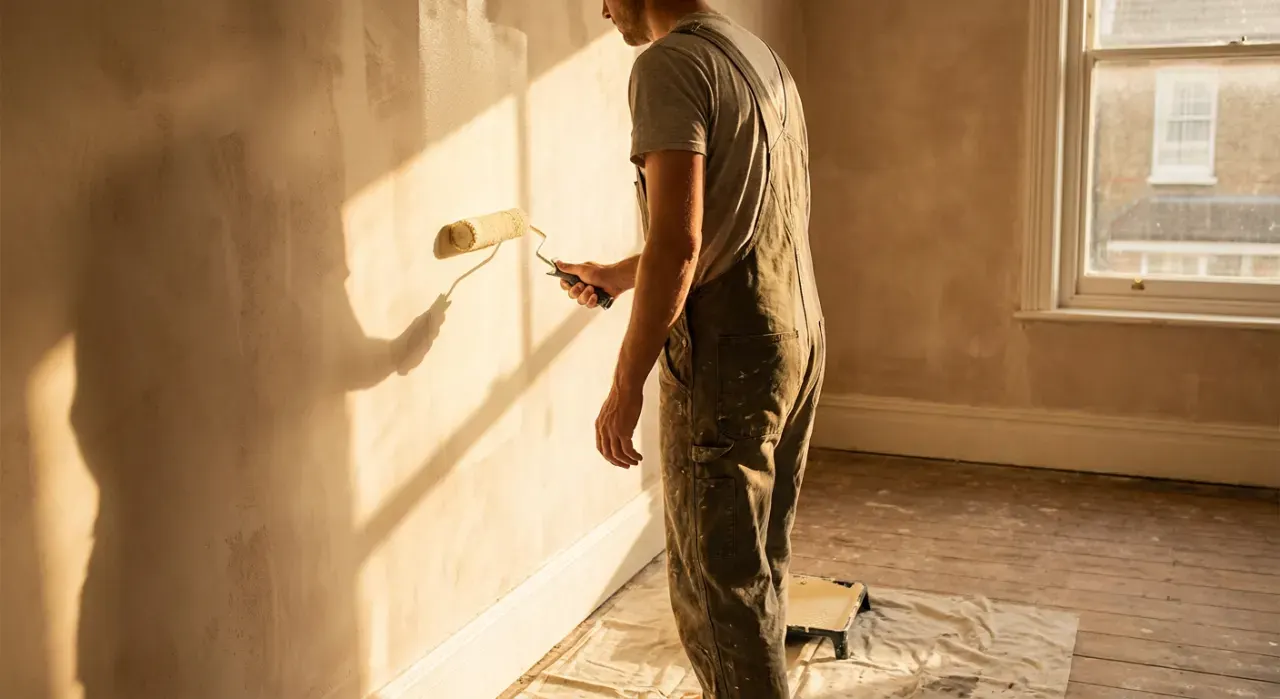
- Remove everything you can. Furniture out of the room entirely, not pushed to the middle.
- Plastic the floor edge to edge and tape it down at the baseboard. Overspray dries and bonds to unprotected floors.
- Mask ceilings, windows, doors and any wall not being sprayed with plastic and tape, using a tape suited to the surface — see painters tape picks.
- Seal the doorway with plastic sheeting so overspray does not migrate through the house.
- Cover HVAC registers and returns, and shut the system off. A running return pulls atomized paint into the ductwork.
- Bag light fixtures, switches, outlets, thermostats and smoke detectors.
Budget more time for this than for the painting. A room that takes 20 minutes to spray takes an hour or two to mask properly, and skipping any part of it is what produces the horror stories.
What are the real safety risks?
Inhalation. Atomized paint produces respirable droplets that rolling does not. OSHA and NIOSH guidance for spray application calls for a NIOSH-approved respirator — a particulate filter for water-based coatings, and an organic vapor cartridge plus particulate filter for solvent-based. Read the product safety data sheet, which states the protection that specific coating requires.
Fire and explosion. Solvent vapors are flammable and heavier than air, so they pool along the floor and travel toward water heater and furnace pilots. Shut off the gas to standing-pilot appliances in or near the work area, turn off HVAC, and do not run space heaters or non-rated fans.
Injection injury. This one is specific to airless sprayers and it is serious. An airless tip atomizes at pressures that can drive paint through skin, and the resulting injection injury looks like a pinprick and is a surgical emergency. Never point the gun at yourself or anyone else, always engage the trigger lock when not spraying, relieve pressure before changing a tip, and never try to clear a blocked tip with a finger. If paint does penetrate skin, go to an emergency room immediately and take the coating safety data sheet with you. This is general safety information, not medical advice.
How do you ventilate properly?
Cross ventilation, not just an open window. Put a box fan in one window blowing out, and open a window or door on the opposite side of the room so replacement air has a path in. That moves airborne overspray out of the space rather than circulating it. Keep it running through the job and for several hours afterward — the EPA guidance on painting and indoor air quality is essentially to maximize air exchange during and after the work and to keep sensitive occupants out of the space.
Do not aim a fan at a freshly sprayed surface; it will pull the finish and pick up dust. Exhaust the room, do not blow across the work. New paint smell and how long it lingers is covered in how to get rid of paint smell fast.
Which sprayer suits interior work?
An HVLP unit for most interior jobs in an occupied home — lower pressure means dramatically less overspray, better control in a confined space and less wasted material, at the cost of speed. Airless for large empty rooms, ceilings and heavy-bodied paint, where the volume advantage matters and the containment problem is smaller. The trade-offs are laid out in airless versus HVLP, thinning requirements in do you have to thin paint for an airless sprayer, and our paint sprayer picks rank on owner reports of clean-up time and tip clogging, which is where cheap units lose people.
We never buy, test or physically handle the products we rank. Recommendations come from aggregated owner reviews, star ratings, review volume and expert consensus — see how we rank.
More from this hub: Paint & Walls · Painting kitchen cabinets · Too cold to paint indoors · How we rank