 Garden


Affiliate Disclosure
Some links on this page are affiliate links. As an Amazon Associate, we earn from qualifying purchases — at no extra cost to you. We do not buy, test, or physically handle the products we cover; our rankings come from aggregated owner reviews, ratings and expert consensus. Commissions never change our verdicts. How we rank · full disclosure.
Crabgrass is beaten in early spring with a pre-emergent applied when soil temperature at 2 inches holds near 55°F for several days — locally, about when forsythia blooms. Once it has emerged, control gets much harder and much less reliable: quinclorac works on young plants and struggles on mature ones. And the free fix that prevents most of it is mowing at 3.5 to 4 inches so the seed never gets the light and heat it needs.
What Crabgrass Actually Is
Crabgrass (Digitaria species, usually smooth or large crabgrass) is a summer annual grass. It germinates in spring as soil warms, sprawls flat from a central point in a star or crab shape that gives it its name, roots at the nodes wherever a stem touches soil, produces an enormous seed load through late summer, and dies completely at the first hard frost.
Two facts about that life cycle explain everything about how it is controlled. First, every plant dies every winter, so you are never fighting a survivor — you are fighting seed. Second, a single mature plant produces seed in the thousands, and that seed stays viable in the soil for several years. One neglected summer stocks the seed bank for the next three or four.
It also tells you something. Crabgrass germinates where sunlight reaches bare, warm soil. A dense lawn cut tall barely gets any. A lawn scalped to 1.5 inches gets a lot. That is not a coincidence, and it is the reason so many crabgrass complaints trace straight back to mower settings.

The Calendar
| Timing | What is happening | What to do |
|---|---|---|
| Late winter | Seed dormant in soil | Watch soil temperature. Buy product now, apply later. |
| Soil at 55°F for 3–5 days | Germination about to start | Apply pre-emergent and water it in with about 0.5 inch of irrigation |
| 6–8 weeks later | Barrier degrading; second germination flush | Split second application, if the label allows a seasonal total |
| Late spring, plants 1–3 tillers | Escapes are visible and small | Post-emergent with quinclorac or fenoxaprop, or hand-pull |
| Midsummer, sprawling clumps | Mature plants, poor herbicide uptake | Accept it, mow high, prevent seed set where you can |
| Late summer to fall | Seed being shed heavily | Overseed thin areas; thicken turf so next year has fewer openings |
| First hard frost | Every plant dies | Nothing. Plan next spring. |
Pre-Emergent: Timing Is the Whole Product
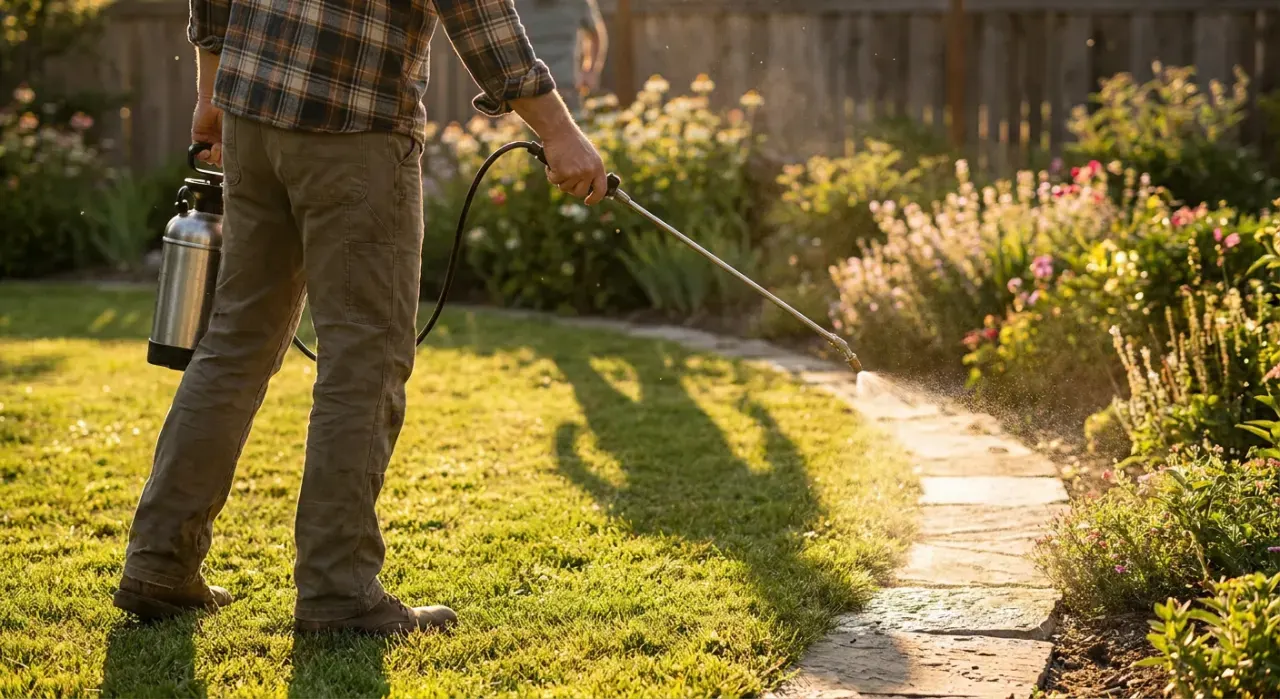
A pre-emergent herbicide does not kill seed. It forms a thin treated layer in the top half inch of soil that interferes with cell division in a germinating seedling as it pushes through. Miss the window and the barrier sits above plants whose roots are already below it, doing nothing.
The trigger is soil temperature, not air temperature. Crabgrass germination begins when soil at 1 to 2 inches deep reaches roughly 55°F and stays there. A warm week in February that spikes the air to 70°F does not move soil much; a run of mild nights does. Apply when soil temperature has held near 55°F for three to five consecutive days — a few days early is fine, a week late is a wasted bag.
Forsythia is the folk indicator, and it holds up. Forsythia comes into full bloom on roughly the same accumulated warmth crabgrass needs, and because it is planted everywhere in the eastern and midwestern US, it is a free local sensor. The rule of thumb gardeners use: apply when forsythia is in full yellow bloom, and certainly before the flowers drop. It is a proxy, not a law — in the Pacific Northwest and Mountain West it is less reliable, and a $12 soil thermometer pushed 2 inches into the lawn at mid-morning removes the guesswork entirely. Many state extension services also publish county-level soil temperature maps.
Rough regional windows, to be checked against local soil temperature rather than trusted blind:
- Gulf South and coastal Southeast — mid-February to early March
- Mid-Atlantic and lower Midwest — mid-March to early April
- Upper Midwest, New England, Mountain West — mid-April to early May
- Pacific Northwest — March, but very variable; use a thermometer
Water it in. Most pre-emergents need about half an inch of rain or irrigation within a few days of application to move the active into the soil surface and form the barrier. Left dry on top of thatch, a granular product is not doing its job.
Split the season. Barriers degrade — most give roughly six to ten weeks of protection depending on the active, temperature and rainfall — while crabgrass germinates in flushes into early summer. Two applications about eight weeks apart, within the label seasonal maximum, is what consistently separates a clean lawn from a mostly-clean one.
One conflict worth knowing: pre-emergents do not distinguish between crabgrass seed and grass seed. If you intend to overseed, you cannot apply a standard pre-emergent that spring — check the label re-seed interval, which is often eight to sixteen weeks. Siduron is the exception used when seeding and preventing crabgrass at the same time. The ranked field and the differences between actives are in best pre-emergent herbicides.
Post-Emergent: Why It Is So Much Harder
Once crabgrass is up, three things work against you at once.
You are trying to kill a grass inside a lawn made of grass. The selectivity margin is narrow, which is why crabgrass products carry more turf-type warnings and more caution about rate and heat than broadleaf products do. Common lawn broadleaf actives such as 2,4-D do not control it at all — a frequent source of the belief that a product failed.
Susceptibility collapses with size. Quinclorac and fenoxaprop are effective on seedlings up to about three tillers, roughly a plant smaller than your palm. On a sprawling clump a foot across, results are inconsistent and often need repeat applications. The practical rule: treat what you can see in late spring, and stop expecting much from midsummer applications.
Heat limits the window. Most labels restrict application above about 85 or 90°F because turf injury risk rises sharply. In much of the country that closes the window right when the crabgrass is most obvious.
A methyl ester of seed oil or a nonionic surfactant is required on many quinclorac labels to get the active through crabgrass leaf wax, and skipping it is a common cause of poor results. Read that section of the label specifically. The lawn-safe product field is ranked in best weed killer for lawns, and the reason a general-purpose bottle is the wrong choice here is explained in selective vs non-selective herbicides.
For a handful of plants, hand-pulling still wins. Crabgrass roots shallowly and comes up whole after rain, and pulling before seed set in July and August directly reduces next year's pressure. Fill the resulting gap, because bare soil is what crabgrass wanted in the first place.
Prevention: Mowing Height Does More Than Any Product
Crabgrass seed needs light at the soil surface and warm soil to germinate. A tall, dense canopy denies it both.
Raise the deck. Cool-season lawns — tall fescue, Kentucky bluegrass, perennial ryegrass — should be cut at 3.5 to 4 inches through the warm months. Warm-season turf is cut lower by nature, but even bermudagrass and zoysia benefit from the top of their recommended range in summer. Going from 2 inches to 3.5 inches shades the soil surface enough to suppress a meaningful share of germination without a single dollar spent.
Follow the one-third rule. Never remove more than a third of the blade in one cut. Scalping opens the canopy exactly when crabgrass is looking for an opening.
Water deeply and infrequently. About an inch a week in one or two soakings, rather than daily light sprinkling. Frequent shallow watering keeps the top half inch of soil moist and warm — precisely the crabgrass germination zone — while doing nothing for turf root depth.
Overseed thin areas in fall. Bare soil in September is crabgrass in June. Thickening the stand is the only permanent answer, and everything else is maintenance around it. The mowing, feeding and watering routine is covered in the lawn care hub.
Fix the edges. Crabgrass concentrates along driveways, sidewalks and curbs because the pavement radiates heat into the adjacent soil strip. Those two-foot bands are worth treating even when the rest of the lawn is clean.
Where to Go Next
If you are not certain crabgrass is what you have — and a lot of what gets called crabgrass is actually nutsedge or annual bluegrass, which need entirely different products — work through common lawn weeds identified first. Preventing next season starts with best pre-emergent herbicides, and the full ranked field across categories is in best weed killers. If dogs use the lawn, read weed killers and pet safety before you spray. Everything sits under the pest and weed control hub.
We never buy, apply or physically handle the products we rank — recommendations come from aggregated owner reviews and expert consensus, and the method is on how we rank. Follow the product label; in the United States it is the legally binding instruction and it overrides anything written here.