 Garden

Affiliate Disclosure
Some links on this page are affiliate links. As an Amazon Associate, we earn from qualifying purchases — at no extra cost to you. We do not buy, test, or physically handle the products we cover; our rankings come from aggregated owner reviews, ratings and expert consensus. Commissions never change our verdicts. How we rank · full disclosure.
"Solar" on a security camera box means "you will probably never charge it", not "it runs on sunlight". The panel is a trickle charger for a battery, and whether it keeps up is a simple sum: how much power the camera spends against how much light the panel collects where you mounted it. Get that sum wrong and you own a camera that dies every February. Get it right and you genuinely never touch it again.
Almost every disappointed owner review in this category traces back to the same three causes — a panel in shade, a panel aimed at the wrong part of the sky, or motion zones so wide the camera records every passing car. None of those are the camera's fault, and all three are fixable in an afternoon. Below are the six models the ownership record supports, followed by the arithmetic that decides whether yours will keep up.
Top Picks at a Glance
Does the panel actually keep up? The arithmetic
The two numbers that matter are rarely printed together. On the spend side, a wire-free camera in standby draws very little; almost all of its consumption is recording an event and uploading it over Wi-Fi. On the supply side, a panel rated at a few watts produces that figure only in bright, perpendicular midday sun, and produces a fraction of it on a gray January morning.
The practical consequence is that event count, not panel size, is what usually decides the outcome. A camera watching a quiet back fence might wake ten times a day. The same camera pointed across a sidewalk with the sensitivity at maximum can wake several hundred times. The first stays charged through winter almost anywhere. The second will not keep up in December north of about the fortieth parallel, no matter which model you bought.
| Situation | Rough daily events | Winter outcome, northern states | Fix |
|---|---|---|---|
| Back fence, no path | Under 15 | Keeps up comfortably | Nothing |
| Driveway, one household | 15–40 | Usually keeps up | Tilt the panel steeper |
| Front of house on a street | 60–200 | Falls behind in midwinter | Narrow motion zones, disable vehicle triggers |
| Panel on a north wall | Any | Falls behind year-round | Separate panel on a south-facing mount |
| Panel under an eave or a tree | Any | Falls behind in winter | Move it — winter shade is longer than summer shade |
| Sustained snow cover on the panel | Any | Stops charging entirely | Steeper tilt sheds snow; brush it off |
Two pieces of physics are worth internalizing. The sun sits far lower in winter, so a panel laid nearly flat collects a small fraction of what a steeply tilted one does in December — the NOAA solar position calculator will show you the actual midday sun angle for your latitude and date, and it is usually lower than people expect. And lithium batteries lose usable capacity in the cold, so the same battery holds less charge in January precisely when the panel is replenishing least. Those two effects compound, which is why solar cameras fail in midwinter rather than gradually.
Our #1 Pick: eufy SoloCam S340
The S340 is the one we would fit on a house without qualification, and it earns that on two design decisions rather than a spec.
The first is the panel. It is large by the standards of this category and it sits on an adjustable mount, which means you can aim it at the winter sun rather than accepting whatever angle the camera bracket dictates. That single feature is the difference between a camera that keeps up in January and one that does not, and it is the thing most all-in-one solar cameras get wrong.
The second is the second camera. Wide-angle solar cameras produce footage that establishes an event and identifies nobody — the classic useless clip of a figure crossing a yard at forty feet. The S340 pairs a 3K wide lens with a telephoto that zooms 8×, and the tracking hands a subject from one to the other. That is what turns a recording into evidence.
Everything records locally with no subscription, which matters more on an outdoor camera than people assume: a wire-free camera at the edge of a property is the one most likely to be reached, and a plan-free camera is the one you will still be running in five years. The honest complaints are that pan-and-tilt cameras are slower to react than fixed ones because the motor has to move, and that the app occasionally needs a re-pair after a firmware update.
Check price on Amazon → (paid link)
The Ranked Field

Best for one camera that covers a whole side of a property and stays charged without help
- Two cameras — a 3K wide lens plus a telephoto for 8× zoom
- Integrated solar panel on an adjustable mount
- 360-degree pan with 70-degree tilt and auto tracking
- Local storage with no subscription required
Why buy it: the one solar camera here that solves both halves of the problem — a panel large enough to keep up in real weather, and a second lens so the footage is identifiable rather than just wide.

Best for households already on Ring who want lighting and a siren as well as a camera
- LED spotlights and a 105-decibel siren built in
- The highest owner rating in this roundup
- Color night vision when the spotlights trigger
- Separate solar panel included; recording requires a Ring Home plan
Why buy it: the strongest deterrent package here, because a light and a siren interrupt an approach in a way a silent camera does not — with the honest caveat that it needs a plan to save anything.

Best for a first solar camera, or covering a low-priority corner cheaply
- Integrated solar panel on the camera body
- MicroSD recording with no subscription
- On-device person detection to cut false alerts
- Simple magnetic and screw mounting options
Why buy it: the cheapest solar camera we would actually recommend. The 1080p sensor is the compromise, but everything else works and nothing is behind a paywall.
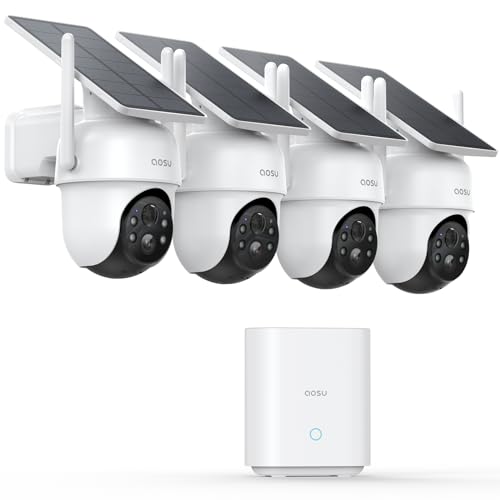
Best for covering four sides of a house in one purchase with nothing monthly to pay
- Four solar cameras plus a base station with 32GB storage included
- No subscription required for recording or detection
- Base station handles the Wi-Fi link, so cameras do not each fight the router
- Cross-camera event view in one app
Why buy it: the base-station design is the reason to buy a kit rather than four separate cameras — the cameras talk to the hub on their own link instead of each competing for a weak signal at the edge of the house Wi-Fi.

Best for two covered angles for the price of one mid-range camera
- Two 2K pan-and-tilt cameras with integrated solar panels
- MicroSD storage in each camera, no plan needed
- Spotlight and siren for night deterrence
- Full 360-degree horizontal coverage from each unit
Why buy it: the pragmatic option when you need coverage on two sides and the budget for one. Owner ratings are strong for the price bracket, which is unusual in the low end of this category.

Best for a driveway or yard where you want the camera to follow a subject rather than watch a fixed box
- 5MP sensor with 3K output
- Automatic human and vehicle tracking across the pan range
- No subscription required, local storage included
- Integrated solar panel with a generous capture area
Why buy it: tracking is genuinely useful on a driveway, where a fixed camera catches a car entering the frame and loses the person who steps out of it.
Quick Comparison
| Product | Best for | Rating | Price | Buy |
|---|---|---|---|---|
| eufy Security SoloCam S340, 3K Dual Camera, Solar, 360° Pan and Tilt, No Subscription | Best Overall | — | Check (paid link) | |
| Ring Spotlight Cam Plus, Solar, Two-Way Talk, Color Night Vision and Siren | Best in the Ring Ecosystem | — | Check (paid link) | |
| Tapo SolarCam 1080p Wireless Outdoor Camera, Battery with Solar, Person Detection | Best Value | — | Check (paid link) | |
| aosu D1 Classic 4-Cam Kit, Solar Powered Wireless Outdoor Cameras, 32GB Local Storage | Best Multi-Camera Kit | — | Check (paid link) | |
| SEHMUA 2K Solar Security Cameras Wireless Outdoor, 2 Pack, 360° Pan and Tilt | Best Budget Pair | — | Check (paid link) | |
| aosu 3K 5MP Solar Security Camera Wireless Outdoor PTZ, 360° Smart Tracking | Best Auto-Tracking | — | Check (paid link) |
Where the footage goes, and the audio rule
Four of the six cameras here record to local storage with no plan, which is the right default for an outdoor camera on a property edge — nothing is held by a company and nothing stops working when a tier changes. The Ring Spotlight Cam Plus is the exception: it will show live video without a plan but will not save a clip, and Ring settled with the Federal Trade Commission in May 2023 for $5.8 million over allegations that employees and contractors accessed customers' private videos and that weak safeguards let attackers take over customer cameras through credential stuffing. Ring has since made two-factor authentication mandatory and added end-to-end encryption as an option. FTC press release on the Ring settlement. It is a genuinely good camera and a household already committed to Ring may reasonably buy it — just enable both protections on day one.
Audio is a separate legal question from video, and outdoor cameras are where it bites. Video of a public street is generally permissible. Recording a conversation is governed by wiretap law: federal law and most states allow recording where one party consents, but a significant minority require all parties to consent, and a camera covering a driveway or a fence line can easily capture a conversation between people who have consented to nothing. The Reporters Committee for Freedom of the Press keeps a state-by-state guide. Every camera here can have its microphone disabled. Check your state — this is general information, not legal advice. It is also good practice to angle motion zones away from a neighbor's windows, which reduces both friction and false alerts.
Getting the install right
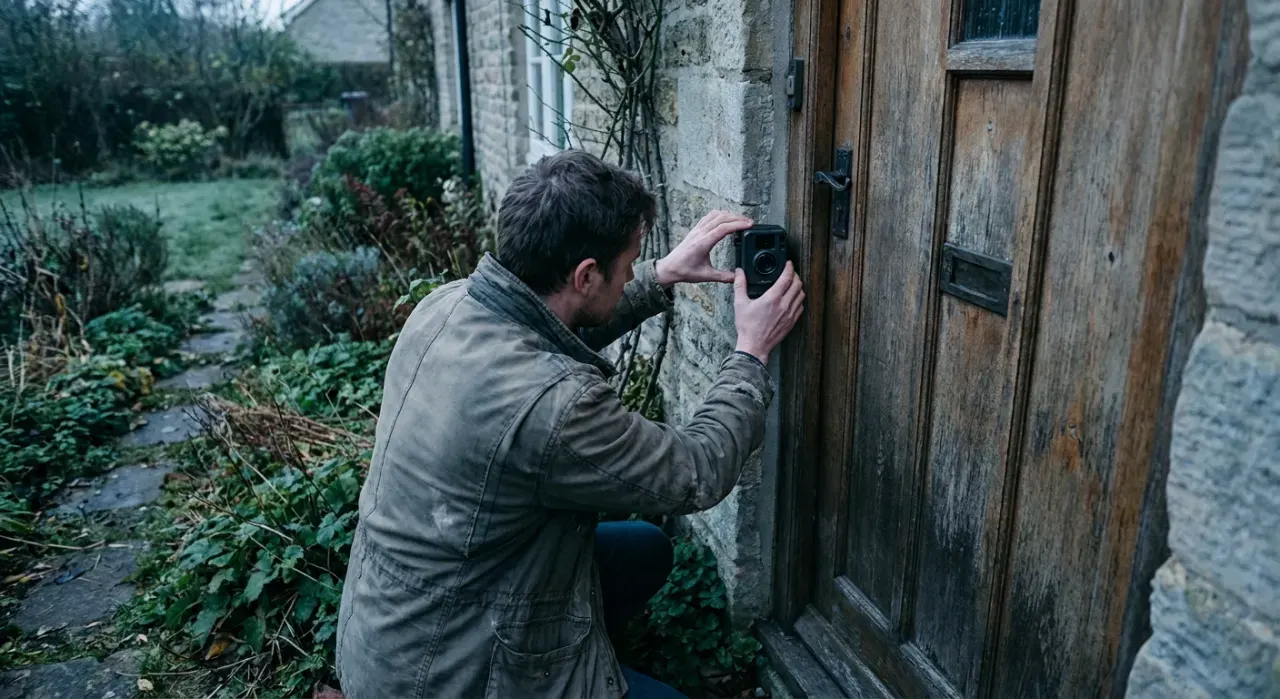
- Mount the camera 8 to 10 feet up, angled slightly down. Higher gets it out of reach but flattens faces into the top of a head, which is useless for identification.
- Aim across a path, not down it. Passive infrared sensors detect movement crossing the field far more reliably than movement coming straight at the lens, which is why a camera pointed down a driveway triggers late.
- Put the panel where you would put a sundial, not where the bracket happens to reach. South-facing, steeply tilted, clear of the eave shadow.
- Check the Wi-Fi before you drill. Stand at the mounting spot with a phone. One bar means you need a mesh node, an outdoor access point, or a kit with its own base station.
- Tune the motion zones on day one. Exclude the street, the sidewalk and the neighbor's driveway. This is the single biggest lever on both battery life and whether you keep the notifications turned on.
Our guide on mounting outdoor security cameras covers the physical side in more detail, and how far a Wi-Fi camera can be from the router gives the realistic distances.
How We Rank
We never buy, install or physically handle these cameras. Rankings come from aggregated owner ratings across the most-owned solar cameras, weighted toward reviews written after a winter has passed — the only ones that say anything useful about whether the panel keeps up — and cross-checked against published specifications. Four things carry the weight: whether the camera stays charged in real conditions, which is what this category is bought for; whether the footage identifies anyone rather than merely recording that something happened; connectivity at the edge of a property; and whether recording works without a subscription. Prices were checked at the time of writing. Full method: how we rank.
What Owners Actually Complain About
Winter charging in northern states. The defining complaint of the category, and it correlates far more strongly with motion-zone configuration and panel aim than with brand.
Wi-Fi at the property edge. A camera on a back fence is often 60 feet and two walls from the router. Owners blame the camera; the network is usually at fault.
Slow wake from standby. Battery cameras sleep to save power, so there is a lag between the sensor triggering and the recording starting. Someone walking briskly can be halfway across the frame. Aim across the path rather than along it to buy back the time.
False triggers from foliage and heat. Passive infrared reacts to a sun-warmed fence or a branch moving in wind. Narrow zones and lower sensitivity fix most of it.
Spider webs on the lens. Genuinely one of the most common night-alert causes, because the infrared illuminators attract insects and the insects attract spiders. A wipe every few weeks solves it.
The Verdict
Buy the eufy SoloCam S340. The adjustable panel is what keeps it running through winter and the second camera is what makes the footage worth having. If you want a light and a siren as well and your house already runs Ring, the Ring Spotlight Cam Plus Solar has the highest owner rating here and the strongest deterrent package — accept the plan requirement and turn on two-factor and encryption.
For four sides of a house in one go, the aosu D1 Classic kit is the cheapest sensible route and its base station solves the Wi-Fi problem that catches most people out. The Tapo SolarCam is the low-risk way to try the format. Whatever you buy, spend twenty minutes on the panel angle and the motion zones — that is worth more than any upgrade on this page. Check price on Amazon → (paid link)
More from this hub: Smart Home & Security · Best solar powered security cameras · Best outdoor security cameras · Wired vs wireless cameras · Where to place cameras · How we rank