 Garden

Affiliate Disclosure
Some links on this page are affiliate links. As an Amazon Associate, we earn from qualifying purchases — at no extra cost to you. We do not buy, test, or physically handle the products we cover; our rankings come from aggregated owner reviews, ratings and expert consensus. Commissions never change our verdicts. How we rank · full disclosure.
The verdict in 90 seconds
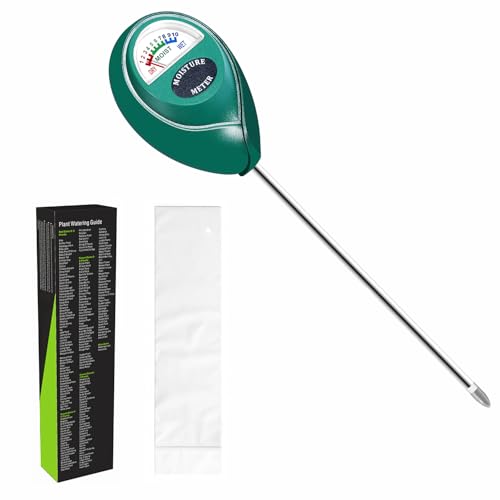
The XLUX moisture meter is the rare twelve-dollar tool that reliably changes an outcome, because it removes the guess from the single most common way people kill plants. One stainless probe, one dial, no batteries, no pH claims, no light meter. It has one of the largest and most consistently positive owner-review bases in gardening. Its limits are real and easily stated: it reads at the probe tip, it needs good soil contact, and it tells you about the top few inches — which is exactly what a container gardener needs and only part of what an outdoor grower does.
Best for houseplants, containers and anyone who waters on a schedule instead of on evidence
- Single 304 stainless steel probe reaching root depth
- No batteries required — reads instantly on insertion
- Ten-point dial banded dry, moist and wet
- ABS body sized for one-handed use in a pot
Why buy it: it replaces a guess with a reading, and overwatering kills more container plants than any pest or disease.
What owners consistently praise
It stops overwatering, which is the whole point. More houseplants die from too much water than from anything else, and the top inch of a pot tells you almost nothing about conditions at root depth. Owners describe the meter ending a long run of killed plants, and that story dominates the positive reviews — particularly from people who had been watering on a weekly schedule.
Single function, honest scope. Reviewers repeatedly contrast it with three-in-one meters whose pH scale is meaningless. Doing one thing and not claiming the other two earns it credibility with experienced gardeners.
No batteries. Nothing to charge, nothing to find flat in March. For a tool used a few times a week for a minute at a time, that is the correct design.
Probe length and build. The stainless probe is long enough to reach the root zone of a normal houseplant pot and stiff enough to push into a raised bed without bending, and the moulded body is easy to hold with one hand while steadying the pot with the other.
Speed. Insert, wait a moment, read. Owners with large plant collections describe checking thirty pots in a few minutes, which is the difference between a tool that gets used and one that stays in a drawer.

What owners actually complain about
It reads where the probe is, not where the roots are. The most legitimate technical criticism. In a large pot or a deep bed the top can be dry while the base is saturated, or the reverse. Owners of big containers learn to take readings at more than one depth and position, and those who do not report confusing results.
Poor contact gives false dry readings. Hard, compacted or very dry soil does not press against the probe, so the needle stays low. It is a physical limitation of the measurement method, and it produces a stream of reviews claiming the meter is broken when it is doing exactly what a resistance probe does.
Salinity skews the reading. Heavily fertilised soil conducts better and reads wetter. Owners feeding regularly report drift over time, and a flush of the pot brings the readings back into line.
Probe corrosion when left in soil. The single largest cause of failure. Owners who use it as a permanent indicator report the readings drifting and then stopping within months. Wipe and store it out of the pot.
Not a calibrated instrument. The dial is a relative 1 to 10 scale, not a volumetric water content percentage, so numbers are not comparable between different soil types. Owners who understand it as a within-pot comparison are satisfied; owners expecting a laboratory figure are not.
Quality control on arrival. A steady minority report a needle stuck at one end of the scale, a loose probe, or a unit that never moves. At this price it is a replacement rather than a repair, but it happens often enough to be a pattern.
Limited use in the open garden. In established beds the probe does not reach the depth that matters, and it can bend in stony soil. Outdoors it is best treated as a check on new plantings and containers rather than on mature shrubs and trees.
Who it suits, and who should buy something else
Buy it if you grow in containers or raised beds and want a reliable, cheap answer to whether a plant needs water today.
Buy a soil test kit instead if the question is pH or nutrients — no probe meter answers that. Our best soil test kit guide covers chemical kits and mail-in lab tests, and the SONKIR 3-in-1 review explains why the pH dial on multi-function meters cannot be trusted.
Buy a hose timer or drip system instead if the real problem is consistency rather than knowledge. A meter tells you what happened; irrigation prevents it — see our best hose timer and best drip irrigation kit picks.
Use a trowel instead if you are checking established outdoor plantings, where depth matters more than a number.

Specifications
| Spec | XLUX Soil Moisture Meter |
|---|---|
| Function | Soil moisture only — no pH, no light, no nutrients |
| Power | None — no batteries required |
| Probe | Single 304 stainless steel probe |
| Body | ABS housing with an analogue dial |
| Scale | 1 to 10, banded dry, moist and wet |
| Reading time | Under a minute, read while inserted |
| Best use | Houseplants, containers, raised beds, new plantings |
| Limitations | Reads at probe depth; affected by soil salinity and poor contact |
| Care | Remove after each reading, wipe dry, store out of soil |
| Use in water | Not intended for liquids or hydroponic reservoirs |
The bottom line
Almost nothing in gardening costs twelve dollars and prevents a recurring, expensive mistake. This does, provided you use it as designed: push the probe properly into the root zone, read it while it is in the soil, take it out afterwards, and treat the dial as a relative scale for that particular pot. It will not tell you about pH, it will not help much with an established tree, and it will corrode if you leave it in a plant like a thermometer in a roast.
Check price on Amazon → (paid link)
Next: set the volume with how much to water a garden, time it with the best time of day to water, settle the evening question in is it bad to water plants at night, or start from the watering and irrigation hub.