 Garden

Affiliate Disclosure
Some links on this page are affiliate links. As an Amazon Associate, we earn from qualifying purchases — at no extra cost to you. We do not buy, test, or physically handle the products we cover; our rankings come from aggregated owner reviews, ratings and expert consensus. Commissions never change our verdicts. How we rank · full disclosure.
The short answer: a mid-size HEPA air purifier uses about 0.5 to 1.0 kWh per day running 24 hours on a medium setting — call it 0.7 kWh, or roughly 12 cents a day at a US average residential rate of 17.5 cents per kWh — the EIA publishes the current price for your state. That is $3.70 a month and about $44 a year of continuous operation. Small bedroom units use 0.2 to 0.5 kWh a day; large whole-room units on high can reach 2 kWh. Filters cost more than the electricity in almost every case.
For context, running an air purifier around the clock uses roughly the same electricity as a 30-watt light bulb left on. We do not physically handle the purifiers we rank; our picks come from aggregated owner reviews and expert consensus, described in how we rank, with the ranked field in best air purifiers.
Daily consumption by size and speed
| Unit | Low | Medium | High | kWh/day at medium, 24 hr |
|---|---|---|---|---|
| Desktop / small bedroom (up to 200 sq ft) | 4 – 8 W | 10 – 18 W | 25 – 35 W | 0.24 – 0.43 |
| Mid-size room (200 – 400 sq ft) | 8 – 15 W | 25 – 40 W | 50 – 80 W | 0.60 – 0.96 |
| Large room (400 – 800 sq ft) | 15 – 25 W | 40 – 60 W | 80 – 120 W | 0.96 – 1.44 |
| Whole-floor / open plan | 20 – 40 W | 60 – 100 W | 120 – 200 W | 1.44 – 2.40 |
| DIY box fan and filter build | — | 50 – 90 W | — | 1.20 – 2.16 |
A note on the last row: a box-fan-and-filter build is a genuinely effective option that research during wildfire seasons has supported, but it is not the low-energy choice — a box fan motor is far less efficient than the purpose-built brushless motors in modern purifiers. See how to build a DIY box fan air purifier for when it makes sense.
Cost by state rate
Figures for a mid-size unit at medium speed, 0.72 kWh per day.
| Rate per kWh | Per day | Per month | Per year |
|---|---|---|---|
| 11¢ — WA, ID, ND | $0.08 | $2.38 | $28.90 |
| 14¢ — TX, TN, MO | $0.10 | $3.02 | $36.79 |
| 17.5¢ — US average | $0.13 | $3.78 | $45.99 |
| 25¢ — NY, NH, VT | $0.18 | $5.40 | $65.70 |
| 32¢ — CA, MA, CT | $0.23 | $6.91 | $84.10 |
| 44¢ — HI | $0.32 | $9.50 | $115.63 |
The formula is watts ÷ 1,000 × hours × rate per kWh. Use the all-in rate from your bill rather than the advertised supply rate. Certification narrows the range: ENERGY STAR room air cleaners are more than 50 percent more energy-efficient than standard models, saving about 211 kWh and $18 to $40 a year.
Filters are the real running cost
| Item | Interval | 2026 cost | Annual |
|---|---|---|---|
| True HEPA filter | 6 – 12 months | $30 – $90 | $30 – $180 |
| Activated carbon filter or sleeve | 3 – 6 months | $15 – $45 | $30 – $180 |
| Washable pre-filter | Rinse monthly | $0 | $0 |
| Combined HEPA plus carbon cartridge | 6 – 12 months | $40 – $120 | $40 – $240 |
| UV lamp, if fitted | 1 – 2 years | $20 – $50 | $10 – $50 |
| Electricity, continuous mid-size | — | — | $29 – $84 |
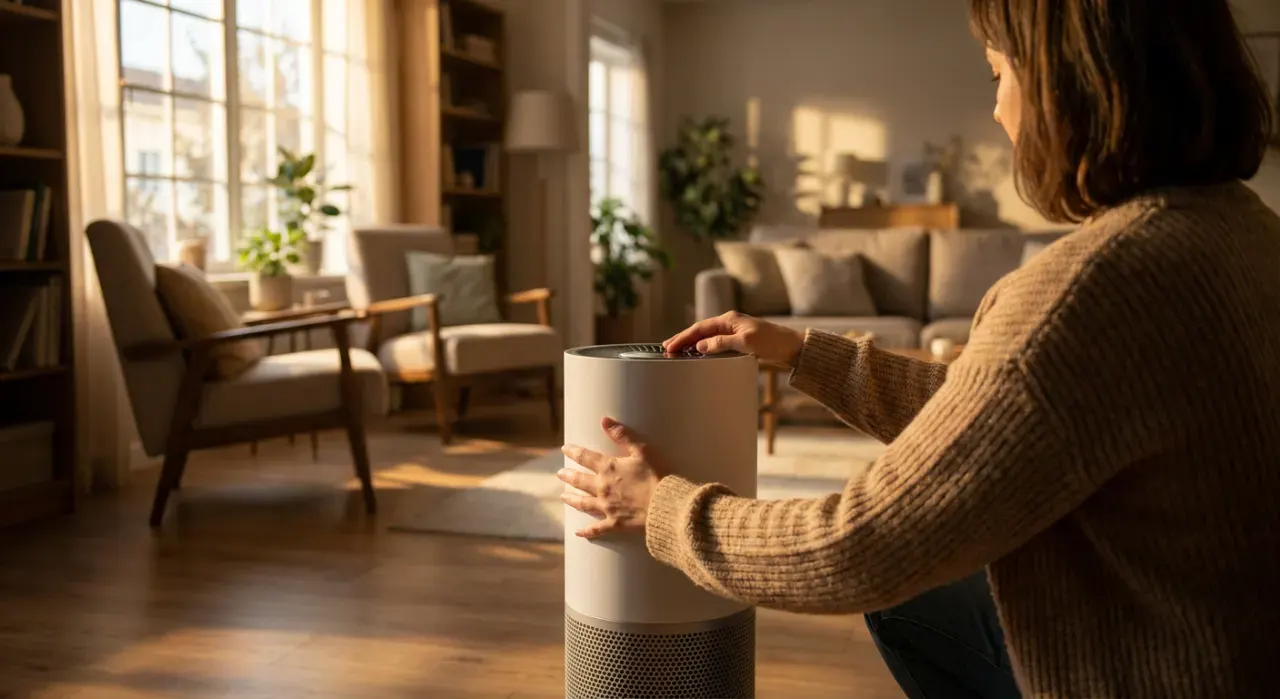
Filter cost commonly runs two to three times the electricity cost, and it varies far more between models than wattage does. Two purifiers with almost identical performance can differ by $100 a year in filters, which over a five-year life is more than either unit cost to buy. Check the replacement price and stated interval before purchase, and rinse the washable pre-filter monthly — it is the cheapest way to extend HEPA life, because the pre-filter catches the hair and lint that would otherwise clog the expensive element.
Running it sensibly
- Run it continuously on a low or medium setting rather than intermittently on high. Benefit depends on sustained air changes per hour, and continuous quiet operation is both more effective and, on many units, more efficient than repeated turbo bursts.
- Match the unit to the room. A purifier rated for 200 sq ft running flat out in a 500 sq ft room uses more energy and delivers less than a correctly sized unit on medium.
- Use auto mode if it has a real particle sensor. It drops to low in clean conditions, which is where most of the day is spent.
- Place it with clearance — a purifier pushed against a wall or under furniture recirculates its own clean air. See where to put an air purifier.
- Turbo has its place: 20 to 30 minutes after cooking, during a wildfire smoke event — the EPA recommends a portable air cleaner to remove fine particles and creating a clean room — or when someone with allergies is about to use the room.
For the filter question in detail see how to replace an air purifier filter and true HEPA vs HEPA-type. On whether the device does what people hope, do air purifiers help with allergies and do air purifiers help with dust are the honest answers, and the ranked field is in best air purifiers. Everything else is at the air quality hub.