 Garden

Affiliate Disclosure
Some links on this page are affiliate links. As an Amazon Associate, we earn from qualifying purchases — at no extra cost to you. We do not buy, test, or physically handle the products we cover; our rankings come from aggregated owner reviews, ratings and expert consensus. Commissions never change our verdicts. How we rank · full disclosure.
The reliable early signs are several drains running slowly at once and gurgling after a flush. Later signs are outdoors: sewage odor near the tank or drainfield, unusually lush or soggy grass over the field, and eventually standing wastewater or a backup into the house. The first two mean book a pump-out. Wastewater on the ground is a pathogen exposure, not just an inconvenience — keep children and pets away from it and call a septic professional the same day.
We never buy, test or physically handle the products we rank; recommendations come from aggregated owner reviews and expert consensus, described in how we rank. More at the DIY plumbing hub.
The signs, in the order they usually appear
| Sign | What it means | What to do |
|---|---|---|
| Several drains slow at once | Restriction at the tank or outlet, not a local clog | Book a pump-out and inspection |
| Gurgling after flushing | Air displacement in a system that cannot move liquid away | Book a pump-out |
| Toilets flushing sluggishly across the house | The whole system, not one fixture | Book a pump-out |
| Sewage odor outdoors near the tank or field | Effluent surfacing, or a saturated drainfield | Call a professional promptly |
| Lush, dark green grass over the drainfield | Nitrogen-rich effluent reaching near the surface | Call a professional promptly |
| Soggy ground or standing water over the field | The field is no longer absorbing | Keep people and pets off it; call today |
| Wastewater visible on the ground | System failure — untreated sewage at the surface | Rope it off; call today; treat as a health hazard |
| Sewage backing up into fixtures | The system cannot accept any more flow | Stop using water; call today |
| An alarm sounding (systems with a pump) | High water level in a pump chamber | Reduce water use; call the service company |
Note the pattern. The indoor signs are inconvenient. The outdoor signs are the serious ones, because they mean the tank has stopped holding solids back and the drainfield is either taking them or has already stopped working. By that point you may be looking at more than a pump-out.
Why surfacing sewage is a health issue, not just a mess
This is the part that gets skipped on most pages about septic problems, and it deserves plain language.
EPA's guidance on why to maintain your septic system states directly that "household wastewater contains disease causing bacteria and viruses and high levels of nitrogen and phosphorus," and that "insufficiently treated sewage from septic systems can cause groundwater contamination, which can spread disease in humans and animals." Where that sewage reaches surface water, EPA notes it can cause "various infectious diseases in swimmers, from eye and ear infections to acute gastrointestinal illness and hepatitis."
Translated to your yard: a patch of wet ground over a failing drainfield is not a lawn problem. It is untreated human waste at the surface, in a place where children play barefoot, where dogs dig and drink, and where shoes track it back indoors. The practical response is not complicated but it does need doing:
- Keep children and pets off the area entirely until it has been fixed and dried out. Rope it off or fence it if that is what it takes.
- Wear gloves and closed shoes if you have to go near it, and wash hands thoroughly with soap afterward — not just hand sanitizer, which is less effective on visibly soiled hands.
- Do not mow it. A mower aerosolizes whatever is on the surface and spreads it across the yard.
- If you are on a private well, be cautious about the water until the system is repaired, especially if the well is close to the drainfield. Testing for total coliform and E. coli is inexpensive and is the only way to know. See our guide to water test kits and well water filtration.
- Do not swim in nearby surface water downhill of a failing system after heavy rain.
Reduce water use inside the house immediately as well. Every gallon you send down a drain goes to a system that has already demonstrated it cannot handle the flow, and reducing input is the only thing you can do that helps before the truck arrives.
Do not open the tank yourself
This warning is worth its own section because the risk is not obvious and the consequences are severe. A septic tank contains hydrogen sulfide and methane, and hydrogen sulfide is both toxic and treacherous — at higher concentrations it rapidly deadens the sense of smell, so the warning odor disappears exactly when the danger rises. OSHA's guidance on hydrogen sulfide is written for workplaces but the chemistry does not care about the setting.
Virginia Cooperative Extension's homeowner guidance carries the same warning: septic tanks can contain dangerous gases, and care is needed when checking one. The rules are short.
- Never enter a septic tank. Not for a moment, not to retrieve something, not with a rope.
- Never lean over an open tank or put your head into the opening.
- Never work on one alone.
- Keep children away from lids, and make sure lids are secure and undamaged — a cracked or unsecured septic lid is a drowning and asphyxiation hazard for a small child, and this is one of the reasons a septic inspection checks them.
- No flames or sparks near an open tank.
Having risers fitted so the lids come to grade is a good idea for cost reasons, and it also means lids get checked more often rather than staying buried and forgotten.
Signs that are probably not the tank at all
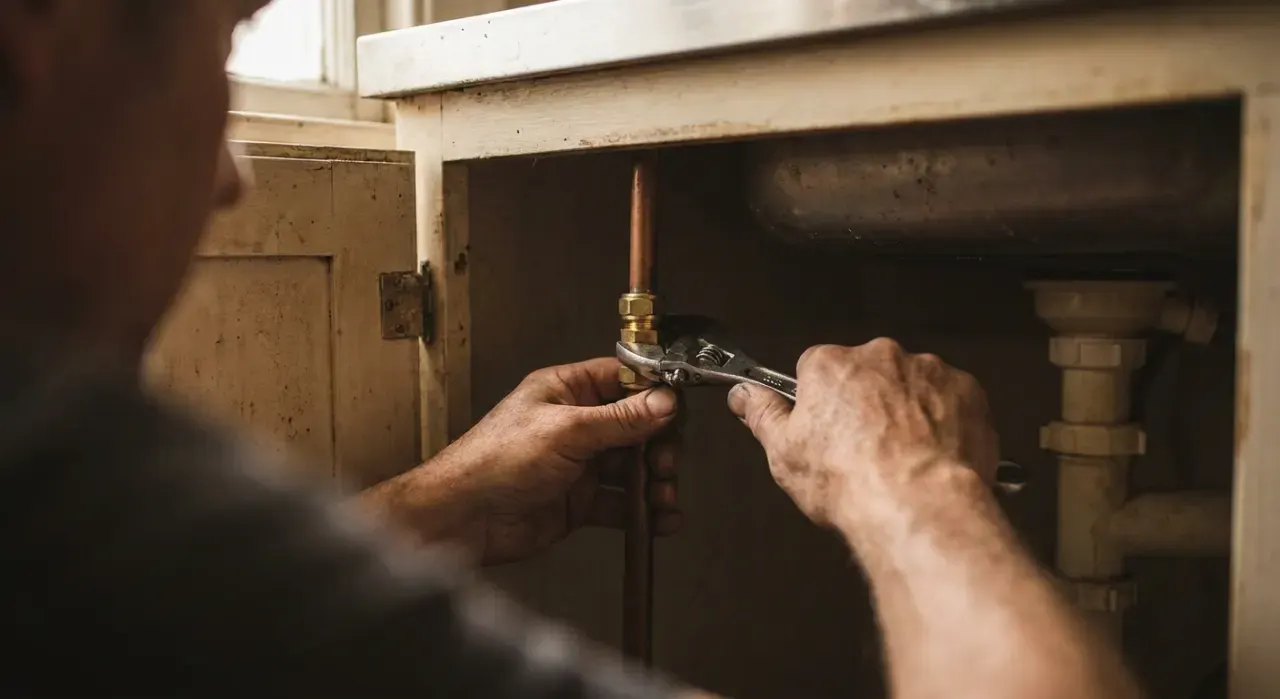
Half the value of a page like this is stopping people from paying for the wrong fix. These symptoms look septic and usually are not.
| Symptom | Usual real cause | Fix |
|---|---|---|
| Sewage smell inside the house | Dry floor drain trap, failed toilet wax ring, or blocked plumbing vent | Pour water down unused drains; check the wax ring; clear the vent. See replacing a wax ring |
| One slow drain, everything else fine | A local clog in that fixture's branch | Plunger or auger. See snaking a drain |
| One slow-flushing toilet | Partly blocked trapway, or a low tank level | Adjust the water level or auger the bowl |
| Wet patch in the yard after rain only | Surface drainage or a downspout, not effluent | Redirect the downspout — and keep it off the drainfield |
| Gurgling in one sink only | A vent problem on that branch | Clear the vent |
| Damp basement wall | Groundwater, not sewage | Grading, gutters, and possibly a sump pump |
The distinguishing question for most of these is simple: is more than one fixture affected? A single slow fixture is a local problem. Several at once, especially the lowest ones in the house, points at the tank or the line to it.
What "full" actually means
A working septic tank is always full of liquid — that is normal and not a fault. The liquid level sits at the outlet, and every gallon that comes in pushes a gallon out to the drainfield. What accumulates over the years is not liquid but two solid layers: sludge on the bottom, and scum (grease, soap residue, light material) floating on top.
The tank works because there is a clear zone between those layers for the outlet to draw from. "Full" in the sense that matters means those two layers have grown until that clear zone is too thin, and solids are starting to leave with the effluent. The commonly used triggers for pumping are combined sludge and scum reaching about a third of the liquid depth, sludge within roughly 12 inches of the outlet baffle, or scum within about 3 inches of it.
This is why an inspection is worth more than watching for symptoms: it measures the layers before solids start reaching the drainfield, which is the event you are actually trying to avoid. EPA recommends inspection at least every three years and pumping typically every three to five, and our pumping frequency guide narrows the interval by tank size and household count.
What waiting costs
The economics here are not subtle. EPA puts routine septic servicing at a few hundred dollars every three to five years, and repair or replacement of a malfunctioning conventional system at $5,000 to $15,000, with alternative system types costing more again. Current market pricing for a pump-out runs roughly $300 to $800 as of July 2026 — our septic pumping cost page breaks that down.
The mechanism connecting the two is worth stating explicitly. When the tank stops holding solids back, those solids travel to the drainfield and lodge in the soil pores. That is not something you flush out or dose with a chemical — the soil's ability to absorb and treat effluent has been physically reduced, and the repair is excavation. Every pump-out you do on schedule is buying insurance against that specific outcome.
If you are seeing the signs, in order
- Cut water use now. Postpone laundry and long showers. Fix any running toilet today — EPA notes a single one can add as much as 200 gallons a day.
- Do not pour anything down the drain to fix it. Not a drain cleaner, not a "shock" treatment, not a drainfield opener. EPA does not recommend septic additives, and the chemical products can damage the drainfield soil you are trying to protect. See do septic tank treatments work.
- Keep people and pets off any wet ground over the tank or field.
- Call a licensed septic service and describe the symptoms precisely: which fixtures, whether it is all of them, and what you can see or smell outdoors. Ask for an inspection with the pump-out, not just a pump-out.
- Get it in writing if they diagnose a drainfield problem, and get a second quote before agreeing to a five-figure job.
- Then set the schedule. Once it is sorted, put the pumping interval in a calendar and keep the receipts.
More from this hub: DIY plumbing · how often to pump a septic tank · septic pumping cost · septic tank treatments · how we rank.