 Garden

Affiliate Disclosure
Some links on this page are affiliate links. As an Amazon Associate, we earn from qualifying purchases — at no extra cost to you. We do not buy, test, or physically handle the products we cover; our rankings come from aggregated owner reviews, ratings and expert consensus. Commissions never change our verdicts. How we rank · full disclosure.
Cool a greenhouse in three layers, in this order: shade cloth at 30 to 50 percent, ventilation area equal to about 20 percent of the floor, and then air movement from fans. Shade is first because it stops heat entering rather than trying to remove it afterward, and it is the cheapest single change at $30 to $90. Most hobby greenhouses ship with roughly a quarter of the vent area they need, so adding a second roof vent and low side louvers is usually the highest-value modification. Target holding the house under 85°F — above about 95°F tomatoes and peppers stop setting fruit.
We never buy, test or physically handle the products we rank; recommendations come from aggregated owner reviews and expert consensus, described in how we rank. More at the greenhouses and season extension hub.
Why a greenhouse overheats so fast
Glazing passes short-wave solar radiation in and blocks the long-wave heat radiating back out — the effect the structure is named for. In winter that is the entire point. In July it means a sealed 8 by 12 greenhouse can run 30 to 40°F above outside air within an hour of full sun, and the interior volume is too small to buffer it.
The practical consequence: a 78°F morning becomes a 110°F house by 11am. Extension guidance across multiple states puts tomato and pepper fruit-set failure in the low to mid 90s, because pollen becomes non-viable at those temperatures. You lose the crop without the plants ever looking wilted.
Layer 1: Shade cloth (the first thing to buy)
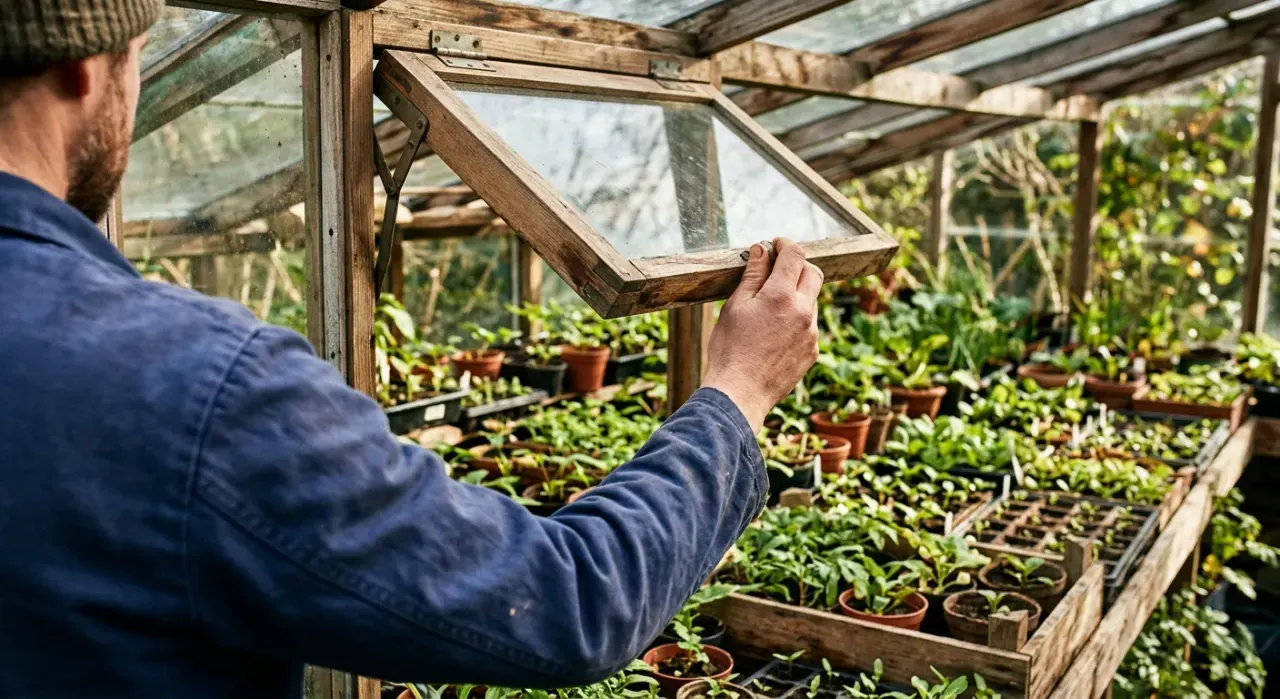
Shade cloth blocks a stated percentage of light before it enters. Fit it on the outside of the glazing — cloth hung inside has already let the heat in and merely shades the plants from it.
| Crop | Shade % | Region note |
|---|---|---|
| Tomatoes, peppers, cucumbers | 30% | Up to 40% in the desert Southwest |
| Mixed vegetables and herbs | 30–50% | Lower end in the North |
| Seedlings and transplants | 40–50% | Protects from scorch |
| Orchids, ferns, shade ornamentals | 50–60% | — |
| Overwintering, dormant stock | None | Remove in fall |
Knitted polyethylene cloth is the standard: it does not fray when cut, survives 5 to 10 years of UV, and costs $30 to $90 for a hobby-house-sized piece. Leave a gap of a few inches between the cloth and the glazing so hot air can move between them — cloth laid flat against the panels transfers heat by conduction.
The cheaper alternative is shade paint, a white compound applied to the outside of the glazing in spring and washed off in fall. It costs about $20, works, and looks exactly as agricultural as it sounds.
Layer 2: Ventilation — do the math
The design rule used across horticultural guidance is total vent area equal to about 20 percent of floor area, split between roof vents and low side vents. That split matters: hot air rises out of the roof vent, pulling cool air in through the low vents. Roof vents alone give you far less flow than the ratio suggests.
| Greenhouse | Floor area | Target vent area |
|---|---|---|
| 6 x 8 ft | 48 sq ft | about 10 sq ft |
| 8 x 12 ft | 96 sq ft | about 19 sq ft |
| 10 x 16 ft | 160 sq ft | about 32 sq ft |
Compare that with what your greenhouse actually has. A typical hobby model ships with one roof vent of 3 to 4 square feet and a door — perhaps a quarter of the target. Adding a second roof vent and a pair of low louvered side vents is a $60 to $200 job and it changes the behavior of the house completely.
Fit automatic vent openers, $30 to $60 each. A wax cylinder expands with heat and pushes the vent open, no electricity involved. They open around 60 to 75°F and are fully open by about 85°F, and they solve the fact that nobody is home at 11am on the day it matters. Ventilation design in more depth is in greenhouse ventilation and overheating.
Layer 3: Move the air
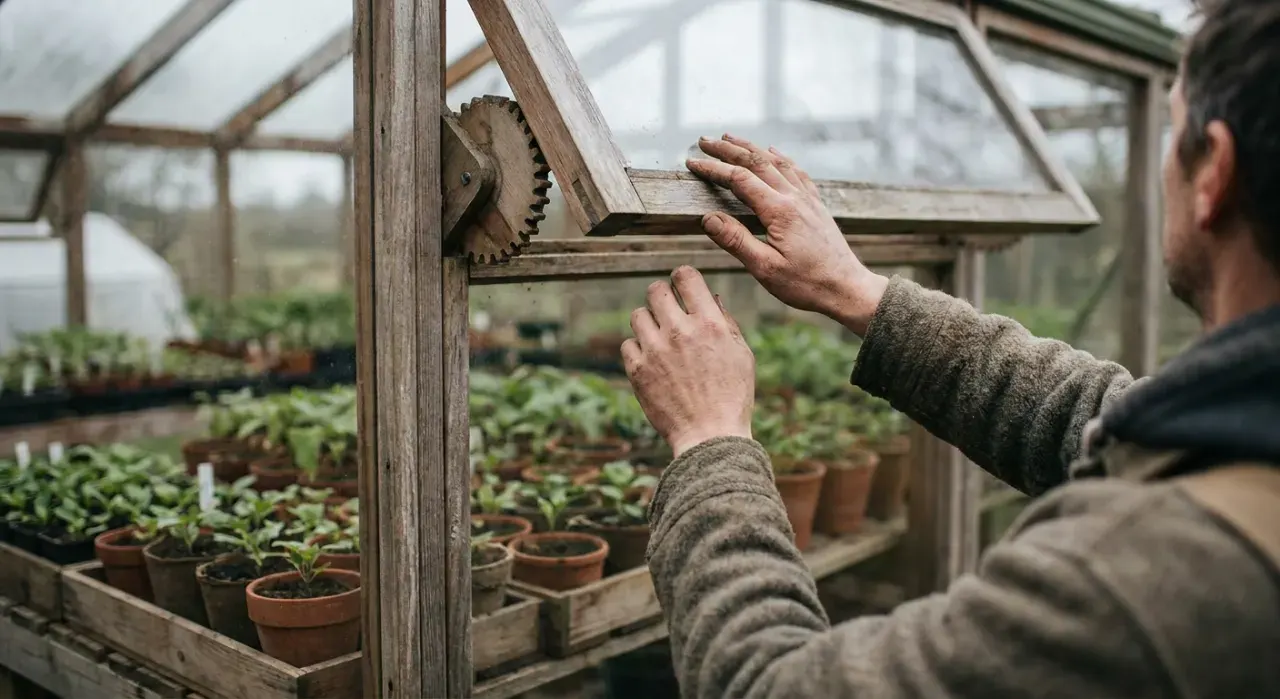
Two different jobs, and they need different fans.
- Circulation fans keep air moving inside. Size for roughly 2 cubic feet per minute per cubic foot of greenhouse volume — an 8 by 12 by 7 foot house is about 670 cubic feet, so a fan or two totaling around 1,300 cfm. A small oscillating fan runs on 30 to 50 watts and can be solar-powered.
- Exhaust fans pull hot air out and draw cool air in through an intake louver at the opposite end, low down. Size for one full air change per minute in summer — again roughly 670 cfm for that house. The intake louver must be at least as large as the fan needs or the fan simply strains.
Air movement also matters for plant health independent of temperature. It strips the humid boundary layer off leaves so transpiration can cool them, and it suppresses the fungal problems that thrive in still, warm air.
Optional: evaporative cooling and damping down
Evaporation cools by absorbing heat as water changes phase, and how well it works depends entirely on your humidity.
- Arid West and Southwest: damping down — wetting the floor and benches in the morning — genuinely drops temperatures several degrees. A wet-wall or evaporative cooler pad system does more, at $200 to $600.
- Humid Southeast, Midwest and Northeast: the air is close to saturated on hot days, evaporation is slow, and the cooling benefit is small while the disease risk from added moisture is real. Skip it and spend the effort on vents and shade.
Misting systems have the same regional split. In dry air they are excellent; in humid air they mostly grow botrytis.
Siting and structure factors
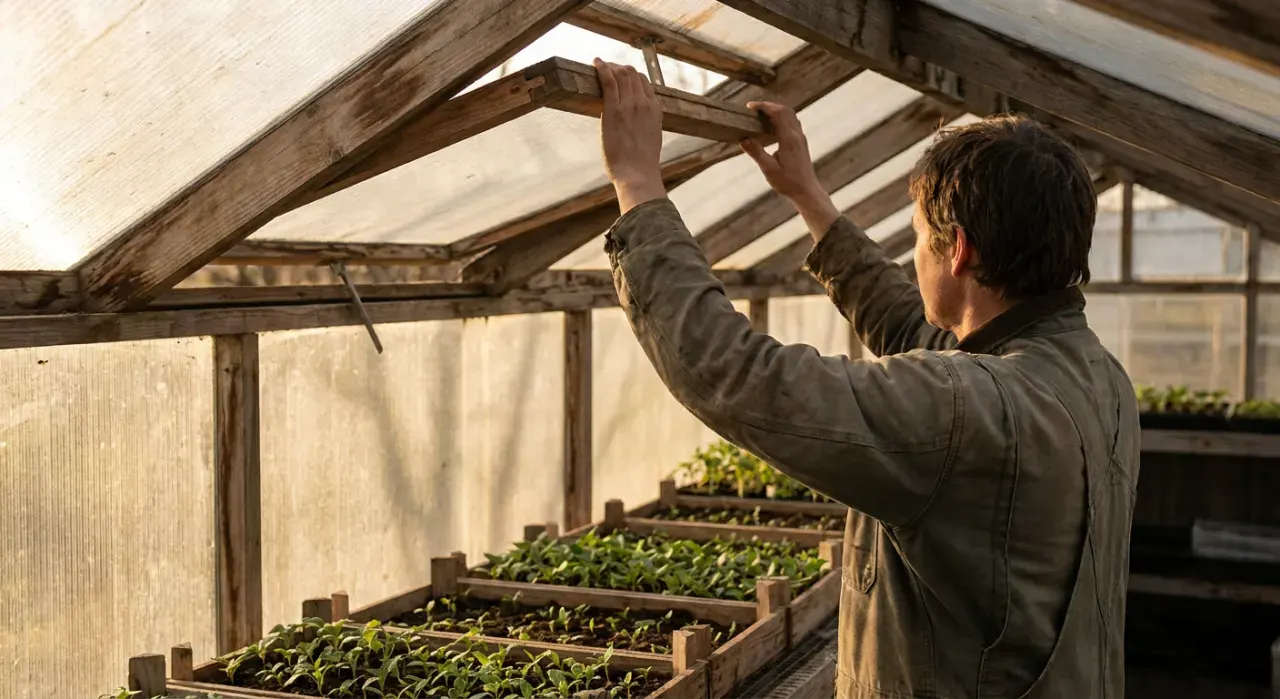
Some of the summer problem is decided before you ever open a vent. A greenhouse sited in full afternoon sun with no deciduous tree to the west runs hotter than one that gets shade after 3pm. Twin-wall polycarbonate diffuses light and runs slightly cooler at leaf level than clear glass, which throws hot focused light. Light-colored gravel or paving on the floor reflects heat back up, while a soil or dark mulch floor absorbs it.
If you are still planning, greenhouse sizing and siting covers orientation and shading, and polycarbonate vs glass vs film covers the glazing trade-off. Structures themselves are ranked in best backyard greenhouse.
Safety notes
Two things to watch. Heat exhaustion in a greenhouse is real — interior temperatures over 110°F are common and people underestimate them because the structure feels familiar. Open the vents and the door before working inside on a hot day, and do not work in a closed house at midday.
And any electrical work — an exhaust fan circuit, an outdoor outlet, a thermostat — should be done by a licensed electrician. A greenhouse is a wet location with a metal frame, GFCI protection is required, and outdoor circuits are permitted work in essentially every US jurisdiction. Those rules are set at state and local level, so check with your building department rather than assuming a national standard. Non-electric options for the other half of the year are in keeping a greenhouse warm without electricity.
Related reading: how to heat a greenhouse in winter, anchoring a greenhouse against wind, what to grow for beginners.