 Garden

Affiliate Disclosure
Some links on this page are affiliate links. As an Amazon Associate, we earn from qualifying purchases — at no extra cost to you. We do not buy, test, or physically handle the products we cover; our rankings come from aggregated owner reviews, ratings and expert consensus. Commissions never change our verdicts. How we rank · full disclosure.
Short answer: twin-wall polycarbonate is the right glazing for most backyard greenhouses — it insulates about twice as well as single glass, diffuses light evenly, survives hail, and lasts ten to fifteen years. Choose glass if the greenhouse is a permanent visible feature and you want maximum light and a 25-plus year life. Choose polyethylene film if you want the largest growing area for the least money and accept recovering it every three to four years.
Below is the detail behind that, because the trade-offs are genuinely different depending on whether you heat, what your weather does, and whether the structure is furniture or equipment.
The Comparison, Side by Side
| Twin-wall polycarbonate | Single glass | Polyethylene film | |
|---|---|---|---|
| Light transmission | 78–80% (4 mm), ~75% (6 mm) — diffused | ~90% — direct | 85–90% when new, falling with age |
| Insulation | R-1.4 to R-1.6 (U ~0.65–0.70) | R-0.95 (U ~1.13) | R-0.85 single layer (U ~1.2); ~R-1.4 double inflated |
| Lifespan | 10–15 years with UV layer | 25+ years | 1–2 years (hardware sheeting), 3–4 years (rated film) |
| Hail / impact | Excellent — flexes, does not shatter | Poor; tempered glass better but still breaks | Good against hail, poor against branches |
| Weight | Light — no heavy foundation needed | Heavy — needs a rigid, level, load-bearing base | Very light |
| Wind behavior | Panels can pop from clips if not secured | Panes shatter under frame flex | Whole structure at risk; cover abrades |
| Typical installed cost per sq ft of glazing | $$ | $$$ | $ |
| Best for | Working greenhouses, cold climates, hail country | Display greenhouses, mild climates, long-term features | Maximum growing area on a budget; season-extension tunnels |
Two figures in that table deserve emphasis, because they drive nearly every practical decision.
Insulation: The Number That Decides Your Heating Bill
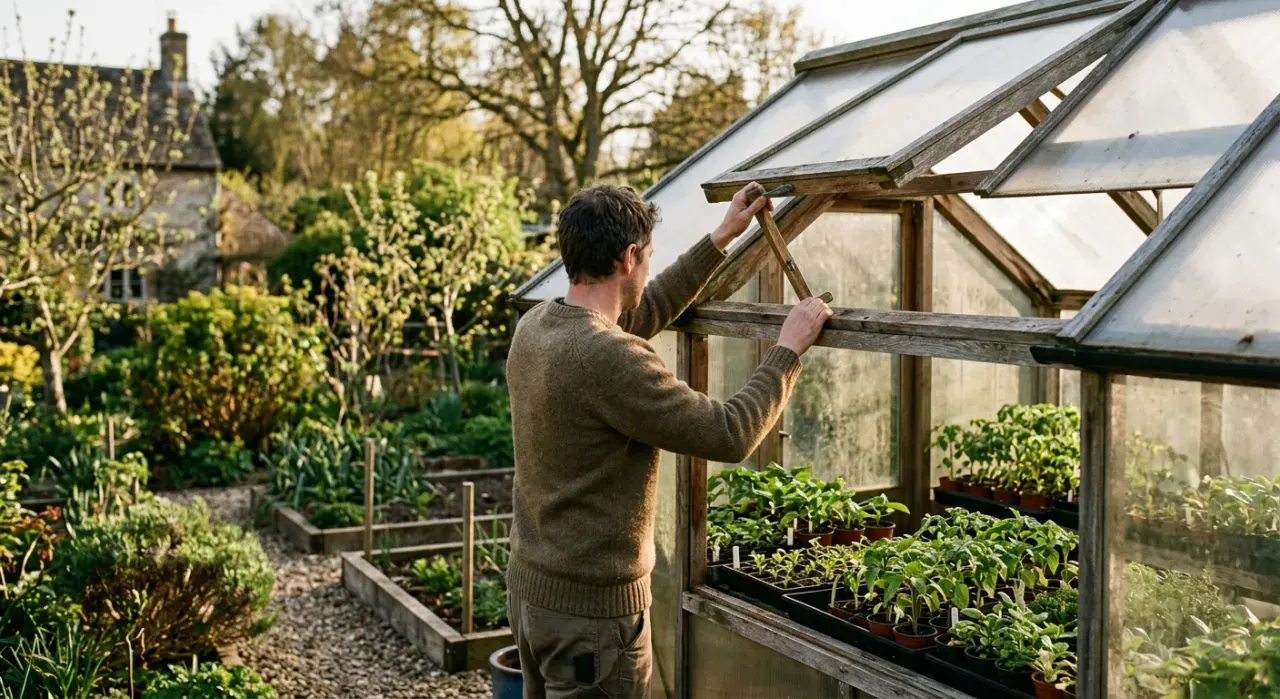
Heat loss through glazing is the dominant winter cost of a greenhouse, and it scales directly with the U-value of the material. Halve the U-value and you halve the heater.
Single glass runs about U-1.13. A single layer of polyethylene film is a shade worse, around U-1.2. Four millimeter twin-wall polycarbonate is about U-0.70, and 6 mm about U-0.65 — call it a 40% reduction in heat loss against glass. Eight millimeter triple-wall reaches roughly U-0.50, and a double layer of inflated film with a blower gets to a similar place, which is why commercial hoop houses use it.
Run that through the heat-loss formula and it becomes concrete. An 8 ft × 10 ft greenhouse has roughly 290 square feet of glazing. Holding 40°F inside when it is 0°F outside needs about 7,500 BTU/hr in 6 mm twin-wall polycarbonate, and about 13,100 BTU/hr in single glass — the difference between one electric heater and three. The full sizing method is in how to heat a greenhouse in winter.
If you never intend to heat, this matters less than you would think. An unheated greenhouse tracks daytime solar gain and loses most of it overnight regardless of glazing, so the insulation advantage narrows. It still buys you a slightly warmer dawn and less condensation, but it is not the deciding factor for a purely spring-and-summer propagation house.
Light: Quantity Versus Quality
Glass wins on quantity. Around 90% transmission is as good as it gets short of specialty films, and in the darkest months — December and January north of about 40° latitude — every percent matters, because light rather than heat is the limiting factor for winter growth.
Polycarbonate wins on distribution. The twin-wall structure scatters light, so instead of moving stripes of bright sun and deep shade you get even illumination that penetrates further into the canopy. Commercial growers have measured yield benefits from diffused light in several crops, and at home the practical effect is that plants at the edges and lower leaves do better, and you get less localized scorch on hot days.
The honest way to weigh this: in a winter-growing greenhouse at high latitude, glass's extra 10% is real and useful. In a spring-through-fall structure, diffusion is worth more than the raw number, and 78% of an abundant summer light budget is plenty.
One more thing that no spec sheet mentions: dirt costs more transmission than material choice does. A season of dust, algae and pollen film can cut light by 10% or more. Washing the glazing every fall — inside and out — is the cheapest light upgrade available on any structure.
Polycarbonate: What to Know Before Buying
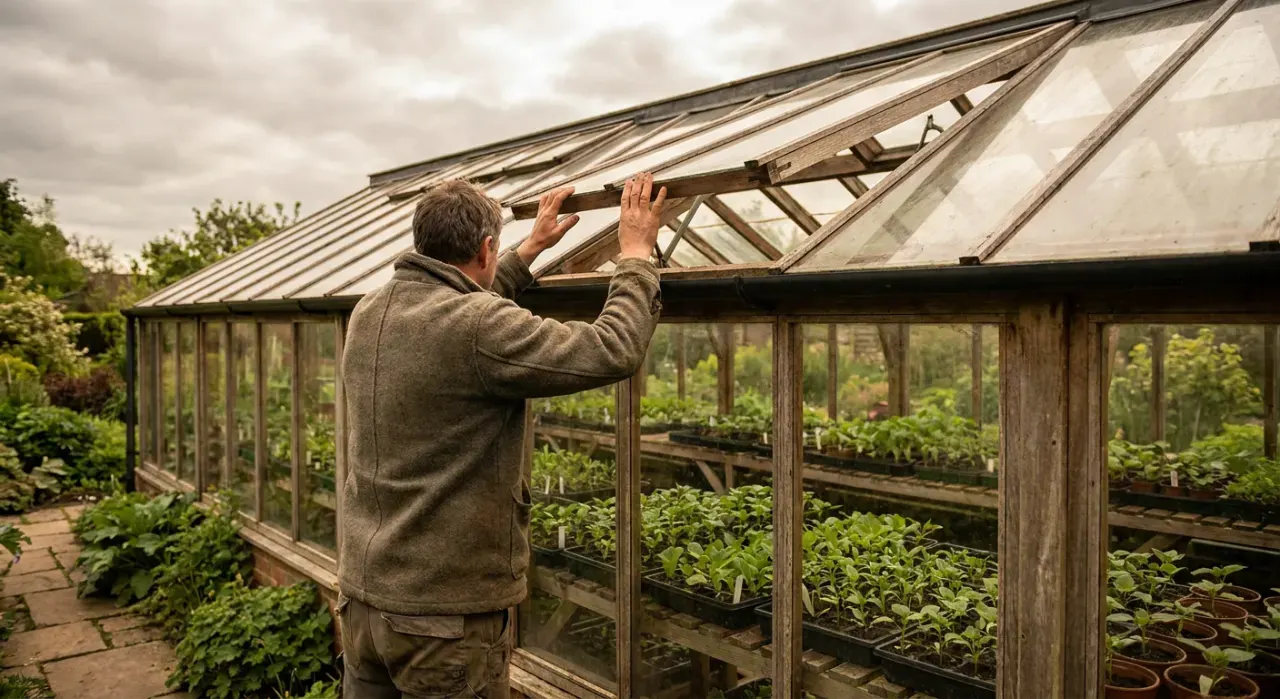
Not all polycarbonate is the same, and the differences are where owner disappointment comes from.
- The UV layer is one-sided. Quality sheet has a co-extruded UV-protective face, identified by the printed protective film. Fitted the wrong way up, the panel yellows and goes brittle within a few seasons. This is a common and irreversible installation error.
- Tape the flutes. The open channels must be sealed with solid tape at the bottom edge and breathable vented tape at the top, or condensation, dust and algae fill them. Green-streaked panels are almost always untaped panels.
- Thickness is not a detail. Kits under 4 mm flex badly, drum in the wind and pop out of their clips. Six millimeter is the sensible upgrade for snow load and hail country.
- Panels leave before frames do. The most common storm damage report on hard-sided kits is intact frame, missing panels. Extra clips, or a bead of clear silicone at the panel edge, are cheap insurance — see anchoring a greenhouse against wind.
- It scratches. Clean with a soft cloth and mild soap only. Abrasive pads and pressure washers permanently haze the surface, and hazed polycarbonate loses transmission.
Glass: When It Is the Right Answer
Glass is the traditional choice and remains the best-looking one. It transmits the most light, does not yellow, does not scratch from ordinary cleaning, and a well-built glass house genuinely lasts decades — there are Victorian glasshouses still working.
The costs are real, though. Glass is heavy, so the structure needs a rigid, level, load-bearing base and any settling cracks panes. It breaks, and in hail country or under trees that is not a theoretical risk. Toughened (tempered) glass mitigates the injury risk and costs substantially more. And it transmits direct beam light, which means hotter hot spots and a greater need for shading — see greenhouse ventilation and overheating.
Choose glass when the greenhouse is a permanent, visible garden feature, when you live somewhere with mild weather and little hail, and when you want the structure to outlive the decade. Avoid it if children play nearby, if you are on an exposed windy site, or if a large tree overhangs the location.
Film: The Value Case, Told Straight
Polyethylene film over a steel hoop frame offers something neither rigid glazing can: growing area per dollar. For the price of a small polycarbonate kit you can cover four times the ground. For anyone who wants to grow crops rather than tend a display, that changes what is possible.
The trade-offs are honest ones. Cheap hardware-store sheeting degrades in one to two seasons. Proper greenhouse film — 6 mil, UV-stabilized, sold with a 4-year rating — gives three to four years in most of the country and less in high-UV states. Insulation is minimal in a single layer. And a film structure is far more vulnerable to wind: the cover flogs and abrades, an open door can inflate the tunnel, and an unanchored hoop house will travel.
Film also has one underrated advantage. Because it is cheap and light, you can take it off. Removing the cover for the windiest months, or over summer when a tunnel is not needed, extends its life and removes the storm risk entirely.
Look for these specs when buying: 6 mil thickness, UV stabilization, a 4-year rating, and an anti-condensate or anti-drip treatment, which stops water forming droplets that fall on foliage and spread disease. Diffused film is available too and brings the same canopy benefits described above.
The Recommendation
Buy twin-wall polycarbonate if you want one structure that works hard, insulates well enough to heat cheaply, tolerates hail and snow, and lasts a decade. Six millimeter if the budget allows; 4 mm is acceptable unheated.
Buy glass if the greenhouse is part of the garden's design, you are in a mild region, and you plan to keep it for twenty years. Specify toughened glass and build a proper level base.
Buy film if area matters more than permanence — a market garden, a big season-extension tunnel, or a first experiment before committing. Anchor it properly, tension the cover, and budget for a recover every three to four years.
Whichever you land on, the glazing is only one of the four decisions that determine how a greenhouse performs. Size and site come first (sizing and siting), venting is what keeps plants alive in spring (ventilation and overheating), and anchoring is what keeps the structure in your yard. If you are ready to choose a specific model, our ranked backyard greenhouses covers both hard-sided and film options, and the structural alternatives are weighed in greenhouse vs hoop house vs cold frame. More at greenhouses and season extension; our method is on how we rank.