 Garden
Affiliate Disclosure
Some links on this page are affiliate links. As an Amazon Associate, we earn from qualifying purchases — at no extra cost to you. We do not buy, test, or physically handle the products we cover; our rankings come from aggregated owner reviews, ratings and expert consensus. Commissions never change our verdicts. How we rank · full disclosure.
The short answer: buy Hunter. It advertises a limited lifetime motor warranty across most of its range and it still sells blade arms, downrods and glass for fans discontinued years ago — the two things that decide a fixture you install once and leave for fifteen years. Buy Westinghouse instead if standard, replaceable glass and fitters matter most, and Big Ass Fans if silence is worth real money.
This page answers which brand. It does not answer which fan. Each entry names one representative model to anchor the company and nothing more — the model-by-model ranking, which leads on different fans, is at best ceiling fan, and that is where the buying decision actually gets made. Then size it with what size ceiling fan for a room, settle the motor question in DC vs AC ceiling fan motors, or handle a tall room with best ceiling fans for high ceilings.
Why Brand Matters More Here Than in Most Categories
Buying by brand is unusually rational for ceiling fans, and the reason is the install. A fan is hardware you bolt to the structure of your house, wire in, and then ignore for ten to twenty years. Nobody enjoys getting back up the ladder. What you actually need is a motor that never develops a hum, a blade set that stays balanced, and a company that will still sell you a downrod in 2036. Those are brand attributes, not model attributes.
So the axes this page ranks on are the ones that only reveal themselves years after the sale:
- Motor type and published motor warranty. The motor is the one part that cannot be economically replaced, and a limited lifetime motor warranty is a claim companies only make when the failure rate is low enough to absorb.
- Replacement remotes and canopy receivers. The most-reported electronic failure in the category, and the one where brand choice genuinely locks you in.
- Blade arm, downrod, glass and light-kit availability years later — whether standard sizes are used, and whether the light module can be replaced at all.
- UL damp and wet ratings across the range, because a fan installed on a covered porch without the right listing is both a hazard and a voided warranty.
- Ownership and brand licensing. Two of the names below are licensed trademarks rather than the original companies, which decides who honors the cover.
- Breadth of range and price positioning — whether the brand can furnish a whole house on compatible hardware or sells one fan at one price.
The Brands at a Glance
Our #1 Brand: Hunter
Hunter has been building ceiling fans since 1886, and that is not a marketing detail — it is the whole argument. A company that has sold fans into American houses for well over a century has a parts catalog with real depth behind it, and that is what you are buying.
What it does better than the others. Two things. The first is the published motor warranty: Hunter advertises limited lifetime cover on the motors in most of its lines, which is the strongest published position in the category and a claim a manufacturer only makes when it expects to honor very few of them. The second is range coherence. Hunter sells damp-rated outdoor fans, low-profile hugger mounts for eight-foot ceilings, large-span fans for great rooms and dozens of finishes, largely on compatible mounting hardware and accessories. If you are fitting out a whole house, that consistency saves real money and real ladder time.
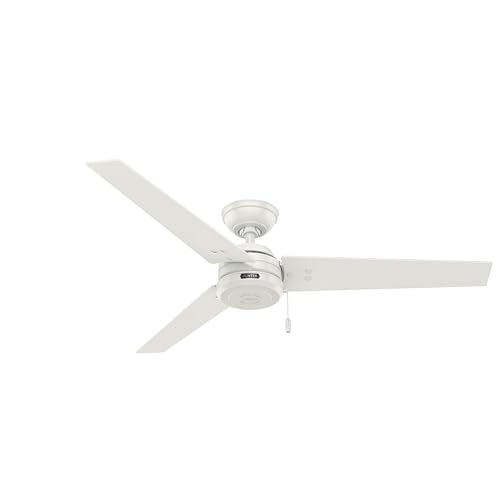
The Cassius is a useful fan to characterize the brand precisely because it is unglamorous: a damp-rated indoor or outdoor three-blade fan with a pull chain and no light at all. No receiver to fail, no integrated LED module to strand you, and it is rated for a covered porch out of the box. That is the Hunter proposition in its simplest form.
Consensus Score ████████░░ 8.5 — the most consistent owner ratings across the widest range of models and price points here.
Where it is weak. Hunter is not the cheapest brand and not the most beautiful; its budget models are ordinary and its styling is conservative next to the design houses. More concretely, the integrated LED modules on its mid-range fans generate a disproportionate share of its one-star reviews, and on several designs the LED is not user-replaceable, which turns a small failure into an expensive one. Remotes and receivers are the next most common gripe. Hunter fans are also heavier than most rivals, which makes solo installation genuinely harder. And the lifetime warranty covers the motor only — the parts that actually fail sit outside it.
Check price on Amazon → (paid link)
The Brands, Ranked
Best for one brand to trust across a whole house, indoors and on a covered porch
- American company building fans since 1886
- Advertises a limited lifetime motor warranty on most lines
- Damp-rated, low-profile, large-span and outdoor lines all share hardware
- Blade arms, downrods and glass still findable years later
Why buy it: Hunter pairs the strongest published motor warranty in the category with the deepest parts catalog, which is what matters on a fixture you screw into the house and leave for fifteen years.

Best for standard fittings and glass you can still buy in a decade
- Westinghouse Lighting trades the name under license
- Generations of fans built to standard sizes and fitters
- Replacement glass, blade arms and light kits widely stocked
- Conventional AC motors rather than DC across most of the range
Why buy it: Westinghouse sells standardization — standard glass, standard fitters, standard downrods, all still orderable long after a model is discontinued, which is genuinely rare here.

Best for furnishing several rooms with current styling on a normal budget
- Fans made and sold under a Honeywell brand license
- Consistently strong owner ratings across the range
- Three mounting options supplied in the box
- Warranty and support handled by the licensee, not Honeywell International
Why buy it: Honeywell-badged fans land the best ratings per dollar in the mid-market, and the three-way mounting hardware removes the most common installation surprise.

Best for a bedroom or great room where the fan has to be inaudible
- Kentucky-based manufacturer of industrial airfoil fans
- Brushless DC motor with genuine airfoil blade profiles
- Seven speeds, app control, ENERGY STAR rated
- Proprietary electronics with no generic remote option
Why buy it: Big Ass Fans is the only brand here engineering a residential fan as an aerodynamic product rather than a light fixture with blades, and owners use the word inaudible.
Quick Comparison
| Product | Best for | Rating | Price | Buy |
|---|---|---|---|---|
| Hunter Cassius Outdoor or Indoor Ceiling Fan, 52 inch, Pull Chain with Standard Mount | Best Brand Overall — Hunter | — | Check (paid link) | |
| Westinghouse Alta Vista Modern LED Ceiling Fan with Light and Remote Control, 52 Inch | Best Long-Term Value Brand — Westinghouse | — | Check (paid link) | |
| Honeywell Ceiling Fans Ventnor 52 Inch Modern Farmhouse Indoor LED Ceiling Fan with Light and Pull Chain | Best Budget-Friendly Brand — Honeywell | — | Check (paid link) | |
| Big Ass Fans Haiku L 52 inch Smart Ceiling Fan with LED Light and WiFi App Control | Best Premium Engineering Brand — Big Ass Fans | — | Check (paid link) |
Warranty, Parts, Ownership and Support Compared
| Brand | Who owns the name | Published warranty position | Motor type across the range | Parts years later |
|---|---|---|---|---|
| Hunter | Long-established US fan manufacturer, also owns Casablanca | Limited lifetime on motors across most lines; 1 to 3 years on other parts | Mostly AC, some DC | Deepest catalog here — arms, downrods, glass, brackets |
| Westinghouse | Westinghouse Lighting trades the trademark under license | Limited lifetime motor cover advertised on part of the range | AC | Standard fitters and glass, widely stocked |
| Honeywell | Made and sold under a Honeywell brand license | Standard limited terms, handled by the licensee | AC | Brand-supplied blades and remotes; thinner than the two above |
| Big Ass Fans | US manufacturer in Kentucky; majority stake reported sold in 2017 | Multi-year to lifetime cover advertised by component | Brushless DC | Manufacturer only — proprietary electronics |
Warranty terms, ownership and licensing all change, and every figure above was accurate to published company material at the time of writing — the specific listing is always the authority. The structural pattern is what to remember: the lifetime claim is on the motor, the failures are everywhere else, and the brands with the deepest mechanical parts catalogs are the two oldest names in the category.
Parts and Consumables: What Actually Fails and What It Costs
A ceiling fan has no filters and no refills, so people assume there is no running cost. There is, and it is concentrated in a handful of parts that fail long before the motor does.
| Part | What goes wrong | Generic replacement? | Typical cost | Brand difference |
|---|---|---|---|---|
| Remote handset | Lost, or stops pairing | Only on AC fans, and only sometimes | $20 to $50 | DC fans generally need the matched handset from their own maker. |
| Canopy receiver | Fan stops responding, or one speed dies | Universal kits work on many AC fans | $25 to $60 plus a ladder | The clearest lock-in in the category. Proprietary on DC fans. |
| Capacitor | Hum, or a speed that stops working | Yes on AC fans, sold by rating | $8 to $15 | Almost none. A cheap fix most owners never attempt. |
| Pull-chain switch | Chain snaps or the switch wears out | Yes | $8 to $12 | None. A generic part on every AC fan. |
| Integrated LED module | Dims, flickers, or fails entirely | No | Often not sold at all | The biggest hidden cost here. On many fans it is not user-replaceable. |
| Glass shade or fitter | Cracked in shipping or in cleaning | Yes where standard fitter sizes are used | $15 to $40 | Westinghouse is strongest; designer brands use bespoke glass. |
| Blade arms and downrods | Bent in shipping, or the wrong length for a new ceiling | Brand-specific but routinely stocked | $15 to $50 | Hunter and Westinghouse have the deepest catalogs. |
Read that table and the real long-term cost becomes obvious, and it is not electricity — running costs are covered in what it costs to run a ceiling fan for 24 hours. It is the non-replaceable integrated LED module. A sealed LED that dies at year seven can turn a working fan into a fixture you have to replace, and it appears across every brand here including the premium ones. If you want a fan that outlives its light source, buy a model with a standard socket or a genuinely replaceable light kit — Westinghouse and Hunter both offer plenty — and accept a slightly chunkier look. The lifespan picture is set out in how long ceiling fans last.
How We Rank Brands
We do not buy, install or physically handle these fans. On a brand page we weight different evidence from a product roundup. Star ratings are read across a manufacturer’s whole catalog rather than at one hero model, because a brand with one great fan and eight mediocre ones is not a brand you can trust with a whole house. Published warranty documents are read for what they exclude as well as the headline term. Parts availability is judged from owner reports of actually obtaining replacements, and from whether a brand uses standard fitters and downrod sizes. Motor type, airflow ratings, damp and wet listings and mounting options are checked against manufacturer documentation. Negative reviews are read closely for the failures that appear in year three rather than week one. And we record ownership and brand licensing, because that decides who honors the cover. Prices were current at the time of writing. Full method on how we rank.
The Brands, Assessed
1. Hunter — Best Brand Overall
Covered above. Who it is for: a whole house, indoors and on a covered porch, on compatible hardware. What it does better: the strongest published motor warranty in the category, the deepest mechanical parts catalog, the broadest range including damp-rated and low-profile lines, and a motor failure rate that owner reports suggest is genuinely low. Where it is weak: integrated LED modules that fail more often than the fans do and are frequently not user-replaceable; remotes and receivers as the second complaint; fans that are heavy and awkward to install alone; conservative styling; ordinary budget models; and a lifetime warranty that covers only the part least likely to break.
2. Westinghouse — Best Long-Term Value Brand
Who it is for: the buyer who wants a fixture that stays serviceable rather than one that impresses. Note the ownership first, because it is genuinely useful to know: Westinghouse Lighting trades the Westinghouse name under license rather than being the original electrical company. What it has built on that name is standardization — standard glass fitters, standard downrods, standard blade arms, standard light kits, all still orderable long after a specific model has gone. If a glass bowl breaks on a Westinghouse fan, you can buy another one. That is rarer than it should be.
What it does better: parts availability and interchangeability, a large and long-established range weighted toward traditional five-blade fans with replaceable light kits, and a limited lifetime motor warranty advertised on part of the range. Where it is weak: styling is conservative and some models look dated next to the design houses; the range is almost entirely AC rather than DC, so it cannot match a DC fan on power draw, quietness or speed steps; owners report pull-chain switches wearing out on non-remote models; the supplied downrods are short, so nine-foot and vaulted ceilings frequently need a longer rod bought separately; and the marketplace review base is smaller than the volume brands, so the durability signal is thinner.
3. Honeywell — Best Budget-Friendly Brand
Who it is for: furnishing several rooms with current styling without overspending. The ownership point matters here too and buyers should know it: Honeywell-badged ceiling fans are made and sold under a brand license rather than built by Honeywell International, so the warranty, the parts and the support all run through the licensee rather than the corporation on the box. That is a factual arrangement rather than a criticism — it is extremely common in fans and lighting — but it changes who you are dealing with if something fails.
What it does better: ratings per dollar, which are consistently strong across the range; styling that is current rather than dated; and three mounting options in the box on most models, which removes the most common installation surprise. Where it is weak: owners repeatedly describe the assembly documentation as poor and the supplied screws as soft; cage-light models put an exposed bulb at eye level from a sofa, which several reviewers find glaring; warranty service is reported as slower and more paperwork-heavy than Hunter’s; the parts catalog is thinner than the two older names; and the range is entirely AC, so the efficiency and noise ceiling is set by the motor.
4. Big Ass Fans — Best Premium Engineering Brand
Who it is for: a bedroom or great room where a fan that hums is a fan you stop using. Big Ass Fans manufactures industrial airfoil fans in Kentucky and applied the same engineering to a residential product: a brushless DC motor, genuine airfoil blade profiles rather than flat paddles, seven speeds, app control and an ENERGY STAR rating. A majority stake in the company is reported as having been acquired by a private investment firm in 2017, which is worth knowing on a product whose electronics are entirely proprietary. Owners describe the Haiku as inaudible, a word that essentially never appears in ceiling fan reviews.
What it does better: quietness at useful airflow, far lower power draw than an AC fan, genuine speed granularity, and build quality that reads as engineered rather than assembled. Where it is weak: price several times the category norm, and owners say so repeatedly. The electronics are proprietary, so a failed receiver or handset is a manufacturer-only part with no generic option — the most significant lock-in on this page. The app and firmware draw consistent criticism for dropped connections and behavior changes after updates, and for putting functions behind a phone that a wall switch used to handle. And three airfoil blades move less air per rotation than five paddles, so people upgrading from a builder-grade fan often find it feels weaker until they learn to run it higher.
The brands just outside this list
Two important names are covered here in prose rather than carded, because the fan that best represents each is already the pick on the model page — repeating it here would just duplicate that ranking.
Minka-Aire is the brand interior designers actually specify, and it is the strongest DC-motor choice in this comparison: sculptural three-blade forms, genuinely good finish quality, six speeds and substantially lower power draw than a comparable AC fan. Its weaknesses are equally clear — prices two to three times a mid-market fan, remote receivers as the most reported failure point, no generic remote option because the fans are DC, and three blades that move less air per rotation than five. If the fan is part of the room’s design, start at best ceiling fan, where it is ranked. Prominence Home is the budget answer and an honest one: a complete fan with LED light, remote, reversible motor and tri-mount hardware for less than many brands charge for the fan alone, with ratings that are good rather than merely good-for-the-price. Its brand-level weaknesses are unit-to-unit consistency — a meaningful minority of owners report wobble or a low-speed hum out of the box while most report neither, which is the signature of loose manufacturing tolerances — a one-year warranty on most parts rather than lifetime motor cover, printed rather than veneered blade finishes, and a thin parts channel. It too is ranked at best ceiling fan.
Beyond those, two categories of name are worth recognizing for what they are. Casablanca is a Hunter-owned premium line, so buying it puts you inside the same parts and warranty organization as Hunter. And retailer house brands such as Hampton Bay and Harbor Breeze are sold exclusively through single chains, which is fine while the chain stocks the parts and a problem the moment it stops — treat a house-brand fan as a fixture with a finite parts life rather than a brand to standardize a house on.
What Owners Complain About, Whatever the Badge
Across every brand here, four complaints dominate the negative reviews, and only one of them is really about the fan.
Wobble is the loudest and the most misdiagnosed. It is almost never a failed motor. In owner reports it traces to a loose mounting bracket, an unbalanced blade set, a blade arm bent in shipping, or an outlet box that is not fan-rated. Every fan here ships with a balancing kit and most people never open it — why a ceiling fan wobbles walks the diagnosis.
Integrated LED failure is second, appears across every brand including the premium ones, and is the modern equivalent of a burned-out bulb you cannot change. It is the strongest single argument for buying a fan with a replaceable light module.
Remotes and receivers are third. The receiver lives in the canopy, so replacing it means the ladder and the wiring again. Fans that also accept wall-switch or pull-chain control degrade far more gracefully, which is exactly why a plain pull-chain fan is a defensible purchase in 2026.
Assembly documentation is fourth, which is a strange thing to have to say about a mature product. Owners across all these brands describe unclear diagrams, mislabeled hardware and missing screws. Budget two hours rather than forty minutes, count the hardware before you climb, and confirm the box is fan-rated — how to install a ceiling fan covers the sequence.
How to Choose Between These Brands
One brand across a whole house, indoors and out? Hunter. Want standard glass and fitters you can still buy in a decade? Westinghouse. Several rooms, current styling, normal budget? Honeywell, knowing the name is licensed. Silence is the requirement and budget is not? Big Ass Fans.
Then check the ceiling before the catalog. Standard eight-foot ceilings need a low-profile or hugger mount to keep blades at least seven feet off the floor. Nine feet and up wants a downrod, and a sloped ceiling needs a canopy rated for the angle — check the maximum degrees in the specification. Confirm the outlet box is a UL-listed fan-rated box rather than a lighting box — ENERGY STAR specifies a UL-listed metal box marked for use with ceiling fans, because a fan can weigh as much as 50 pounds. Choose damp-rated for a covered porch and wet-rated only for direct exposure. And decide about the light before the finish, because a sealed LED module is the part most likely to end the fixture. Then pick the actual fan at best ceiling fan and size it with what size ceiling fan for a room. Everything else lives in the heating and cooling hub.
The Verdict
Hunter is the ceiling fan brand we would tell a friend to buy: the strongest published motor warranty in the category, the deepest parts catalog, and a range wide enough to fit out a whole house on compatible hardware. Choose Westinghouse for standard, replaceable glass and fitters, Honeywell for the best styling per dollar with the licensing understood, and Big Ass Fans if silence justifies the price. And keep the real lesson in view: the lifetime warranty is on the motor, but what ends most fans is a sealed LED module or a dead receiver — so buy the brand that will sell you those parts. Now choose the actual fan at best ceiling fan. Check the current Hunter price on Amazon → (paid link)