 Garden


Affiliate Disclosure
Some links on this page are affiliate links. As an Amazon Associate, we earn from qualifying purchases — at no extra cost to you. We do not buy, test, or physically handle the products we cover; our rankings come from aggregated owner reviews, ratings and expert consensus. Commissions never change our verdicts. How we rank · full disclosure.
Buy an inverter if you care about noise, power quality or weight; buy a conventional generator if you care about watts per dollar. An inverter rebuilds its AC waveform electronically, which lets the engine throttle down at light load — that is where the quiet, the fuel economy and the clean output all come from. A conventional generator holds a fixed 3,600 rpm because its output frequency depends on engine speed. For the same money, conventional gives you roughly twice the watts.
How each one actually makes power
Conventional. The engine spins an alternator directly, and the frequency of the electricity produced is set by how fast it turns. To deliver 60 Hz, a two-pole alternator must hold 3,600 rpm — precisely, continuously, whether you are drawing 4,000 watts or 40. Voltage regulation is mechanical and approximate, so the waveform is a rough approximation of a sine wave.
Inverter. The engine spins an alternator that produces high-frequency AC of no fixed frequency. That is rectified to DC, and an inverter module synthesizes a clean 60 Hz sine wave from it. Because frequency no longer depends on engine speed, the engine is free to idle when little is being drawn and rev when the load rises. Everything else follows from that.

The comparison, item by item
| Inverter generator | Conventional generator | |
|---|---|---|
| Noise at quarter load | 50–58 dBA | 68–78 dBA |
| Power quality (THD) | Typically under 3% | Typically 15–25% |
| Fuel use at quarter load | Very low — engine idles | High — engine at full speed |
| Fuel use at full load | Comparable | Comparable |
| Weight for 3,500 running watts | ~80–100 lb | ~130–170 lb |
| Cost per running watt | Roughly double | The value option |
| Maximum practical output | Up to about 12,000 W | Up to 15,000 W and beyond |
| Parallel two units | Usually yes | Rarely |
| Repairability | Engine yes, control board usually not | Generally serviceable throughout |
| Behavior at light load | Ideal | Causes carbon buildup and wet stacking |
What harmonic distortion actually does
Total harmonic distortion measures how far the output deviates from a true sine wave. A wall outlet is typically under 5%. An inverter generator is usually under 3%. A conventional portable generator runs 15% to 25%, and under some load conditions considerably worse.
Whether that matters depends entirely on the load. A resistance heater, an incandescent bulb, a water pump or an air compressor does not care — it converts whatever it is given into heat or rotation. A switching power supply, an LED driver, a variable-speed motor controller or a modern appliance control board does care: distorted input causes extra heating in components not designed for it, and over time that shortens life or produces erratic behavior.
The failure people actually report is a furnace that will not run correctly on generator power, because modern high-efficiency furnaces use variable-speed ECM blower motors with sensitive control boards. If your backup plan includes a modern furnace, that alone is an argument for an inverter — or for a conventional machine plus a good online UPS in front of the sensitive load.

Which one your situation calls for
| If your use is… | Buy | Because |
|---|---|---|
| Camping or tailgating | Inverter | Campground decibel limits and weight |
| RV with a rooftop AC | Inverter | Quiet hours, plus clean power for the converter |
| Home essentials with a modern furnace | Inverter | Variable-speed blower boards dislike distortion |
| Whole-home backup including a well pump | Conventional | Watts per dollar; the load is motors, not electronics |
| Job site, tools and compressors | Conventional | Rugged, repairable, and distortion is irrelevant |
| Farm or rural property | Conventional | Output, serviceability and heavy sustained loads |
| Long outages with mostly light load | Inverter | Fuel saved over days is measured in gallons |
| Dense neighborhood, multi-day outage | Inverter | Noise becomes a genuine social problem |

Best for quiet essentials backup, RVs, and anything with a circuit board in it
- 5000 peak / 4500 running watts on gasoline
- Clean sine wave output with low harmonic distortion
- Engine throttles to match load — far less fuel at light load
- Rated around 52 dBA at quarter load
Why buy it: you are paying for three things at once — quiet, clean power and light-load efficiency — and all three come from the same design choice.

Best for maximum watts per dollar for whole-home backup and job sites
- 12500 peak / 9500 running watts on gasoline
- Transfer-switch-ready 50A and 30A 240V outlets
- Dual fuel with remote electric start
- Fixed-speed engine, open steel frame
Why buy it: twice the output of the inverter above for a third more money, at the cost of noise and a rougher waveform — for a well pump and a furnace, that is a good trade.
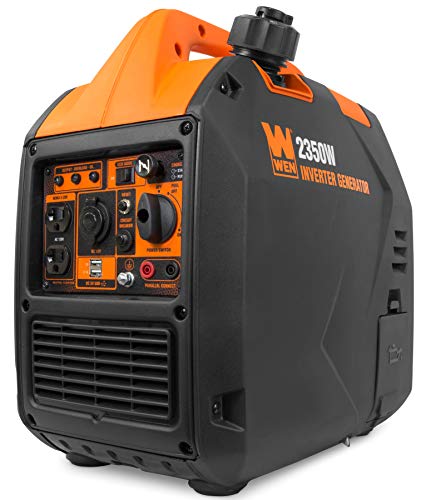
Best for camping, tailgating and running a refrigerator quietly
- 2350 surge / 1900 running watts
- About 39 lb — the weight advantage inverters are built for
- Rated around 51 dBA at quarter load
- Fuel shut-off to run the carburetor dry before storage
Why buy it: no conventional generator of this output is anywhere near this light or this quiet — at the small end, the inverter argument is not close.
Portable vs standby: the other comparison
The inverter-versus-conventional question sits inside a larger one, which is whether you want a portable machine at all.
| Portable generator | Standby generator | |
|---|---|---|
| Total cost (2026) | $500–$2,000, plus $500–$1,500 for a transfer switch | $7,000–$20,000 installed |
| Starts itself | No — someone goes outside | Yes, automatically within seconds |
| Fuel | Gasoline or propane you store and refill | Natural gas line or a large propane tank |
| Runtime | Limited by fuel on hand | Effectively unlimited on natural gas |
| Installation | Transfer switch only — licensed electrician | Electrician plus gas fitter, pad, permits |
| Noise | 52–78 dBA depending on type | Roughly 60–70 dBA, and sited away from the house |
| Maintenance | Oil, filters, fuel stabilizer, monthly exercise | Annual dealer service, self-testing weekly |
| Can be taken elsewhere | Yes — job site, RV, camping | No |
The honest summary: a standby generator buys automation, not capacity. A 9,500-running-watt portable covers substantially the same loads as a 12 kW standby unit for about a fifth of the total cost. The standby earns its price where outages are frequent and long, where a sump pump failing floods a basement, where someone depends on powered medical equipment, or where the property is empty when the power fails. Full cost breakdown in how much a whole house generator costs.

Three things people get wrong
"Inverters are more reliable." The engine is the same class of component in both, and the engine is what fails. Inverters add a control board, which is one more failure point and usually not economical to repair. What actually determines reliability in both is whether stale gasoline was left in the carburetor.
"Conventional generators cannot run electronics at all." They can, and millions do. The risk is cumulative stress on sensitive components rather than instant failure, and it can be managed by putting a good UPS in front of the loads that matter.
"An inverter always uses less fuel." At light load, hugely. At full load, barely — because an inverter at full output is running its engine at full speed too. The efficiency advantage is real but it lives at the bottom of the load range.
Where to go next
Size the machine before choosing the type in what size generator do I need. Then compare the fields directly: best inverter generators and best generators for home backup. Fuel consumption figures for both designs are in how much gas a generator uses, and the connection method in how to connect a generator to your house. Everything sits under the power tools and workshop hub.
We never buy or physically handle the machines we compare — verdicts come from aggregated owner reviews, published specifications and manufacturer data. The method is on how we rank. Product links are affiliate links; they earn us a small commission at no cost to you and never change a recommendation.