 Garden

Affiliate Disclosure
Some links on this page are affiliate links. As an Amazon Associate, we earn from qualifying purchases — at no extra cost to you. We do not buy, test, or physically handle the products we cover; our rankings come from aggregated owner reviews, ratings and expert consensus. Commissions never change our verdicts. How we rank · full disclosure.
Vacuum high-traffic areas twice a week, the whole house once a week, and entryways every other day if you can. Bedrooms warrant a weekly pass, and more if anyone in the house has allergies. Add a pass for every pet and every additional person in the household. The reason is not tidiness: soil that reaches carpet is mostly sharp mineral grit, and every footstep grinds it against the fibers, so removing it early is what makes carpet last. Frequency matters, but technique matters as much — one slow pass removes more than three fast ones.
We never buy, test or physically handle the machines we rank; recommendations come from aggregated owner reviews and expert consensus, as described in how we rank. The category sits at the vacuums and floor care hub.
The schedule, room by room
| Area | Baseline | With pets | With allergies |
|---|---|---|---|
| Entryway and mudroom | 2 – 3x per week | Every other day | Every other day |
| Main living area | 2x per week | 3 – 4x per week | 3x per week |
| Kitchen | 2 – 3x per week | 3x per week | 3x per week |
| Hallways and stairs | Weekly | 2x per week | 2x per week |
| Bedrooms | Weekly | 2x per week | 2x per week |
| Guest and spare rooms | Monthly | Monthly | 2x per month |
| Under furniture | Monthly | 2x per month | 2x per month |
| Upholstery | Monthly | Weekly | Weekly |
| Vents and baseboards | Quarterly | Quarterly | Monthly |
The entryway row does most of the work in that table. Soil enters a house at the doors and gets tracked inward, so a short pass at the entry two or three times a week removes debris before it reaches the rest of the floor. Pair it with good doormats — an outside scraper mat and an inside absorbent mat — and the whole-house workload drops noticeably.
Why frequency is a maintenance question
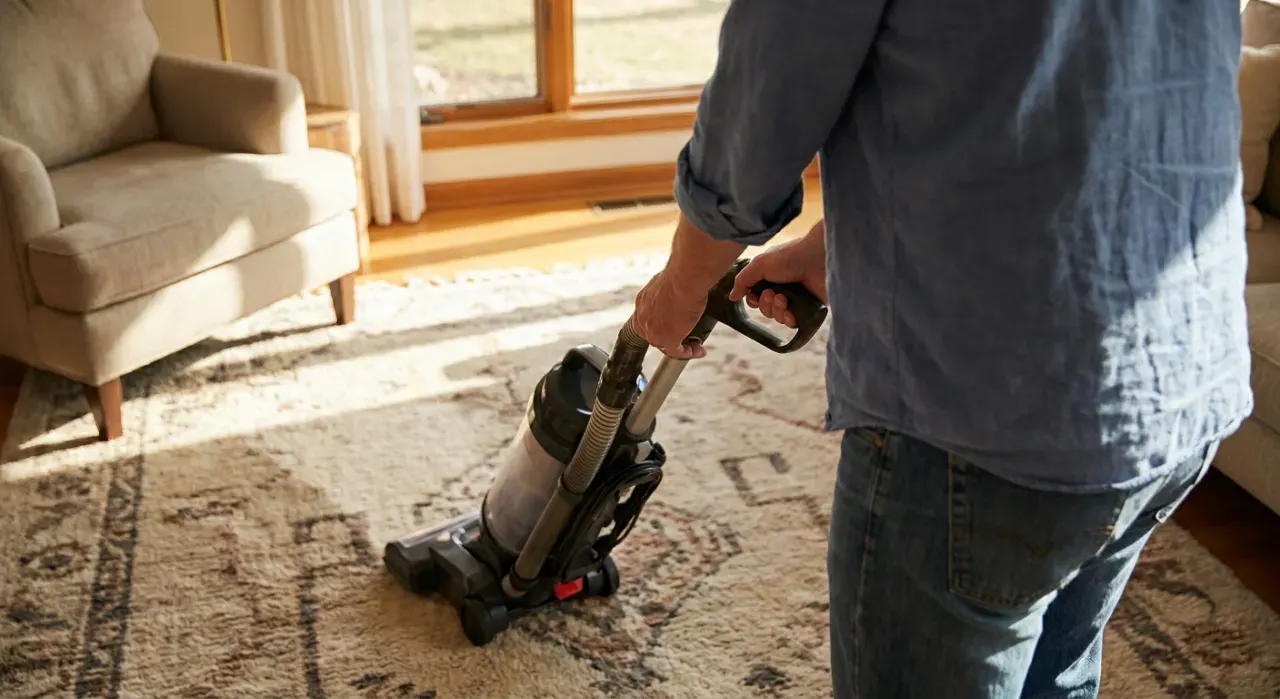
Household soil is not mostly lint. A large fraction of what lands on a floor is mineral matter tracked in from outside: sand, silt and grit with sharp, irregular edges. It works its way down into the base of a carpet pile, and every footfall drives those particles against the fiber, cutting it. The visible result is a traffic lane that looks dull and matted long before the carpet is actually worn out — and much of that appearance is fiber damage rather than dirt.
Vacuuming removes grit before it gets deep enough to do that. This is why carpet manufacturers recommend frequent vacuuming rather than warning against it, and why the same carpet in two households can look entirely different at year five.
The corollary is that a pass over a traffic lane is worth more than a pass over the middle of a guest bedroom. If you only have ten minutes, spend them on the entry, the hallway and the path between the door and the kitchen. Uniform coverage feels thorough and is a poor use of the time.
Technique beats frequency
- Go slowly. The brushroll needs time in contact with the pile to work grit upward into the airstream. A slow pass at roughly one foot per second removes far more than a fast sweep, and this is the largest single improvement available to most people.
- Overlap passes by about half the head width. Suction is strongest at the center of the head and weakest at the edges.
- Work in two directions on carpet. Pile lies in one direction; passing across it as well as with it lifts material the first direction pushed flat.
- Set the brush height for the carpet. Too high and the roller barely touches; too low and it stalls, burns belts and burnishes fiber. Start high and lower until you hear the motor load slightly.
- Switch the brushroll off on hard floors. A spinning brush scatters grit sideways and can mark a finish — see vacuuming hardwood without scratching.
- Do edges with the crevice tool. Where wall meets floor is where the most soil accumulates and where a floor head reaches least.
- Empty the bin or change the bag before it is full. Airflow drops long before capacity is reached.
What changes the interval for your house
- Pets. Add at least one pass a week per animal, and more during a shedding season. Beds and feeding stations want their own attention — see vacuuming with pets.
- Allergies. Bedrooms move to twice weekly, since that is where exposure hours are highest. Machine choice matters as much as frequency here — see HEPA vacuums and allergies.
- Small children. Floor-level living means floor-level exposure. Living areas move to three times a week.
- Carpet vs hard floors. Carpet hides soil and needs agitation; hard floors show it sooner and need only removal.
- Shoes indoors. A no-shoes household has dramatically less mineral grit reaching its floors. It is the cheapest change on this page.
- Season. Spring pollen, fall leaves, winter road salt and grit — all three push the schedule up temporarily.
- Household size. Soil load scales with the number of people crossing the floor, not with square footage.
Where a robot changes the schedule
A robot vacuum shifts the shape of the routine rather than replacing it. What robots do genuinely well is hold a low baseline: running most days, they remove surface debris before it is walked into the pile, which is precisely the mechanism that protects carpet. What they do poorly is deep-pile agitation, edges, corners, stairs and upholstery, and their small bins and modest airflow limit how much they lift out of a dense carpet in one pass.
The pattern owners settle into is a robot on a daily schedule plus a full-size vacuum once a week for the deep pass and the edges. That combination usually cuts the manual workload roughly in half rather than to zero. Two practical notes: run the robot in daylight or with lights on if it navigates optically, and keep floors clear of cables and socks, since the most common owner complaint is not cleaning quality but a machine tangled and stalled halfway through a run. Robot upkeep is more frequent than an upright's, because everything on it is smaller — see how to clean a robot vacuum and robot vacuum vs regular vacuum.
Beyond the weekly pass
| Task | Interval |
|---|---|
| Move furniture and vacuum beneath | Monthly |
| Vacuum upholstery and mattresses | Monthly, weekly with pets |
| Vacuum baseboards, vents and window tracks | Quarterly |
| Deep clean carpet by extraction | Every 12 – 18 months |
| Clean or replace vacuum filters | Every 1 – 6 months by type |
| Clear the brushroll of wound hair | Monthly |
Deep extraction cleaning is on a much longer cycle than most people assume, and doing it too often can leave residue that attracts soil faster. The reasoning and the interval are covered in how often carpets should be deep cleaned.
Keeping the machine able to do the job
A vacuum that has not been maintained cleans worse than a cheaper one that has. The two most common causes of what owners describe as lost suction are a clogged filter and a full bag or bin — neither of which is a fault. A stretched belt is the third, and it is sneaky, because the machine sounds completely normal while the brushroll turns too slowly to agitate anything.
The full routine and its intervals are in the vacuum maintenance schedule, with specifics in cleaning a vacuum filter, replacing a vacuum belt and unclogging a vacuum hose.
If the machine itself is the limiting factor, the field is at best vacuum cleaner, with the ownership trade-offs in corded vs cordless and brand differences in Dyson vs Shark.
More from this hub: Vacuums & Floor Care · best robot vacuum · how we rank.