 Garden

Affiliate Disclosure
Some links on this page are affiliate links. As an Amazon Associate, we earn from qualifying purchases — at no extra cost to you. We do not buy, test, or physically handle the products we cover; our rankings come from aggregated owner reviews, ratings and expert consensus. Commissions never change our verdicts. How we rank · full disclosure.
Short answer: an unheated greenhouse grows hardy leaves and roots all winter — spinach, mache, claytonia, arugula, tatsoi, mizuna, kale, winter lettuce, scallions, parsley, chard, radishes and carrots — plus overwintering garlic and shallots. It will not keep tomatoes, peppers or basil alive. Sow between mid-August and late September so plants are near harvest size before daylight drops below 10 hours in early November.
The structure is not a heater. What it gives you is wind protection, a warm day, dry foliage and a gain of roughly one and a half USDA zones — enough to change what a northern winter looks like on the plate, provided you grow the right things and sow them at the right time.
What an Unheated Greenhouse Actually Does
Be precise about this, because unrealistic expectations are why people conclude an unheated greenhouse "does not work."
Overnight, the air inside an unheated greenhouse falls to within a few degrees of outside. Glazing is a poor insulator; without a heat source, the structure has nothing to give back except whatever the soil and any thermal mass stored during the day. On a clear, still night the interior can even dip briefly below outside air through radiative cooling.
The gains come from three other directions. Daytime warmth is dramatic: on a sunny February day the interior can pass 80°F while it is 35°F outside, and those hours of warm soil are when winter crops actually grow. Wind protection matters more than most gardeners realize, because it is desiccation rather than cold that shreds exposed winter greens. And dry foliage, out of rain, sleet and snow, keeps leaves harvestable rather than battered and rotting.
Add a floating row cover directly over the beds inside — the "greenhouse within a greenhouse" — and you gain roughly another zone and a half. That is the technique that makes winter harvests routine in the northern tier, and it costs almost nothing. Our ranked row covers and frost cloth covers the weights; for winter use inside a structure, a medium weight around 0.9 to 1.25 oz per square yard is the usual choice.
The Rule That Decides Everything: 10 Hours
Temperature is not the limiting factor in a winter greenhouse. Daylength is.
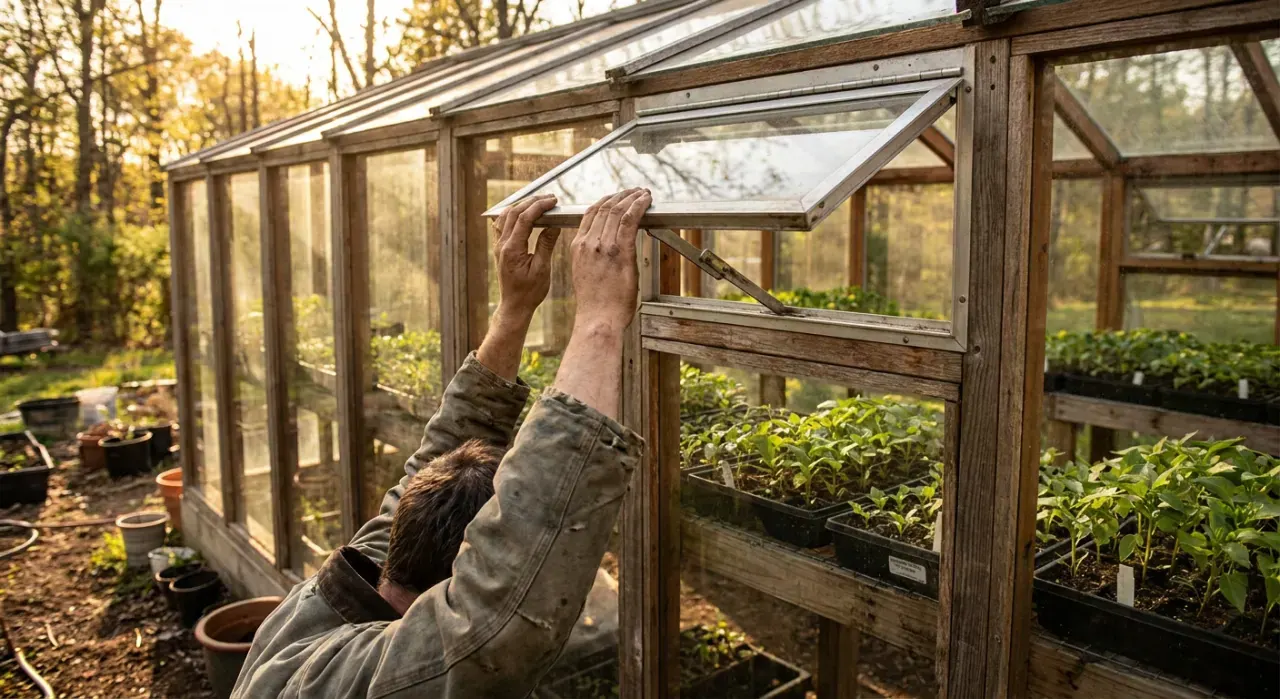
Below roughly 10 hours of daylight, most cool-season crops effectively stop putting on new growth. They stay alive, they stay green, they hold — but they do not size up. At 40° north latitude that window runs from about the first week of November to the first week of February. Further north it is longer; in the southern tier it is shorter or barely applies.
The consequence is a hard planning rule: a winter crop must be close to harvest size before that window opens. You are not growing through winter so much as storing a standing crop in the field and harvesting from it. Sow in September and you eat all winter. Sow in November and you have a tray of seedlings that will do nothing until February — at which point they grow away fast and give you an early spring harvest, which is a legitimate but different plan.
The Crops, With Sowing Dates and Hardiness
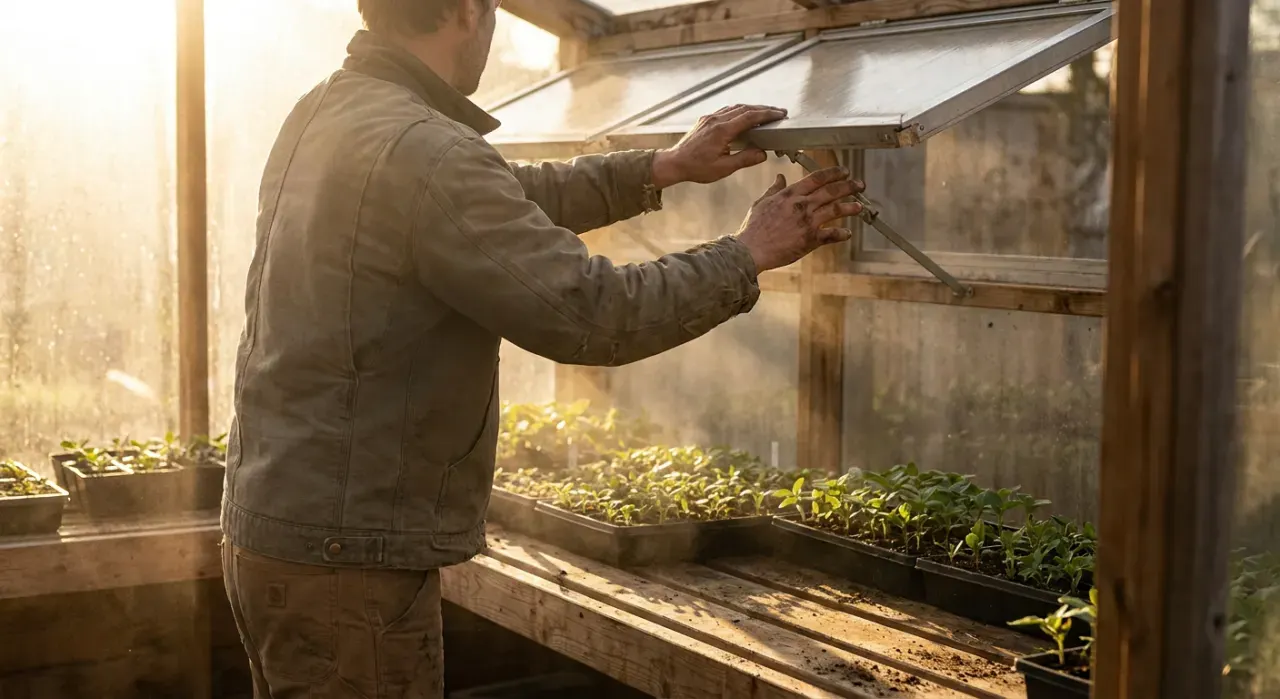
Dates below assume roughly USDA zone 5 to 7. Shift about two weeks later for each zone warmer, two weeks earlier for each zone colder.
| Crop | Sow for winter harvest | Hardiness in an unheated house | Notes |
|---|---|---|---|
| Mache (corn salad) | Late Aug – mid Sept | Exceptional — survives well below 0°F under cover | The single most reliable winter green. Slow, small, unbothered by anything. |
| Spinach (savoyed types) | Mid Aug – late Sept | Excellent — takes single digits under cover | The winter workhorse. Cut outer leaves; it regrows in February. |
| Claytonia (miner's lettuce) | Late Aug – late Sept | Excellent | Succulent, mild, keeps producing through the darkest weeks. |
| Tatsoi & mizuna | Late Aug – mid Sept | Very good — to the mid teens under cover | Fast, generous, mild mustard flavor. |
| Arugula | Sept – early Oct | Very good | Fastest of the group; can be sown latest. Flavor sharpens in cold. |
| Kale (Winterbor, Red Russian) | Mid July – mid Aug | Excellent | Needs a long lead time. Sweetens noticeably after frost. |
| Winter lettuce (Winter Density, Rouge d'Hiver) | Late Aug – mid Sept | Good — to the low 20s under cover | Choose winter-bred varieties; summer types collapse. |
| Swiss chard | Late July – Aug | Good; may die back and re-sprout | Reliable early-spring regrowth even if winter knocks it flat. |
| Scallions / bunching onions | Aug – Sept | Excellent | Almost indestructible. Harvest as needed all winter. |
| Parsley & cilantro | Aug – early Sept | Good | Fresh herbs in January are a genuine luxury. |
| Radish (winter types: daikon, Black Spanish) | Late Aug – mid Sept | Very good | Store in the ground and pull as wanted. |
| Carrots (overwintered) | Late July – mid Aug | Excellent in soil under cover | Sugars rise in cold — the sweetest carrots of the year. |
| Garlic & shallots | Oct – Nov (plant cloves) | Excellent | Overwinter for a much earlier, larger summer harvest. |
| Turnips (Hakurei, Purple Top) | Late Aug – mid Sept | Good | Roots and greens both usable. |
What will not work without heat
Tomatoes, peppers, eggplant, basil, cucumbers, squash, beans and melons are all tender. They stop growing below about 50°F and die at or slightly above freezing, which an unheated greenhouse cannot prevent. The same is true of most tropical houseplants left out there. If those are the plants you want alive, you need a heat source — the sizing and running costs are in how to heat a greenhouse in winter.
A Zone-by-Zone Reality Check
| USDA zone | What an unheated greenhouse gives you |
|---|---|
| Zones 3–4 | Standing crops hold rather than grow from November to February. Add an inner row cover and expect harvests to pause in the deepest weeks, then resume. Mache, spinach and kale are the reliable three. |
| Zones 5–6 | The classic winter-harvest scenario. With an inner cover you can cut greens most weeks all winter. Carrots and radishes store in the ground. |
| Zone 7 | Continuous harvest with minimal fuss; lettuce does well; sowing windows are wider at both ends. |
| Zones 8–9 | Winter growing is easy and the greenhouse becomes as much about rain shelter as warmth. The bigger issue is summer heat — shade and vent aggressively. |
Managing It Through the Winter
- Add the inner layer. Hoops and row cover directly over the beds, laid on by late October. This is the single highest-value action and it doubles the effective protection.
- Water sparingly, in the morning. Check by hand weekly. Water the soil, not the leaves, and never in the afternoon — wet foliage going into a cold night is how botrytis starts.
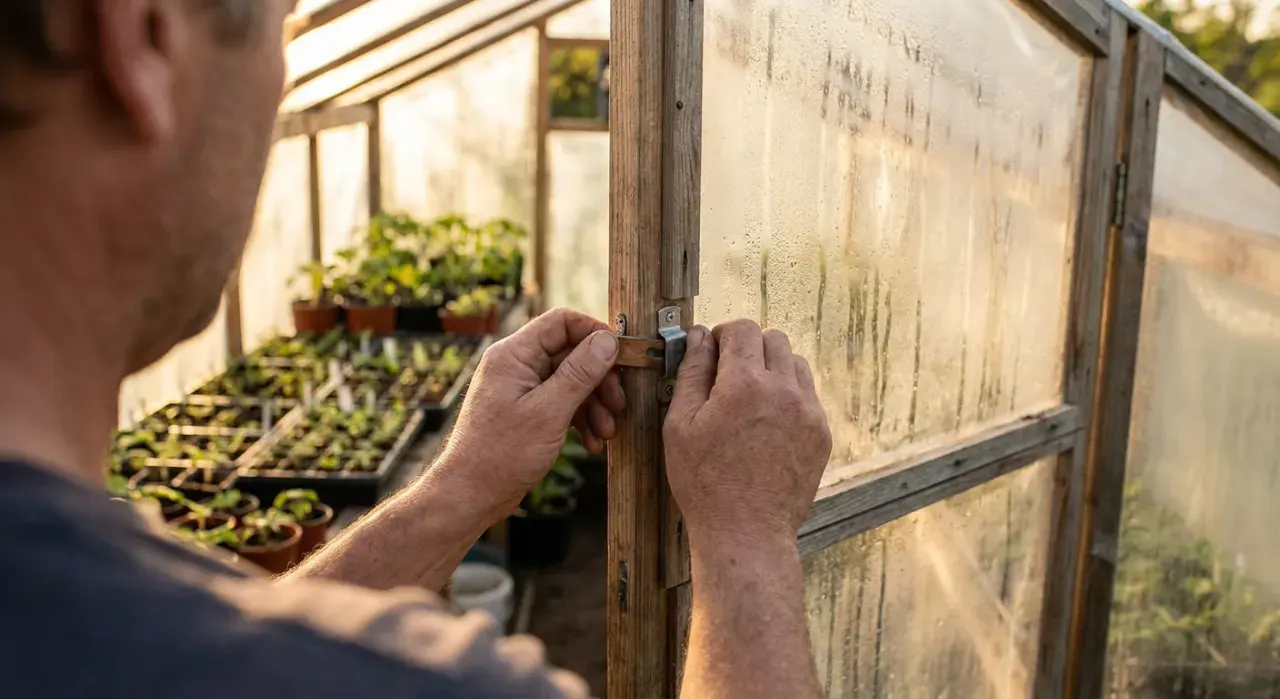
- Vent for humidity, not heat. Crack a vent for 10 to 20 minutes on mild, dry, still days, then close it early to bank the afternoon warmth. Keep watching temperatures: a sunny February day can still push the interior past 80°F.
- Harvest at the right time of day. Frozen leaves are brittle and shatter. Wait until the greenhouse has warmed and the crop has thawed, usually late morning, then cut.
- Cut outer leaves, leave the crown. Cut-and-come-again harvesting keeps a spinach or chard plant producing for months rather than ending it.
- Clear debris weekly. Yellowing leaves on cold wet soil are the fuel for gray mold. Two minutes with a bucket every week prevents most winter losses.
- Watch for slugs and aphids. Both stay active in the mild, sheltered interior long after the outside garden has shut down.
You May Not Need the Greenhouse
Every crop on this page can also be grown under a cold frame or a low tunnel of frost cloth over hoops, at a fraction of the cost and with no siting or anchoring constraints. The greenhouse advantage is comfort and scale: you can stand up in it, work in it in bad weather, and grow far more. If winter salad is the whole ambition, start with a frame and see whether you want more.
If you do want the structure, size and site it properly first (sizing and siting), and remember that the spring overheating problem arrives long before the winter cold problem does (ventilation and overheating). Ranked options are in best backyard greenhouses, the structural comparison is in greenhouse vs hoop house vs cold frame, and the whole hub starts at greenhouses and season extension. Our research method is on how we rank.