 Garden
Affiliate Disclosure
Some links on this page are affiliate links. As an Amazon Associate, we earn from qualifying purchases — at no extra cost to you. We do not buy, test, or physically handle the products we cover; our rankings come from aggregated owner reviews, ratings and expert consensus. Commissions never change our verdicts. How we rank · full disclosure.
Short version: good storage is not about buying more containers. It is about getting things off the floor, giving every item a fixed home, and choosing systems rated for the weight you will actually put on them. This hub covers garage shelving and overhead racks, closet and pantry systems, the bins that survive an attic summer, and the practical engineering — weight ratings, anchoring, stud spacing — that separates a shelf that lasts a decade from one that sags in a year.
We do not buy or physically install the products we rank. Every recommendation is built from aggregated owner reviews, star ratings, review volume and expert consensus, which we explain in full on how we rank. For storage that means paying close attention to reviews written a year or more in, because sagging shelves, stripped fasteners and racks that shifted under load are problems that only show up with time.
The One Principle That Does the Work
Almost every organizing problem in a home is a floor problem. Things end up on the floor because there is nowhere else obvious to put them, and once the floor has a pile the pile grows. Every system in this hub — wall shelving, overhead racks, closet towers, pantry risers — exists to convert wasted vertical space into usable storage so the floor stays clear.
That is also the cheapest fix available. A single 48-inch by 24-inch steel shelving unit costs less than most people spend on decorative baskets and recovers roughly 32 square feet of stacked storage from eight square feet of floor. Start with vertical capacity, then buy containers to fit it — never the other way around, which is how garages end up with three incompatible bin sizes and no shelf that fits any of them.
Garage Storage: Four Systems, Four Jobs
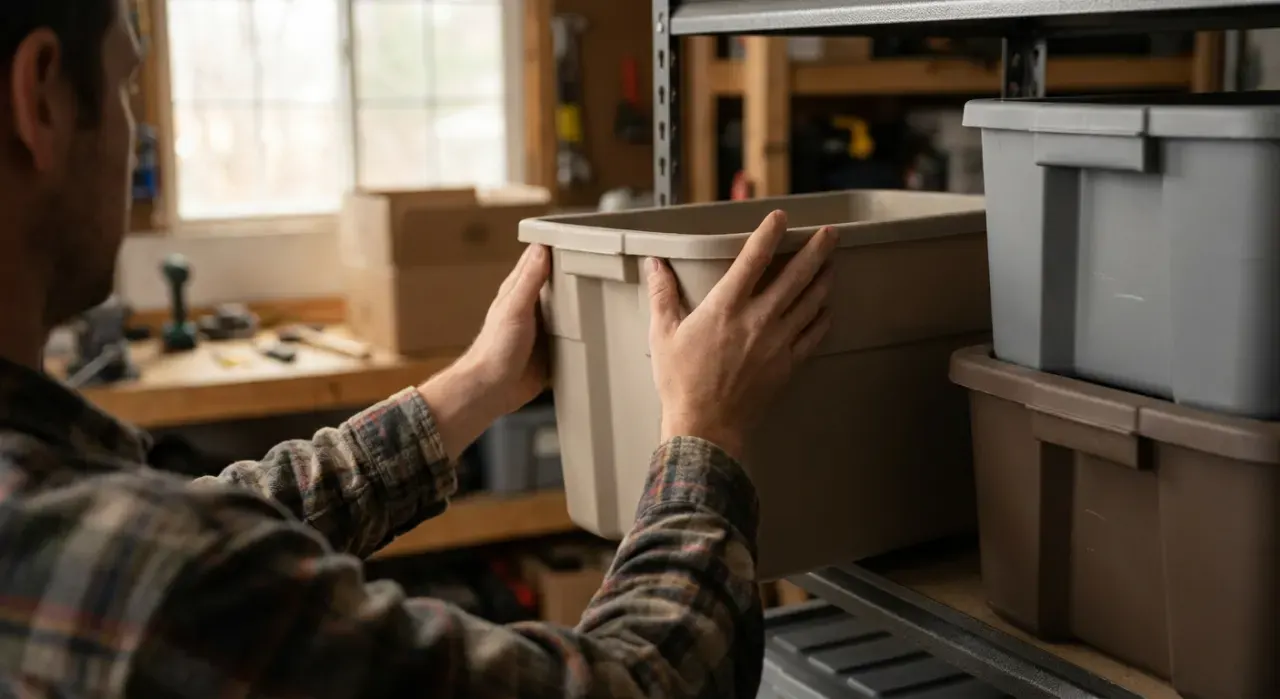
Freestanding steel shelving is the workhorse. It needs no wall, assembles in under an hour, and holds 800 to 1,000 lbs per shelf on boltless units. It is the right first purchase for almost every garage — our best garage shelving ranking covers the field.
Overhead ceiling racks store what you touch twice a year: holiday decorations, luggage, camping gear. They use space that is otherwise entirely dead, but they demand correct joist mounting and honest load discipline. See best overhead garage rack.
Wall-mounted shelving keeps the floor completely clear beneath it, which matters if you park inside. It carries less than a freestanding unit and depends entirely on the wall behind it, so stud location dictates the layout — the details are in anchoring into studs and concrete.
Cabinets and closed storage hide clutter and keep dust off, at roughly three times the cost per cubic foot of open shelving. Use them where appearance matters or where you need things locked away from kids. The trade-offs across all four are laid out in wall vs freestanding vs overhead.
Weight Ratings, Read Honestly
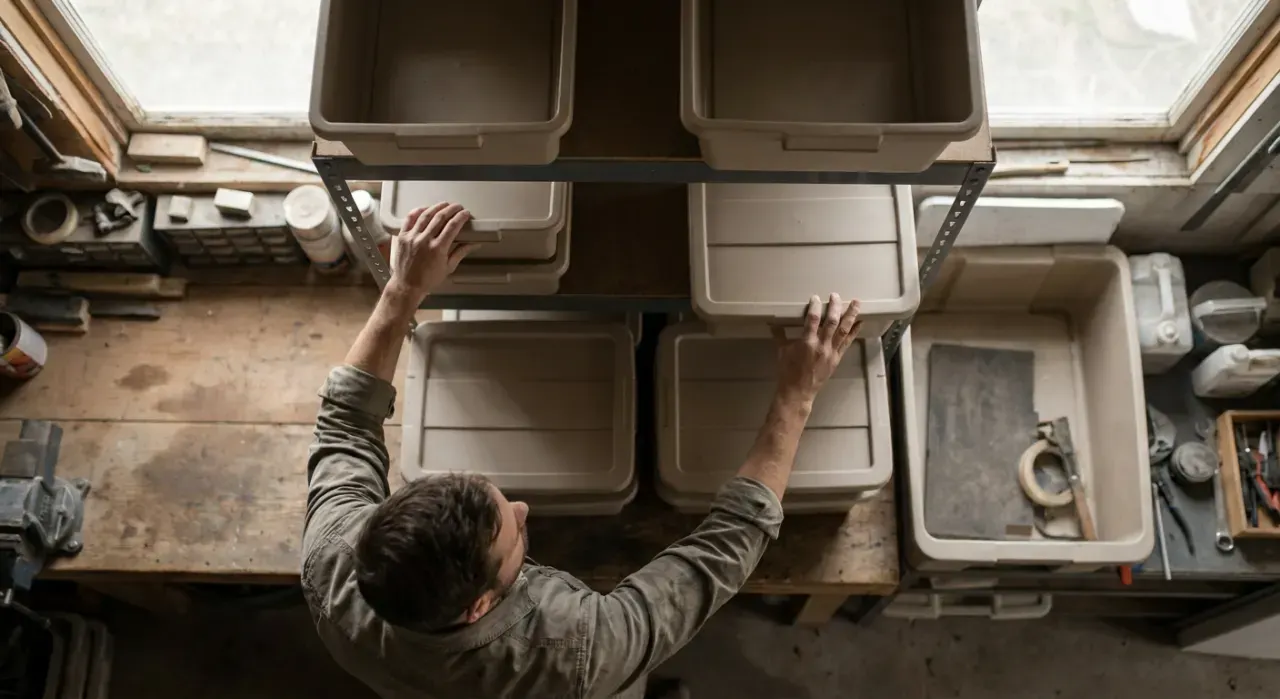
Storage marketing leans hard on big numbers, and those numbers come with conditions worth understanding. A rack advertised at 4,000 lbs is usually quoting total unit capacity across four shelves, so the figure that governs your planning is 1,000 lbs per shelf. That per-shelf rating also assumes an evenly distributed load across the full deck. Concentrate the same weight in the middle third — an engine block, a stack of ceramic tile, a chest freezer of ammunition boxes — and you are asking the beam to do roughly twice the work it was rated for.
Three practical rules follow. Put dense items on the lowest shelf, both for stability and because that shelf transmits load straight into the floor. Spread heavy items along the shelf rather than stacking them in one spot. And leave real margin: a shelf loaded to 60 percent of its rating will still be flat in ten years, while one loaded to 100 percent will show a visible bow within a season. Our shelf weight ratings explained guide goes deeper on how those figures are derived.
Anchoring and Tip-Over Safety
Tall storage units tip. The Consumer Product Safety Commission has published repeatedly on furniture and appliance tip-over incidents, and loaded shelving in a garage carries the same risk profile: a top-heavy unit, a child climbing it, and hundreds of pounds coming forward. The fix costs a few dollars. One L-bracket from the top rail of each unit into a wall stud, or into a masonry anchor if the wall is block or concrete, removes the failure mode entirely.
On a framed wall, studs are typically 16 inches on center, occasionally 24 in newer garage construction. Find them with a stud finder and confirm with a small pilot hole before committing to a lag screw. On concrete or CMU, use a sleeve or wedge anchor rated well above the pull-out load, and drill with a hammer drill and a masonry bit sized to the anchor. The full method, including which fasteners hold and which strip, is in anchoring into studs and concrete.
Bins, Labels and the System That Survives
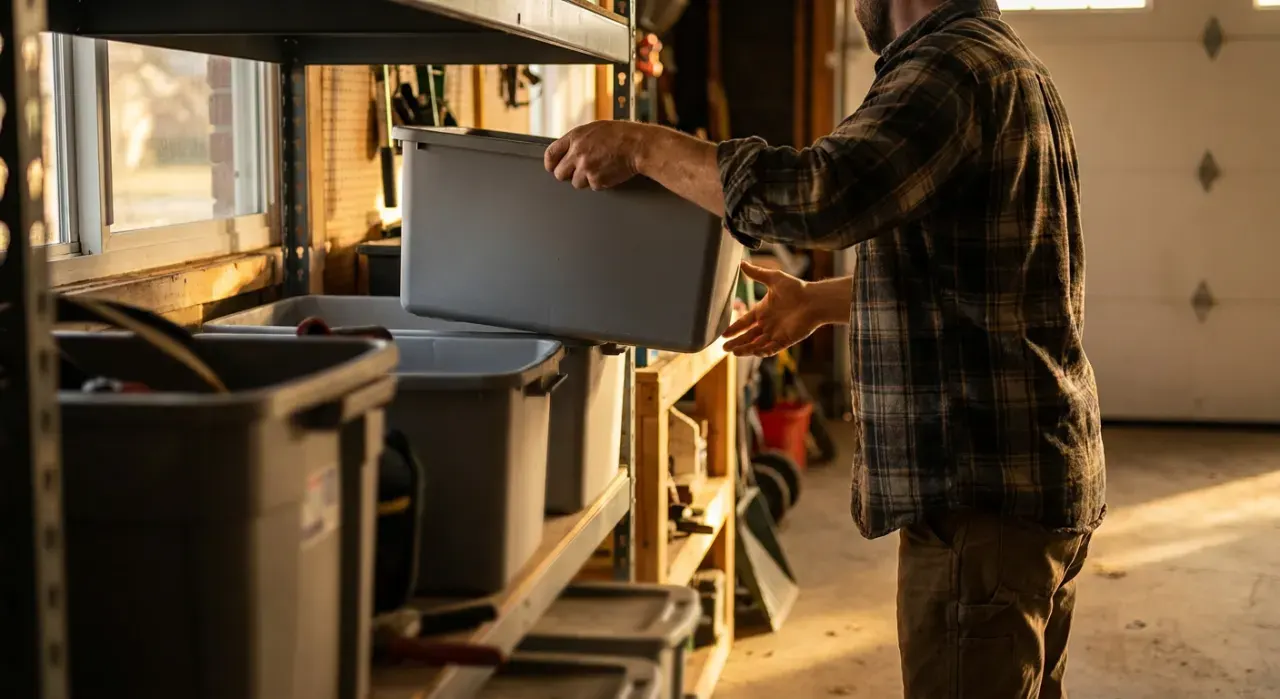
Containers are where organizing projects quietly go wrong. The rule that fixes most of it: pick one bin footprint and buy it in quantity. Matching bins stack squarely, fit a shelf without wasted air, and can be swapped between rooms without rethinking the layout. Mixed bins waste roughly a fifth of every shelf in gaps and prevent stacking entirely.
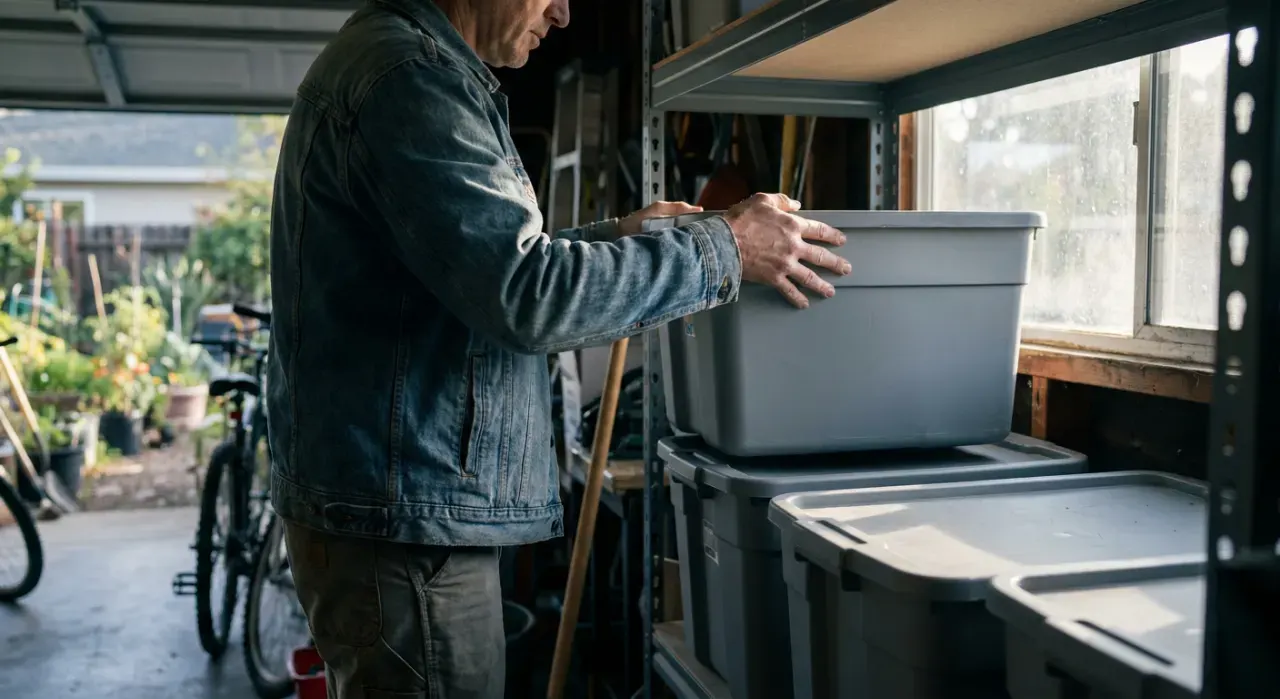
Clear bins beat opaque ones for anything you access more than twice a year, and every bin needs a label on the end, not the lid, because on a shelf you will only ever see the end. For attic and garage storage, weather-resistant totes with gasketed lids are worth the premium — cardboard fails in humidity, and rodents treat it as a building material. Our best storage bins ranking sorts the field, and storing things in a hot attic covers what survives a 130°F summer up there and what does not.
Closets, Pantries and Small Spaces
Indoors the constraint flips from weight to geometry. A standard reach-in closet wastes an enormous amount of volume through a single hanging rod at 66 inches with one shelf above it. Double-hanging shorter garments at 42 and 84 inches roughly doubles capacity in the same footprint, and a modular tower down one side converts dead corner space into folded storage. The math for a closet under six feet wide is in small closet layout, and the ranked hardware is in best closet organizer system.
Pantries fail for a different reason: depth. Anything more than about 14 inches deep hides its back row, and hidden food gets bought twice and thrown away once. Risers, pull-out bins and turntables exist entirely to make depth visible — see best pantry organizers. Under beds, the constraint is clearance, usually five to seven inches on a standard frame, which rules out most rigid boxes and is exactly why the rolling and fabric options in best under-bed storage exist.
Where to Start
If your garage is the problem, start with the best garage shelving ranking and add one overhead rack for seasonal items. If the house is the problem, start with closets, because clothing storage failures cascade into every other room. And before you buy a single bin, read how to organize a garage — the zone method in it applies just as well to a basement or a spare room, and it is the difference between a system that holds for years and one that unravels by spring.